sentiment-analysis
(49)
Brandlight asks what AI says about you - before your customers do
The enterprise software company turns AI answers into a marketing brief. Its most revealing finding: a brand can gain visibility while the citations beneath it disappear.

The Last Mile of Media Monitoring Is Still Human
DigiMent Research is betting that the hardest part of media intelligence is not finding more mentions. It is deciding which ones deserve a human being's attention.

State wanted your opinion. Your follower count could stay home.
With $14 million behind it, State tried to turn everyday opinions into a network of their own. Its experiment reveals the distance between giving everyone a voice and giving them a reason to return.
Feefo puts a receipt behind the stars
The British review platform built its business around a simple restriction: customers need an invitation. Now it is selling what happens after the stars - from better advertising to a clearer view of what needs fixing.

DataEQ turns customer complaints into a better to-do list
The company formerly known as BrandsEye pays people to teach its AI what customers mean. For banks, insurers and service teams, the payoff is knowing which complaint needs action - and what keeps causing it.
Brandwatch Built a Business by Turning the Internet's Noise Into a Balance Sheet
A dead-end search engine became an enterprise listening machine, then a $450 million acquisition. Brandwatch's useful trick is not hearing everything online - it is helping large teams decide which signals deserve a meeting.
Brands Were Copying Amazon Reviews Into Excel. Revuze Turned the Mess Into a Daily To-Do List
Revuze started with a travel-planning idea, found its real market in retail, and built an AI system for turning scattered customer comments into product fixes, sharper listings and earlier warnings. The bet is simple: a complaint becomes valuable when someone knows what to do next.
Respondology Started by Hiding the Worst Comments. Now It Wants Brands to Find the Money in the Rest.
A racist pile-on aimed at Serena Williams gave this Boulder team its first problem to solve. Seven years, three products, and $16 million in disclosed Series A financing later, Respondology is betting that the comment section is not merely a mess to clean up - it is a neglected customer channel.
Tellagence Spent 15 Years Teaching AI the Difference Between Outrage and Sold Out
Most social-listening tools count the noise. This Portland company wants to explain it - and its 15-year path from Twitter influence maps to research-validated contextual intelligence is a useful playbook for founders building in a market that keeps changing names.

Sentiment Is a Thermometer. Root Cause Is the Diagnosis
A mood score can tell you the customer is upset. It cannot tell your product team what to fix—or stop the next avoidable contact from happening.

How Four AI Tools Turn Customer Griping Into Roadmaps
Pendo, Idiomatic, Keatext and Zonka Feedback all promise the same thing - that the pile of reviews, tickets and survey replies your customers leave behind can become a to-do list. Here is how the category actually works, and where each tool fits.
Sogolytics
How a bootstrapped survey tool from Herndon, Virginia quietly grew into an experience management platform serving 100,000 customers - and why it still refuses to hide its best features behind an upsell.

Thematic
One trusted view of your customer, built from the bottom up across every channel - from raw feedback to confident action.

SmartSurvey
The British survey company that decided keeping your data on home soil was a feature, not a footnote - and built a 600,000-user business on it.

Zonka Feedback
The platform for actionable customer feedback in the AI era.
SentiSum
AI-native CX intelligence that tells you what's breaking, what it's costing, and what to fix.

Six Tools Fighting Over Your Customer Feedback
SentiSum, Sleekplan, Birdeye, Kapiche, Frill and Savio all promise to turn customer noise into a roadmap. They disagree, loudly, on what that even means.

Eight Feedback Tools Fighting for Your Customer's Voice
SentiSum, airfocus, Contentsquare, Feedier, Nolt, Featurebase, Condens and Mopinion all promise to tell you what customers really want. Here is how the feedback-tool landscape actually splits up - and which slice each one owns.
Keatext
The Montreal company teaching machines to read the feedback businesses collect but rarely finish reading.
Kapiche
The AI feedback analytics platform that reads every customer conversation - not just the 5% who fill out your survey - and tells you what it costs you.
Idiomatic
Idiomatic built a machine that reads every complaint so support teams don't have to - one custom-tuned category at a time.

Feedier
Feedier reads every signal across regions, business units and channels, then tells your leadership what to fix, what it's worth, and what it means for retention and revenue, in real-time.
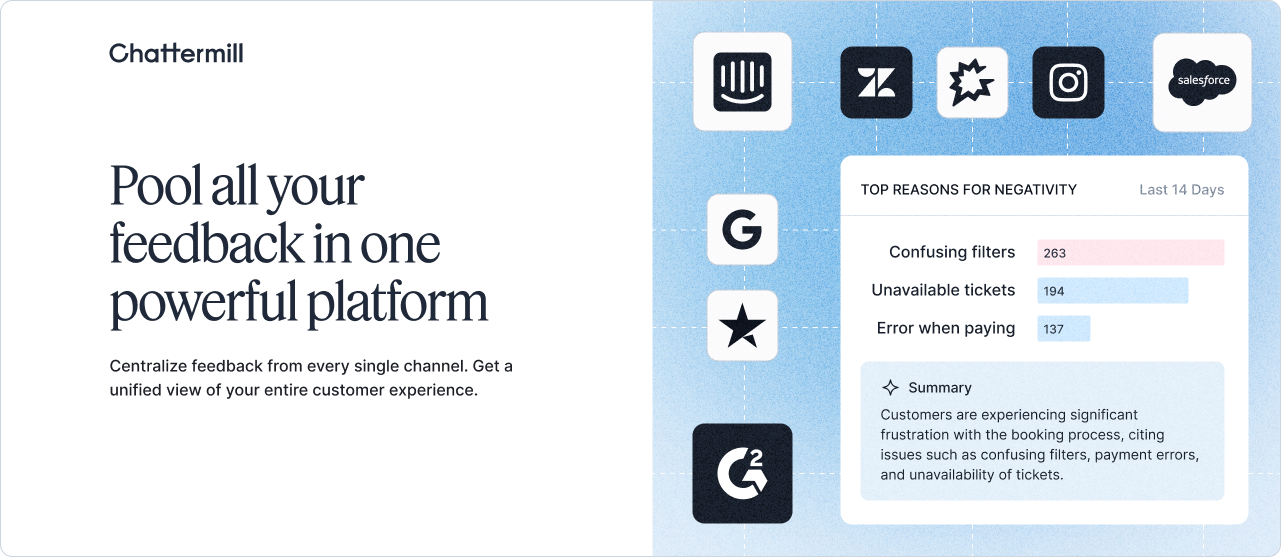
Chattermill
A new kind of customer intelligence platform, purpose-built for the agentic era. Trusted by CX, product and insights teams from the world's leading enterprises.

NewsCatcher
NewsCatcher is a news and web search API company that turns the open web into a clean, structured database of real-world events. It pulls from 90,000+ global sources, then deduplicates, enriches, and standardizes the articles so risk, finance, and AI teams can query news the way they query a database. Founded by Artem Bugara and Maksym Sugonyaka, it went through Y Combinator in Summer 2022.

Roark
Roark is an observability, testing, and quality-assurance platform for voice AI agents. It lets teams replay real production calls against new agent versions, catch failures before they ship, track caller sentiment and vocal cues, and monitor live voice interactions with 40+ built-in metrics. Founded in 2025 and backed by Y Combinator (W25), Roark says it processed more than 10 million minutes of calls in its first six months.

Syncly
Syncly is an AI platform built by a team that previously sold a machine-vision startup for $200M. It began as a customer-feedback analytics tool that ingests support conversations from Zendesk, Intercom, Gorgias, Slack, Front and Gong, then auto-tags them, scores sentiment, and surfaces the issues quietly driving churn - so CX and revenue teams can act before customers leave. The company has since expanded into AI social intelligence for the video era, adding tools to monitor TikTok, Reels and Shorts, discover creators, and unify voice-of-customer signals across channels.

The Hog
The Hog is a San Francisco startup from Y Combinator's Fall 2025 batch that packages people data, company data, web search, news, social signals, sentiment, and scraping behind a single pay-per-call API for AI agents and go-to-market teams. It routes each request through multiple data providers using waterfall logic, positioning itself as one endpoint that replaces a stack of tools like Clay, Apollo, Exa, and Tavily. Founded by growth operator Hudson Liao and AI engineer Paulo Nascimento, it aims to compress market research and outreach from hours into minutes.
inFeedo AI
inFeedo AI is an employee experience company built around Amber, a conversational AI that acts as a Chief Listening Officer for enterprises. Amber checks in with employees, surfaces sentiment and disengagement in real time, predicts attrition, and automates HR support. Founded in India and backed by Y Combinator, Tiger Global and Jungle Ventures, inFeedo serves 175+ enterprises across 60+ countries, helping CHROs at companies like Sony, Lenovo, Tata and Samsung understand how their people really feel.

Lucidya | لوسيديا
Lucidya is a Riyadh-based, AI-native customer experience management (CXM) platform built for Arabic-speaking markets. Using a proprietary Arabic NLP engine that understands 15+ dialects with roughly 92% sentiment accuracy, it unifies social listening, media monitoring, surveys, customer profiles and omnichannel support into a single system, and now deploys autonomous AI agents for customer-facing roles. Founded in 2016 by Abdullah Asiri and co-founders, the company serves enterprises and governments across the MENA region and in 2025 raised a $30M Series B, one of the largest AI funding rounds in Saudi Arabia.

Prosa.ai
Prosa.ai is an Indonesian deep-tech company that builds natural language processing and speech technology for Bahasa Indonesia. Founded in 2018 by ITB academics and an industry veteran, it develops NLP APIs, speech-to-text and text-to-speech engines, voice biometrics, chatbots and analytics that let banks, insurers, government agencies and enterprises understand and act on Indonesian-language text and voice data - a market largely underserved by global AI providers.