Having an opinion was the easy part. Finding somebody to hear it was the business opportunity. State, the London startup built by brothers Alexander and Mark Asseily, looked at online conversation and saw a peculiar entrance requirement: before strangers would listen, you often had to assemble an audience. The brothers wanted a person’s first contribution to count for something. Bring a view. Leave the performance anxiety at the door.
The original State was a consumer opinion network, publicly launched on the web and iPhone in February 2014. People reacted to topics; the service connected and compared those reactions. Its proposed commercial future lay in the collective picture that emerged. A decade later, the company behind it, Equal Media Ltd, was dissolved. That makes State a revealing experiment to revisit: an unusually concrete answer to the question of how a quiet person gets heard.
Three words and you’re in
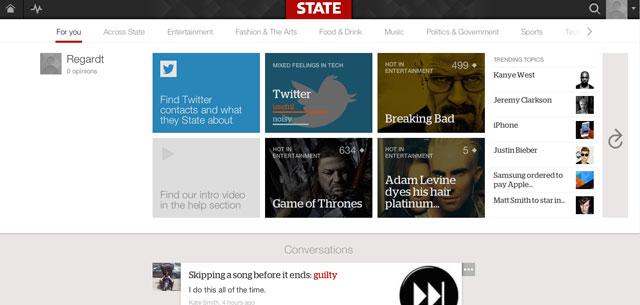
The entry point was deliberately small. Choose a subject, select up to three expressions that described your response, and add a longer comment if you wanted. At the public launch, the catalogue covered roughly 25 million topics and 10,000 expressions. Those were things to discuss and ways to react, not counts of customers. You could participate without composing an essay, inventing a joke or pretending to be an expert.
Research Live’s Brian Tarran tried it with Paper, Facebook’s news app. His reaction expressed an interest in trying the product; his additional comment asked for a UK release. State then showed him grouped reactions, his position on a sentiment range and people with similar or different views. A small contribution produced an immediate result. The product did not simply swallow a comment and wish its author luck.
That exchange explains the appeal better than the phrase “opinion network.” A person could discover disagreement, recognise company or follow a subject into another conversation. The optional text mattered, too. Picking a few expressions made participation quick, while a comment could supply the circumstances that the expressions missed. State tried to make a little room for both the hurried commuter and the person with a paragraph ready.
A different address for a thought
State’s founders had already worked on technologies that connected people. Alexander co-founded Jawbone; Mark’s background included Skype, Rebtel and Moxi. Here, the connection they wanted to build began with meaning. A view on a film or a political issue could help locate relevant people and content, even when the contributor had no prior relationship with either. The company called this an opinion graph.
In a 2014 Memeburn interview, Alexander distinguished the proposition from Medium’s publishing approach. His argument was that easier expression, combined with automatically counting contributions, could bring more people into participation. That was a choice about the intended customer. State was courting the person with something to say who might never become a regular writer, alongside people who already enjoyed online discussion.
The competition was consequently broader than another app with a comment box. Facebook and Twitter already occupied people’s conversational habits. Medium served writers; Quora and forums offered places to pursue subjects. State’s opening was the short, comparable reaction and the connections built from it. Its challenge was giving that opening enough everyday usefulness to earn a place among services people already checked.
a topic
reaction
views
Your contribution becomes a way to navigate.
$14 million bought a chance to try
By February 2013, State’s $14 million in early financing was public. Its backers included technology investors and entrepreneurs, and its advisers included Tim Berners-Lee. That was considerable support for a product asking people to form a new habit. The money gave the experiment room to exist. It did not establish that people would use it regularly, or that an organisation would eventually pay for the resulting insights.
The distinction between funding and cost matters here. Fourteen million dollars describes reported financing, not an audited bill for building State. Nor does it describe what an individual paid to participate. The commercial proposition described at launch was to develop a consumer network first and eventually earn money from aggregated opinion data. Researchers and brands were prospective beneficiaries of that picture of the crowd.
As a business design, that places two demanding tasks in sequence. First, persuade people to contribute often enough to make the network useful. Then produce insights useful enough that another group will pay. A delightful consumer interface does not automatically prove the second proposition. An attractive research idea does not automatically supply the first group with a reason to open the app tomorrow.

The map was an answer to feedback
There is a particularly useful moment in State’s short public product history. On May 1, 2014, the company announced a substantial iPhone update, including a world map showing clusters of people discussing topics. It also offered word maps and simpler sharing. The announcement attached those changes to something more specific than a founder’s intuition: requests from the people already using the service.
“Based on community feedback, we learned that people really want more nuanced insights and personal connections.”Mark Asseily · May 2014
Read that as a product brief. Counting an opinion was only part of the experience users wanted. They also wanted to learn something and meet somebody. The map gave the promise a visible shape; the sharing tools made it easier to bring others into a discussion. This was an identifiable change in emphasis, rather than evidence of a wholesale abandonment of the original idea.
State also took opinions beyond its own browsing experience. Stateclip, a bookmarklet, let people connect material encountered elsewhere on the web to a reaction. A reader could start with an article and move into the network through the subject it raised. That offered a practical route into participation: respond to something already holding your attention, instead of opening an unfamiliar app and wondering what to say.
An election gave the network a date
State’s arrival in South Africa in May 2014 coincided with the national election. That timing gave a broad proposition a local reason to matter. People could debate issues that were already pressing, rather than search a vast catalogue for a topic. The company’s wider ambition still ranged across entertainment, technology and politics, but this launch had a recognisable public event around which conversation could form.
By that month, State said it had received opinions from more than 100 countries. Geographic breadth made for an appealing map. It also raised a harder editorial question: whose opinions were inside it? Poynter’s launch coverage described an early audience tilted toward technology and warned that usefulness depended on reaching sufficient scale. A worldwide footprint and a representative picture are different achievements.
That is a limit on how to read the output. A chart can faithfully summarise its contributors and still tell you little about people who never joined. More reactions within one enthusiastic community do not, by themselves, fill gaps elsewhere. Anyone adapting State’s approach for feedback or research should begin by naming the population they want to understand, then examine who actually responds.
Topics available around launch.
Not users. Not survey respondents.
A good joke still needs a habit
State understood some of the absurdity it was competing against. A 2014 advertisement mocked people preoccupied with their social-media presentation. Time noticed the joke: a commercial criticising social-network behaviour was, itself, selling a social network. The pitch had an everyday target. Thinking about how a post will perform can become more absorbing than the experience supposedly being shared.
But recognising an irritation does not settle how people behave. Our reading of State’s central difficulty is that an audience promised by the product must become an audience experienced by the user. The first useful comparison, reply or unexpected connection has to happen often enough to become a habit. A catalogue can be prepared in advance. The human response needs people to turn up.
The corporate ending is concrete. A Gazette notice records the appointment of a liquidator to Equal Media in November 2022. Companies House records its dissolution on May 19, 2024. Those dates mark the legal trajectory; they should not be treated as a precise account of when the service stopped attracting users. The documented outcome is a closed company, rather than proof that any particular feature caused the closure.
The address has another chapter
Visit State.com today and the proposition is political participation. Its current terms identify the operator as Collective Thinking Ltd. The site’s UK FAQs describe routing constituent concerns to representatives, grouping related contributions and allowing reactions to motions. An AI guide called the Oracle helps people navigate the service. This is a different product and legal operator from the original Equal Media company profiled here.
The comparison is interesting without assuming corporate continuity. The earlier network offered connections across almost anything people might discuss. The current site describes a more specific destination for a contribution: the representative responsible for an issue. For a user, that is a clearer account of where a statement is supposed to go. Whether that produces action is a separate question from whether the routing works.
The most useful thing to copy from the original State is modest: make a first contribution easy, then show its author what it changes. A feedback tool can reveal related responses; a community can surface an unanswered view. Such designs need enough relevant participants, trustworthy interpretation and a reason to return. State’s ambition was to let a stranger’s opinion matter immediately. Every product built around participation has to deliver that moment somehow.