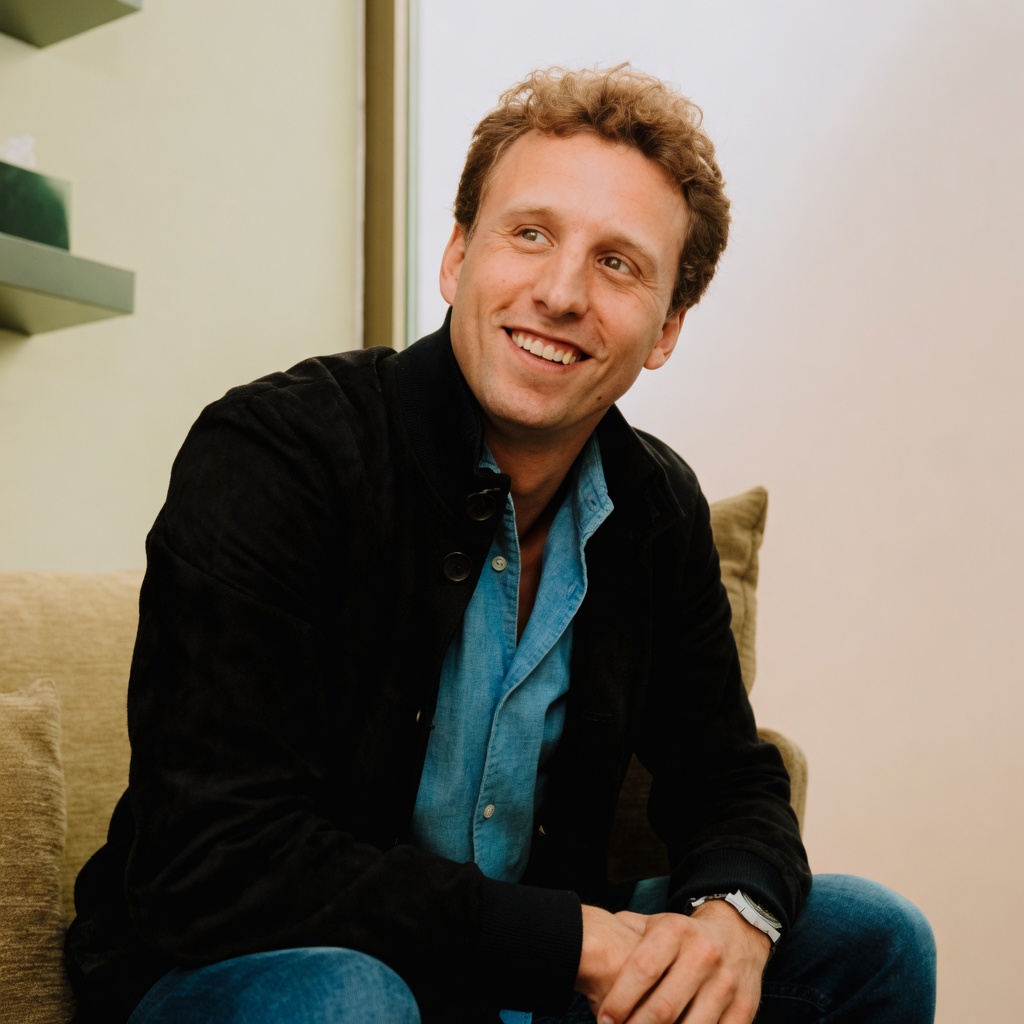
YesPress Profile — Venture Capital
Julien
Bek
The man who bet on Revolut before it was Revolut — and is now betting on the death of software-as-usual
"For every dollar enterprises spend on software, they spend six on services."
YesPress Profile — Venture Capital
The man who bet on Revolut before it was Revolut — and is now betting on the death of software-as-usual
"For every dollar enterprises spend on software, they spend six on services."
The Story
He was 18 years old in Geneva when he decided to sell e-cigarettes. Not because e-cigarettes were obviously going to be big - they weren't yet - but because he could see a market forming before the crowd noticed it. That early habit of spotting the thing right before it becomes the thing is now Julien Bek's professional superpower at Sequoia Capital, where he's one of the London office's founding partners on the early-stage team.
That teenage venture became E-clope, one of Europe's very first e-cigarette companies. It didn't become a unicorn. But it sharpened something that would matter a great deal later: the ability to look at a market that doesn't quite exist yet and see its shape clearly enough to move on it. Most investors want proof. Bek has always wanted the pattern.
At Global Founders Capital, he was based in London and San Francisco - the two cities that defined European tech ambition in the mid-2010s. He backed Revolut in its Series A round in 2016. At the time, Revolut was a scrappy currency exchange app with a bright purple card and no banking licence. Today it's valued at over $45 billion. The timing wasn't luck. It was a specific read on what European consumers actually wanted from financial services, made before anyone had the data to prove it.
"For every dollar enterprises spend on software, they spend six on services."
- Julien Bek, Sequoia Capital, 2026Accel came next. He joined in 2018 as a partner focused on fintech, collaboration, and productivity - three categories that would collide spectacularly with COVID. He helped lead the investment in Hopin, the virtual events platform that became one of the fastest-growing companies in history before the pandemic tailwinds disappeared. He also backed Melio, the B2B payments company for small businesses, and worked closely with the teams at Miro and BeReal. Four very different bets, four companies that became breakout names.
In September 2023, Sequoia called. He joined as a partner in London - one of the first hires as the firm built out its early-stage European presence. The brief: find the companies that matter before they obviously matter. The portfolio is taking shape: Dust (enterprise AI for teams), Rillet (AI-native accounting), Tacto (procurement software), and Lemni, which raised a $4M pre-seed in early 2025.
Then, in March 2026, he published something that spread far beyond the usual VC-essay circuit. "Services: The New Software" laid out a thesis that was equal parts precise and provocative: the next trillion-dollar company won't sell software. It will sell the outcome. It will use AI to automate the delivery of services that humans currently perform - legal work, accounting, financial analysis, insurance brokerage - and price itself on results rather than seats. Fortune ran a feature on it. Founders rewrote their pitch decks. The debate continues.
The Geneva teenager who once built an e-cigarette company before e-cigarettes were a thing is now, at one of the world's most consequential venture capital firms, asking the same question he always has: what does the market want before it knows it wants it?
The Big Idea
Published March 2026, the essay that rewrote how a generation of founders thought about pricing, AI, and what a trillion-dollar company actually looks like.
The next trillion-dollar company won't sell software licenses or AI tools. It will sell an outcome - a legal case won, a financial report completed, an insurance policy issued. AI automates the delivery. Humans handle the edge cases. The customer buys the result.
In 2025, the fastest-growing AI companies were copilots - software that helps humans work faster. In 2026, the transition to autopilots has begun. The processes that deliver professional services can now be largely automated, like aviation autopilots: the human monitors, the machine executes.
Bek targets services that are already outsourced, require mostly "intelligence" (tasks with clear right/wrong answers), and can be delivered at lower cost with healthier margins using AI. The kill zone: legacy professional services firms that haven't noticed the automation wave arriving.
The Bek Framework
How Julien Bek decides which services AI can automate - and which still need a human in the room.
Tasks with clear correct/incorrect answers. AI's natural territory.
Tasks requiring taste, intuition, and hard-won expertise. Humans still win here.
Career Arc
Investments
In His Words
"For every dollar enterprises spend on software, they spend six on services."Services: The New Software, Sequoia Capital, 2026
"The next $1 trillion company won't sell hardware or software as a product - it will sell an outcome, and use AI-powered software to help deliver it, alongside human expertise."Sequoia Capital thesis, 2026
"When you're a smaller company, the best thing you can do to compete with the larger ones is actually disrupt them on pricing."Fortune, April 2026
"The processes that deliver these services could be largely automated in the same way that autopilots function in aviation - a human is still there monitoring."Fortune, April 2026
Things Worth Knowing
He built one of Europe's first e-cigarette companies at 18 - years before vaping was mainstream. Pattern recognition as a hobby, before it became a career.
He backed Revolut in its Series A for just $9M in 2016. The company is now worth over $45 billion. The math on that bet is left as an exercise for the reader.
He's based in London but was part of the conversation on a 2024 podcast that asked: why can't Europe build a $100B company? His answer was nuanced. The tide may be turning.
His investment sweet spot is $5M at seed or Series A. Patient enough to go early. Disciplined enough to stay focused. The check size reflects a philosophy, not just a fund constraint.
He has been to Tel Aviv to meet Sequoia founders and described the local talent pool as "the strongest it's ever been." He thinks globally from a London desk - the model for the modern European VC.
He published one essay in 2026 and it sparked a month-long industry debate. The sign of a good thesis: everyone has a take, even the people who disagree.