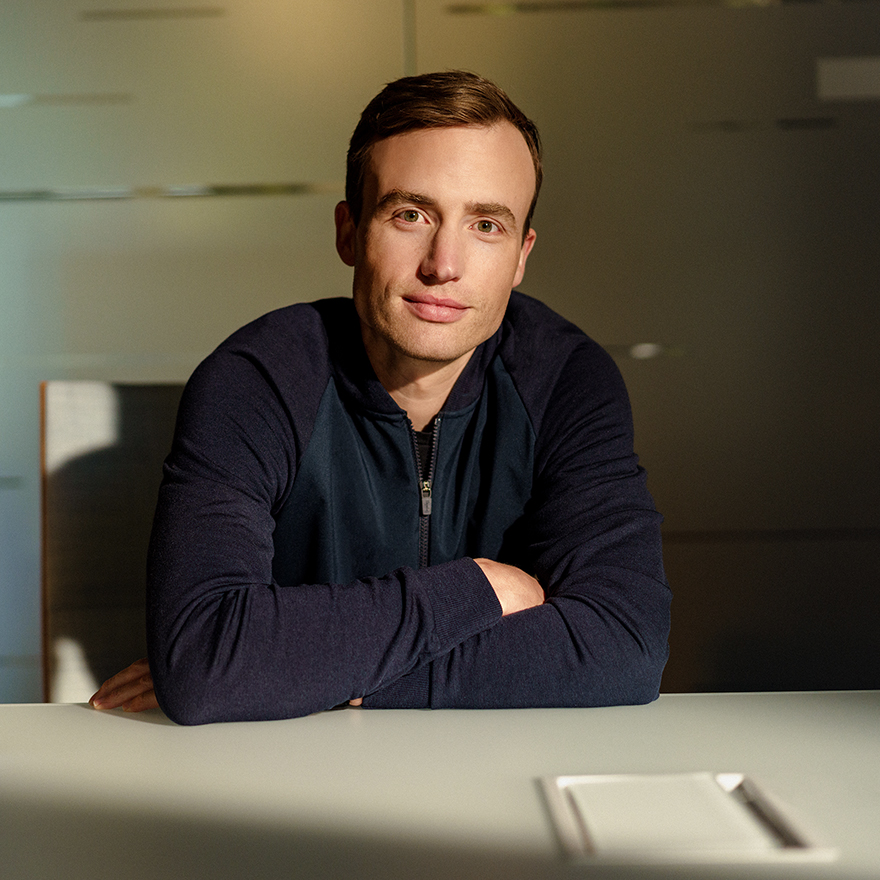
The Stonecutter at Sequoia's Growth Table
In February 2024, Andrew Reed got appointed to Klarna's board. In February 2026, he led Sequoia into ElevenLabs at an $11 billion valuation - and joined that board too. In the weeks between, he recorded his first long-form podcast, titled Don't Flinch, and hit a decade at one of the most competitive institutions in the world. Not bad for someone who, by the firm's own account, walked in the door at 23 as possibly the youngest junior partner in Sequoia's history.
Reed is a growth investor - which in Sequoia's taxonomy means he hunts the messy middle: companies past early chaos, not yet at public scale. It is the phase where narrative logic can mask broken fundamentals, or where a screaming red metric can be the tell of a monopoly forming. Reed is very good at reading which is which.
He is not loud about it. His Twitter bio lists three interests: bikes, investing, the internet. His email is public (areed@sequoiacap.com). He is on the boards of Figma, Klarna, Bolt, Vanta, Strava, Warp, Harmonic, Sourcegraph, Medallion, and others. The portfolio is not a collection of bets. It is a worldview expressed in cap tables.
In our work, you never know which days will be the biggest of your career. But if you stay focused and keep hammering, those days will happen.
- Andrew ReedThe Stutter That Built a Superpower
Andrew Reed grew up with a childhood stutter. He couldn't be the loudest person in the room. So he became the most observant one. While others talked, he watched - tracked body language, noticed hesitations, clocked the gap between what people said and what they meant. In venture capital, where the entire game is reading humans under pressure, this turned out to be an asymmetric advantage.
He calls it the ability to "see the little kid inside people." Most investors evaluate founders. Reed builds trust with them. Two-way vulnerability, he says. Ask founders how they're feeling, not just what the numbers say. Let them ask you the uncomfortable stuff back. The thesis: a founder who trusts you will tell you the real thing. The founder who doesn't will give you the deck version.
When Reed developed conviction on Vanta's Christina Cacioppo, he did it in seconds - not after a full diligence process. He has said he knew immediately after meeting her. This is not recklessness. It is what years of watching people do to a pattern-recognizer: the signals come faster.
He studied at Amherst College, graduating with distinction. Then Goldman Sachs, San Francisco tech banking. His work there included the RingCentral IPO - a Sequoia portfolio company. Someone at Sequoia noticed. In February 2014, he crossed over, leaving a banking career behind to become what Fortune called, at the time, possibly the youngest junior partner in Sequoia's half-century history.
The 95/120 Rule
Reed talks about running at 95% capacity, not 100%. The reserve 5% is not slack. It is stored potential - kept for the moment when an opportunity demands 120%. He has tested this. When the Tourlane founders caught his eye, he emailed them requesting dinner and then, before receiving a reply, bought a plane ticket to Berlin. That is what reserve capacity looks like in practice: not impulsiveness, but readiness to act when conviction arrives.
"You never know which days will be the biggest of your career. Keep hammering."
Figma: The Miss That Became a Model
Early in his Sequoia career, Andrew Reed passed on Figma. He looked at the team, recognized they were exceptional - then concluded that a browser-based design tool couldn't work. The product didn't fit his mental model. So he passed.
Over the following months, market feedback started rolling in. Designers were using it. Developers were using it. The browser turned out to be a feature, not a constraint. Reed watched the evidence accumulate, fought his own confirmation bias, and then did something most investors don't do: he called Dylan Field directly, said he had been wrong, and asked if there was still room to partner.
There was. He joined Figma's board in January 2019. Adobe later attempted a $20 billion acquisition. The deal was blocked by regulators. Figma remained independent and continued growing. Reed remained on the board.
Your natural instinct will be to look for evidence that your previous decision was right... You have to stare it in the face.
- Andrew Reed, on reversing his Figma call$200 Million in the First Week of COVID
March 2020. Markets were in freefall. Institutional memory of 2008 made every check feel reckless. Reed wired $200 million into Robinhood. He has described his internal test in that moment: What would my best self do right now? Not his cautious self. His best self. He answered the question and acted.
This is the decision he uses to illustrate his emotional framework for investing - that feelings are data, not noise. That panic is a signal worth interrogating, not suppressing. That the difference between a great investor and a good one is often not intelligence but the willingness to act on conviction when the external environment is screaming the opposite.
Reed's COVID moment distilled a philosophy he carries into every board meeting: don't flinch. When the numbers look wrong, when the timing is bad, when everyone else is frozen - ask what the best version of you would do, then do that. It is simple. It is also very hard.
The Bets That Built the Decade
Reed's portfolio is a map of how the internet evolved from 2014 to 2026 - design tools going collaborative, fintech going mainstream, developer infrastructure going critical, voice AI going everywhere. Most of these weren't obvious at the time. Several were actively resisted by smart people.
Six Lines Worth Keeping
"You only have one spin on this rock, so enjoy it."
"Now I'm more interested than suspicious when something seems off."
"Founders are human beings. They have senses of humor, diverse interests, ups and downs."
"Do great work. Tie out your numbers. Follow your enthusiasm, you can't manufacture it."
"Find people you admire. Embrace change. Don't flinch. Never disappoint yourself."
"Emotions matter. Look for outliers. Make work enjoyable." - His three hard-won pieces of advice
The VC Who Won't Let His Twin Win
Andrew has a twin brother named Will. Will is also in venture capital - at a different firm. By day, they invest in different portfolios and compete for the same deals from opposite sides of the table. By weeknight, they play chess online against each other. On weekends, they mountain bike. The scoreboard, presumably, is never settled.
In 2019, Andrew married "the best person I know" - that's a direct quote from his year-end tweet. He reads science fiction and fantasy at scale (7 volumes into Robert Jordan's Wheel of Time, wrestling with the sunk cost fallacy about whether to finish). He prioritizes 8 hours of sleep, not as wellness theater but as a cognitive performance strategy. He sleeps like he invests: deliberately.
He admires Doug Leone's willingness to reinvent at 58, pivoting toward Brazilian fintech Nubank with the same curiosity as a first-year associate. That kind of intellectual courage over a long career is, for Reed, the ideal. Not the loudest year. The longest game.
The Decade, Annotated
Personality, Compressed
Eight Facts That Stick
- 1Possibly the youngest junior partner in Sequoia's 50+ year history when he joined at 23.
- 2His twin brother Will is a VC at a competing firm. They battle in online chess on weeknights.
- 3Flew to Berlin to meet Tourlane founders before they replied to his email - and he was right to go.
- 4Publicly posts his email: areed@sequoiacap.com. Rare for a partner at a top-tier fund.
- 57 volumes into Robert Jordan's Wheel of Time. Still battling the sunk cost fallacy about finishing.
- 6Childhood stutter. Credits it as the origin of his ability to read founders in seconds.
- 7Passed on Figma. Then called Dylan Field to say he was wrong. Then joined the board.
- 8Twitter handle: @andrew__reed - double underscore. The single-underscore was taken.