The Franchise Queen Who Became a Venture Capitalist
Before anyone in Silicon Valley had heard her name, Renata George was running one of Eastern Europe's most successful franchise media networks. When she sold it in 2008, she didn't move to a beach. She moved to the next challenge - figuring out how venture capital actually works, and then rewriting the rules for who gets to participate in it.
That trajectory - from post-Soviet media entrepreneur to U.S. fund manager to Singapore-based corporate venture to global diversity advocate - is not a career pivot. It is a single consistent act: finding rooms that need more of the right people, and then making sure those people get in.
She started angel investing in March 2010, barely two years after the exit. RealSpeaker. FaceNoteMe. iProtect. BiMetall+. Early bets. By 2011, she was raising an actual VC fund on American soil. Not networking toward one, not pitching to be a scout. Raising one.
"I consider private equity and venture capital as opposites. In private equity, you start with the numbers, and then you try to fit everything into the numbers. In venture capital, you start with people, and then you try to figure out what numbers you can make."
That distinction is everything. It explains why she gravitates toward founders, not models. Why she judged startup competitions at AngelHack and SXSW. Why her portfolio is a biography of bets on humans - teams at Handl, Butlr, Spenny, BuildStream, Sable, Coursalytics - most of them Y Combinator alumni. She helped companies raise roughly $30 million from state institutions and another $20 million from venture capital investors. The numbers followed the people.
Women.VC: The Nonprofit Nobody Else Built
In an industry that spent decades congratulating itself for having one woman on the cap table, Renata George built the infrastructure to change the ratio. Women.VC started as a not-for-profit initiative - her own initiative - to advance women in venture capital and private equity. Not a Slack group. Not a newsletter. An actual organization with board members, programming, and a database of who the industry's best female investors actually are.
The research she led through Women.VC landed a meaningful counterargument against one of VC's laziest myths: that investing in female fund managers means accepting lower returns. Her work showed that women VCs' portfolio returns match or exceed industry averages. Numbers don't have a gender. Returns don't either.
Her approach to gender equity in VC is also worth noting for what it doesn't do. She doesn't isolate men from the conversation. She argues that gender segregation - having "women-only" conversations about women in VC - widens the gap rather than closing it. The people who control capital allocation need to be in the room when the argument is being made. That's not soft politics. That's strategy.
The Book That Was Crowd-Voted Into Existence
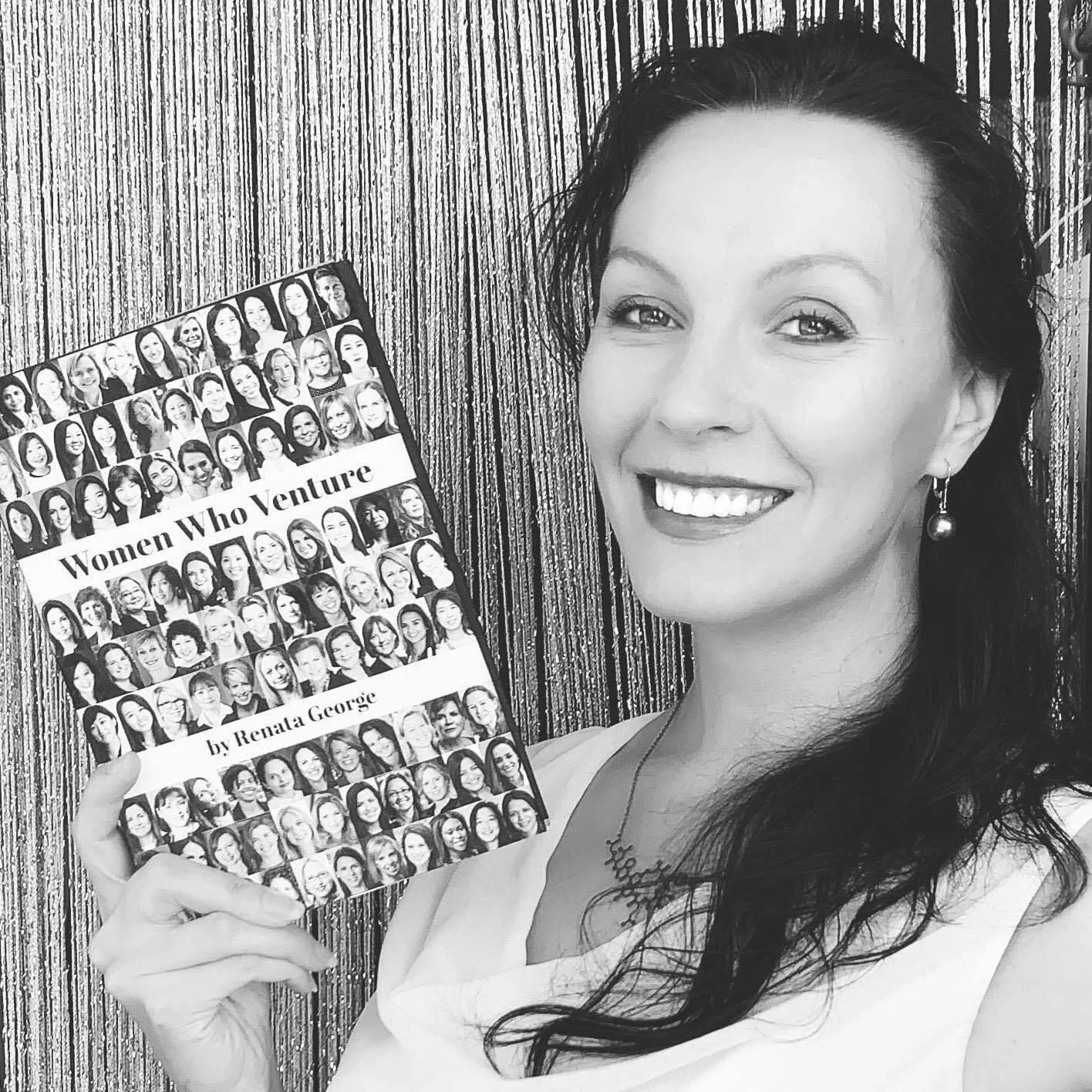
When Renata George decided to write Women Who Venture: You Can't Be What You Can't See, she didn't compile a list of the most famous female investors. She went to social media and asked hundreds of people to vote on their favorites. The subjects of the book were chosen by the community it was meant to serve. That's not a publishing gimmick. That's the methodology of someone who understands networks.
The publishing record is a map of her preoccupations. Mentorship (2013). Networking (2015). The VC mindset (2018). The women who built the industry (2019). Each book is essentially field research from wherever she was standing at the time.
The Grandmother Behind the Investor
Renata George credits her grandmother as her primary role model. Not a famous investor. Not a Forbes billionaire. Her grandmother - for teaching her how to project confidence and earn respect inside spaces dominated by men. This is not a small thing to carry from Eastern Europe to Silicon Valley to Singapore. It is, arguably, the whole story.
She describes herself as Curious, Dedicated, and - her own word - Provocateur. An Agent Provocateur, specifically. Someone who introduces friction into comfortable systems on purpose. She challenges her team to go "1% above and beyond" every day. She refuses to manage people paternalistically - she wants partners, not reports. She fills the gaps in her own knowledge by hiring people who know more than she does in any given area.
"Women across the technology industry take business and investments seriously - they wield power and influence. Female millennial investors, the ones out there, are making a societal impact."
From Kursk to Berkeley to Singapore
The geography of her education mirrors the ambition of her career. She took a BBA in Finance Management at Kursk State Medical University - an institution better known for training doctors than investment professionals, which is either ironic or entirely on-brand. Then an MBA in Venture Investments from the Russian Academy of National Economy and Public Administration.
In 2012, she completed the Venture Capital Executive Program at UC Berkeley's Haas School of Business - the same year Forbes first named her one of the top women in VC and angel investing. She has also trained at MIT Sloan School of Management. She lectures at the University of San Francisco. The direction of knowledge has consistently been: absorb everything, then transmit it.
The VC Academy, where she serves as Program Director and editor-in-chief of vc.academy since February 2017, is the institutional expression of that impulse. Not a one-off talk. A sustained curriculum. She is also a Director of Diversity in Venture Capital at PEI - Alternative Insight, where she works with the Venture Capital Journal to introduce emerging fund managers to limited partners who wouldn't otherwise find them.
What "Talking Less and Doing More" Looks Like
Her professional tagline is: "Connecting the dots in venture capital by talking less and doing more." The record supports the claim. Between 2020 and 2021 alone: investments in six YC-associated startups, a new institutional role at PEI, continued programming at VC Academy. She doesn't announce intentions. She reports results.
Her portfolio in the 2020s leans toward companies solving specific, concrete human problems. Handl (YC W20) - logistics. Butlr - occupancy sensing. BuildStream - construction workforce. Coursalytics - learning analytics. These are not moonshots. They are tools. Functional things built by people she believed in before the market confirmed it.
The full arc looks like this: a woman from Kursk who taught herself franchising, then sold what she built, then learned investing by doing it, then wrote the books about it, then built the organizations to change who gets to do it at all. The box was gone before she even arrived at the room.
In Her Own Words
"Don't think outside of the box - act as if there is no box. To all the women out there, we have already smashed all the ceilings."
"In venture capital, you start with people, and then you try to figure out what numbers you can make."
"Connecting the dots in venture capital by talking less and doing more."
"Female millennial investors, the ones out there, are making a societal impact."
Achievements
- Named by Forbes (2012) as one of "The Top Women in Venture Capital and Angel Investing"
- Named by Forbes (2015) in "Millennial Women Venture Investors"
- Founded Women.VC, a nonprofit advancing women in VC and private equity globally
- Published five books on investing, mentorship, and networking
- Helped technology companies raise approximately $30M from state institutions
- Helped technology companies raise approximately $20M from venture capital investors
- Built and successfully exited a major franchise media network in Eastern Europe
- Raised an independent U.S.-based venture capital fund in 2011
- Established a corporate venture arm for an Asian unicorn startup
- Led research demonstrating women VCs' portfolio returns match or exceed industry averages
- Guest Lecturer at the University of San Francisco
- Startup competition judge at AngelHack and SXSW
Five Things You Didn't Know
She got her finance degree at a medical university in Kursk. The curriculum covered accounting, not anatomy - but still.
Her Twitter handle, @womanvc, is her entire career thesis compressed to one handle. Some people need a thesis statement. She needs five characters.
The subjects of her book Women Who Venture were chosen by public vote on social media. The community picked who got profiled.
She went from franchise media in post-Soviet Russia to VC in Silicon Valley to corporate venturing in Singapore. Three continents, one consistent thesis: back people early.
She calls herself an "Agent Provocateur" in venture capital. Not a disruptor. A provocateur. The distinction matters.