A telephone call has a useful courtesy built into it: somebody has usually agreed to be at the other end. An opinion placed on the internet enjoys no such arrangement. It may find an audience, start an argument or disappear with the dignity of a leaflet dropped into a canal. Mark Asseily worked on both sides of that difference. His career passed through internet calling before he co-founded a company that tried to give an ordinary opinion somewhere to go.
That company was State. Mark was its co-founder and CEO at launch; his brother Alexander was co-founder and chairman. Together, they proposed a network organised around what people thought. The practical challenge was to give a contribution a useful life beyond the person who made it. A view could become a connection, a recommendation or part of a larger picture. The author could arrive without bringing a crowd.
The phone call came first
Mark’s earlier work belonged to the machinery of getting products into people’s hands. At Moxi in Palo Alto, he handled technology licensing and developed business for a software platform aimed at major American cable operators. His work at Skype involved business development, strategic product decisions and negotiations. Later came responsibility for a 200-person products business in the Middle East, followed by leadership of product development at Rebtel. His education included Princeton and an MBA at Stanford.
There is a temptation to read a founder’s earlier jobs as an orderly procession toward the company that follows. Careers rarely provide so obliging a plot. What these roles do establish is experience with several layers of the same transaction: the platform, the partner, the product and the person using it. A licensing agreement and a screen on a phone sit far apart in an organisation. Each can determine whether somebody ever gets to use the thing.
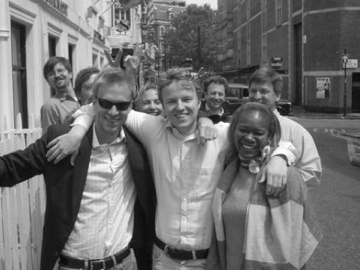
An old team photograph gives that earlier chapter a human scale. Skype colleagues are gathered together outside in Soho, several pressed into the foreground, others visible behind them. The accompanying caption identifies Mark in business development. It is the sort of company photograph that does useful damage to the mythology of technology: here are the people, occupying an actual pavement. Nobody is floating above a diagram.
The photograph offers no grand explanation of his later choices. It does put him inside an earlier effort to change how people communicated. When State arrived, the connection it proposed would have a different starting point. You would begin with a subject and a view. Somewhere beyond your existing contacts, another person might recognise it.
A network with a different entrance
State took shape with the two brothers as founders. Alexander brought his experience founding Jawbone; Mark brought his own background in software distribution, internet calling and product work. Their partnership joined different professional histories rather than two copies of the same résumé. By 2010, Mark was listed as EqualMedia’s co-founder and CEO in the Skoll World Forum programme. The work preceded the public app by several years.
The public launch came in February 2014, following earlier testing. State had attracted a reported $14 million in early financing. At the public launch, the team numbered roughly 30, mainly in London, with an office in San Francisco. Those details describe the scale of the attempt. They do not tell us how it felt to make the first contribution, which was the product’s more intimate test.
A new arrival could choose a topic and react using a small set of expressions. The service matched and compared contributions, helping people discover other views and other participants. Its catalogue was enormous: around 25 million topics, with a vocabulary of roughly 10,000 expressions. The interface offered a compact beginning to a much larger conversation. You could start without composing an essay. Literature would have to wait its turn.
- 01A subjectChoose something you care about.
- 02A reactionAdd words that express your view.
- 03A connectionExplore related opinions and people.
This made a particular demand of the software. It had to preserve enough meaning in a short reaction for the resulting connection to feel sensible. Two people might use different words for similar feelings; another pair might use the same word with different intentions. The invitation looked simple because much of the difficulty had been placed underneath it.
The machinery beneath a reaction
Mark’s name appears among seven inventors on a published opinion-network patent application assigned to Equal Media. Filed in August 2012 and published in February 2013, it describes a system for collecting and analysing electronic opinions. Natural-language contributions would be mapped to shared opinion objects, with relationships presented through an opinion graph. The document gives the social proposition a technical skeleton.
An inventor listing is a credit for participation in the disclosed invention. It does not divide the work among the seven people, and it would be foolish to turn Mark into the solitary author of a team’s system. What it establishes is a documented connection between the founder and the machinery of the idea. His involvement extended into a technical proposal about how contributions could be represented and related.
There is an editorial problem hiding inside that technical one. A network must decide what belongs together. An expression of enthusiasm, an objection and a hesitant qualification each deserve different treatment. Organise too loosely and the picture becomes muddy. Organise too tightly and a person’s view can lose the very detail that made it worth sharing. State chose to make that act of organisation central to the product.
Then the users asked for people
By May 2014, Mark had a concrete account of what participants wanted. The iPhone app was being updated with a world map, word maps and easier sharing. He connected those changes to the responses of people already using State. The original invitation had produced a further request: help us understand more, and help us find one another.
“Based on community feedback, we learned that people really want more nuanced insights and personal connections.”
Mark Asseily · May 2014
The world map plotted clusters of people around topics. Word maps offered another way of viewing the range of reactions. Sharing became simpler. These are ordinary product changes in one sense: the familiar business of adjusting an interface. They also reveal where a broad ambition meets a daily habit. After contributing, a user needs something worth looking at, somebody worth encountering or a reason to bring a friend.
State’s bookmarklet offered another route in. A person reading an article or looking at a photograph elsewhere could connect it to the network through an opinion. That reduced the burden of beginning. The interesting subject was already in front of you. The product could follow your attention rather than ask you to manufacture an occasion for using it.
A footprint is not a public
In May, State said opinions had come from more than 100 countries. Its South African launch coincided with the national election, giving the network a specific event around which people could participate. The service also offered developers a basic API. The invitation was spreading through geography, the web and software connections, each a different way of reaching a potential contributor.
Company-reported, May 2014. Geographic reach, not a representative sample.
The distinction in that small print matters. A map showing contributions from many places can be accurate and still leave most people out. Early users were tilted toward technology. The usefulness of the collective picture depended on who joined and how broadly participation developed. A globe is a generous canvas; it can make a few dots look like an answer.
For Mark’s product, this created two related jobs. People needed a satisfying personal experience. The accumulated contributions also needed to support a meaningful collective view. Success at one could help the other, but the two were never interchangeable. A lively conversation among a particular group remains a conversation among that group, however handsome the map.
The question outlived the company
The corporate chapter has a definite endpoint. Equal Media Ltd was dissolved on 19 May 2024. That date belongs to the original operating company. It is a boundary on how to describe State’s history, rather than an invitation to invent a simple explanation for every turn the business took.
Mark’s story remains interesting at the scale of a person doing the work. He moved through partnerships, product development and the attempt to organise opinions into a network. There were negotiations before there were reaction words. There were colleagues on a pavement before there were people plotted on a world map. Those are different scenes from a career spent around the practical arrangements of communication.
A call gives its participants a relatively clear exchange: speak, listen, reply. State tried to build an exchange for a person who arrived with a view and no waiting audience. Mark’s feedback statement brings the ambition down to human proportions. People wanted more understanding and more connection. The software had offered them a place to put an opinion. They were asking for somebody at the other end.