Consider the moment an engineer’s prototype finally works. The sensor reads correctly. The board boots. Someone suggests ordering a thousand. Suddenly, the interesting questions change. Can the processor be bought in that quantity? Will the software still be supported? Who assembles the system, and what happens when a component disappears? Avnet has built its business around the distance between that first successful demonstration and a product that can reliably leave a factory.
- Avnet sells components, then helps customers design, integrate and supply the products around them.
- Farnell brings it into smaller orders and early development, before volume production begins.
- Holding inventory helps customers meet deadlines, but leaves Avnet exposed when demand slows.
The company’s ancestor was a much simpler operation. In 1921, Charles Avnet began buying and selling surplus radio parts on Manhattan’s Radio Row. Radio was new; finding useful pieces was a business. Today the pieces include semiconductors, connectors, power devices and embedded computers. The underlying transaction remains recognizable: somebody has a component, somebody else has an application, and considerable work separates the two.
£691 million to meet the engineer earlier
Avnet’s position becomes clearer through a purchase. In October 2016, it completed the acquisition of Premier Farnell for approximately £691 million in equity value. Broadline distribution already gave Avnet relationships with companies buying components in volume. Farnell brought a business geared toward engineers, development orders and proof of concept. It moved the conversation closer to the first sketch.
The logic was straightforward. An engineer selecting parts for a prototype might eventually help determine what a manufacturer buys for production. Serving that engineer early creates an opportunity to remain useful later. The businesses address different purchasing moments, even when their customers ultimately want the same thing: a design they can actually build.
- 01ExploreCommunities & development kits
- 02DesignComponent selection & engineering
- 03BuildIntegration & manufacturing support
- 04SupplyInventory & global logistics
A simplified map of services, not a mandatory customer workflow.
At the same time, Avnet was narrowing its focus. It agreed to sell its Technology Solutions business to Tech Data in a transaction announced at approximately $2.6 billion; the sale closed in February 2017. Management said it would concentrate investment on components, embedded solutions, and design and supply chain services. Buying access to earlier decisions while leaving another distribution business was a deliberate change in where Avnet wanted to compete.
The shelf has a balance sheet
There is a price for being the company with the parts. Avnet purchases products for resale, earns a margin, and uses its infrastructure to support delivery, engineering and customer credit. Inventory makes availability possible. It also consumes capital. At the end of fiscal 2026, the company held approximately $6.07 billion in inventory.
The uncomfortable part arrived before the recovery. Avnet’s filings date the industry downturn to the second half of calendar 2023: customers had elevated inventories while underlying component demand weakened. Sales fell, followed by operating income. A customer working through yesterday’s stock has less reason to place tomorrow’s order. Even an efficient distributor cannot make that customer need more parts.
Annual reported revenue, US dollars. Bars start at zero; fiscal years end in June.
Fiscal 2026 brought a rebound. Annual revenue reached $27.63 billion, approximately 25% above fiscal 2025. The company also reported annual inventory days of 81, down from 99. Those measures belong together. Sales show that products are moving; inventory days help show how quickly capital moves with them. The improvement does not remove the next cycle’s risk.
For customers, this suggests a better purchasing question than simply asking who has the lowest quoted price. What does the distributor commit to hold, deliver and support? For Avnet, the corresponding question is how much stock it can carry without turning a service promise into an expensive warehouse problem.
A carmaker needs continuity
General Motors offers a concrete example of the work beyond a purchase order. In May 2026, Avnet announced that GM had named it a 2025 Supplier of the Year in the Creativity Team of Semiconductors category. The account described five years of collaboration through supply disruption, emphasizing coordination across the automaker’s wider supply network.
“Trust is the foundation.”
David Paulson · Avnet Velocity
On Avnet’s work with General Motors, May 2026
That short observation has a practical meaning. A supply partner needs to understand the customer’s problem well enough to coordinate a response. For a manufacturer, continuity involves more than spotting a part in a catalog. Avnet’s role includes connecting supply information, supplier relationships and execution across organizations.
Its May 2026 Singapore expansion shows another version of that service. The new integration facility sits inside an existing Farnell distribution center and supports system, server and rack builds, plus international shipping. Avnet described it as support for customers pursuing a China-plus-one strategy. Adding a production option can matter as much as adding another product to a catalog.

A board is a starting point
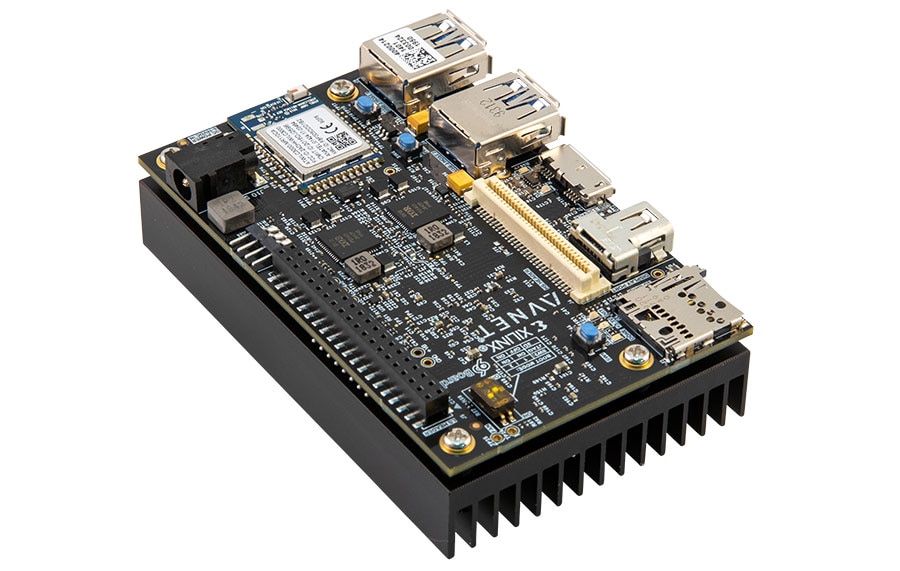
The engineering side is visible in smaller objects. Avnet’s Ultra96-V2 development board combines an AMD Zynq UltraScale+ device with memory, connectivity and expansion interfaces. It gives developers hardware on which to test software and programmable logic. Public GitHub repositories and community projects help make the board usable beyond its specification sheet.
Tria, an Avnet company, addresses embedded computing through modules, systems and design services. In March 2026, it announced expanded operating system support on Qualcomm-based hardware, including Yocto Linux, Windows 11 IoT and Android. For a product team, the choice of software can shape hardware decisions. Working through both together can reduce the number of interfaces the customer must manage alone.
Ask the awkward questions early
Avnet faces substantial alternatives. Its filings identify Arrow and other broadline distributors, while Farnell competes with Digi-Key, Mouser and RS. Manufacturers also sell directly. Avnet’s proposition is the combination of development access, engineering support, inventory and integration. Which combination matters depends on the customer’s order and the complexity of the product.
The useful habit to copy is simple: investigate supply while designing. Ask about component availability, replacements, software maintenance and production quantities before committing the board. Bring a bill of materials and a realistic volume forecast to the discussion. A project needing one readily available part may need little extra help. A product crossing suppliers, operating systems and borders gives Avnet considerably more to do.