The car helped. In 1982, Phil Gallagher was a Drexel student with bills to pay, a degree to finish and a tired Chevrolet Vega. A lunch arranged through a former workplace introduced him to Jack Green of Hamilton Avnet. The offer was a sales job on commission. It also brought a new Chevrolet Malibu, which looked rather good outside a Philadelphia fraternity house. Electronics was unfamiliar territory. Reliable transport had its own persuasive vocabulary.
Forty-four years later, Gallagher is Avnet’s chief executive. Between those two points lie regional responsibility, a global computing business, a departure, a return and a board appointment. His career makes an interesting case for the value of being remembered: by someone who can offer an introduction, by colleagues who want you back, and by customers who trust you when a shipment becomes complicated.
A business education in moving things
Gallagher grew up in South Jersey and studied business marketing at Drexel. Before the executive appointments, there were ordinary jobs: delivering newspapers, working a checkout, driving a summer-camp bus and pumping gas at Hess. On an early résumé, he dressed that last assignment up as “petroleum transferring agent.” Even a future distributor apparently understood the importance of packaging.
His later professional vocabulary would become more elaborate, though moving useful things to people who needed them remained a fair description of the work. Avnet connects component manufacturers with businesses designing and making electronic products. The transaction can involve engineering help, procurement, financing, integration and logistics. A chip is small. The arrangements required to get the right chip into the right product can occupy a considerable number of adults.
That breadth matters in understanding Gallagher’s advancement. A distributor’s customer relationships sit alongside supplier relationships; selling more is only part of the assignment. His early work eventually led into sales, marketing and operations leadership. From 2004 to 2009, he was president of Avnet Electronic Marketing Americas, responsible for the components business across the region.
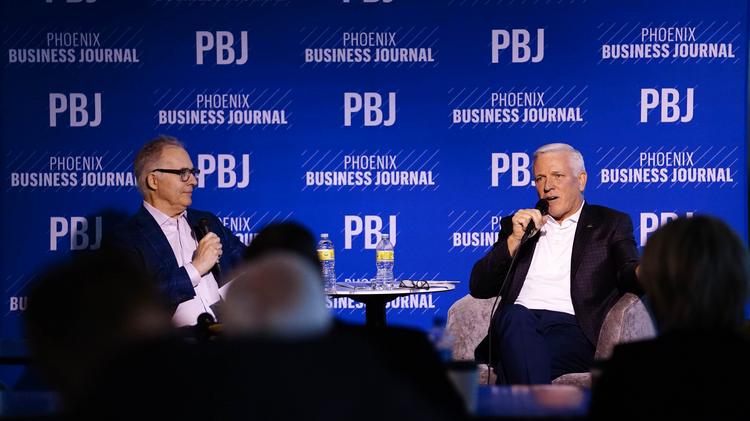
Thirty-five countries, then a different employer
In January 2009, Avnet announced that Gallagher would take charge of Technology Solutions that March. The division had generated $7.6 billion in fiscal 2008 revenue and operated in 35 countries. It distributed enterprise computing and embedded technology products, bringing him into a different part of the same commercial machinery: computer manufacturers, software suppliers and the businesses assembling systems around them.
The promotion gave him responsibility for strategic direction and daily operations across Asia Pacific, the Americas and Europe. He reported to chief operating officer Rick Hamada. The remit helps explain why Gallagher’s later approach to Avnet reaches beyond boxes of components. He had worked with both the parts and the computing systems those parts eventually help make possible.
Then came an interruption that a neat company biography can easily smooth away. He left Avnet in 2014. From 2016 to 2017, he served as president of Americas sales and marketing at TTI, the specialist distributor of interconnect, passive, electromechanical and discrete components. The long Avnet career was real; uninterrupted service would be an inaccurate description.
When he returned in 2017, Avnet had changed. Technology Solutions had been sold to Tech Data, Premier Farnell had been acquired, and Bill Amelio was chief executive. Gallagher returned to lead Core Distribution. Familiar people and a familiar company name surrounded a materially different collection of businesses.
He was careful about how that move was understood. Discussing his return, he praised TTI and said its leadership had supported his decision. He had seen a chance to help Avnet through difficulties. A relationship business makes even an exit part of the work: the people on the other side of today’s departure may still be across the table tomorrow.
The chief executive gets the whole problem
In November 2020, Avnet made Gallagher permanent chief executive and appointed him to its board. Chairman Rodney Adkins described a leader who would concentrate on the fundamentals. Gallagher’s stated strategy centered on the distribution business, its employees and its commercial relationships as the company approached its hundredth anniversary.
The appointment expanded his accountability even after years in senior management. He later described the difference plainly: having participated in board meetings and earnings calls did not prepare him completely for being the person ultimately responsible for everything. Another adjustment was time. Invitations and demands multiply; a chief executive still has to decide where his presence contributes something useful.
His answer begins with questions. He wants to understand what employees, suppliers and customers are experiencing before making decisions. In recruitment, he pays attention to adaptability and emotional intelligence. Senior people must make judgments with incomplete information. They also have to recognize the effect their words have on colleagues who are listening rather more closely than the speaker may realize.
“The higher up you go, the more grey things become.”
Phil Gallagher / on decisions and uncertainty, 2023
There is a practical consequence to that view. A manager who waits for every fact to settle may never decide; a manager who discourages uncomfortable information may decide with the wrong facts. Gallagher’s preference for hearing trouble early gives the organization a chance to do something about it. The executive office can only fix the problems that reach it.
A hundred-year company has to keep moving
Avnet began in 1921 with Charles Avnet buying and selling radio parts in New York. By the time Gallagher was discussing its centenary in 2021, the company supported customers with engineering, financing, product enhancements, marketing and system integration alongside physical distribution. The expanding service list reflected changing customer needs rather than a departure from the original business of helping technology find a market.
Gallagher pointed to connected products and automotive electronics as examples. More connectivity means more decisions about components, software and integration. A manufacturer introducing a product has to coordinate those decisions before it can sell anything. His account of Avnet’s place in that process put the company between invention and production, helping customers work through both.
The same idea appeared in his August 2022 discussion of component shortages and product design. A delay in obtaining one part can affect the design around it. Engineers and purchasing teams therefore have overlapping problems. Gallagher’s experience on both the computing and component sides gives his distribution argument some useful context: the purchase order belongs to a longer sequence.
Artificial intelligence still needs cable
By April 2026, that sequence increasingly led to data centers. Gallagher described demand for power management products, wiring, cables and sensors, alongside opportunities in supply chain services. He had been struck by the activity Avnet’s sales teams were seeing around hyperscalers. Artificial intelligence may arrive in conversation as software, but the facilities running it require a conspicuously physical shopping list.
He also raised a less fashionable question: what return will companies get on their AI investments? He saw potential in productivity and efficiency, while observing that enterprise customers were still working out applications and financial payback. It is a distributor’s perspective on a technology boom: enthusiasm has to make its way into an actual customer requirement, then into an order and ultimately a useful result.
In June, he wrote about another requirement: knowing where components come from. Shortages and price increases can make an alternative supplier look attractive. His case for authorized distribution rested on authenticity, handling, quality assurance and traceability. Trust here has a concrete meaning. Someone needs to know what happened to a component before it reaches the customer’s production line.
That concern connects the early salesman with the current chief executive. Relationships matter partly because buyers cannot personally inspect every handoff. Gallagher’s argument asks distributors to earn the confidence on which those transactions depend. In that business, a reputation has operational uses.
The numbers, with the team still in view
Avnet’s fiscal 2026 results, announced on August 5, offered a substantial financial marker: annual sales of $27.6 billion, up 25 percent. Fourth-quarter sales reached $8.3 billion. Diluted earnings per share for the year were $4.01, compared with $2.75 a year earlier. Gallagher attributed the performance to execution and the company’s longer-term strategy.
The figures describe a company’s results, produced by many people and market conditions. Gallagher’s public acceptance of individual recognition has made a similar distinction. Receiving ECIA’s North Star Award in 2024, he directed attention toward the employees, suppliers and industry colleagues who had helped him. “We are always stronger together,” he said.
His responsibilities also extend beyond Avnet. In October 2025, he joined Dycom Industries’ board, bringing distribution and operating experience to a contractor involved in telecommunications infrastructure. His Arizona commitments include business and economic-development organizations; he also serves on the advisory council of Women in Electronics. These connections place him in rooms where the conversation involves an industry or a region, rather than a single company’s order book.
His message introducing Avnet’s code of conduct makes those expectations explicit. He asks employees to treat integrity and fair dealing as part of their daily work with customers, suppliers and one another. The company names ownership, teamwork and inclusiveness among its values. For a leader whose responsibilities cross regions and product categories, a shared set of expectations provides a way to connect decisions made far from headquarters. Those decisions accumulate into the experience customers have of the company.
There is a pleasing continuity here. His first Avnet opportunity began with somebody making an introduction. Decades later, his work still depends on getting people with different needs into productive conversations. The Malibu was a persuasive opening benefit. The relationships proved to have a considerably longer useful life.
Read, watch and follow
- Avnet
- Phil Gallagher on LinkedIn
- Read: Gallagher’s leadership interview
- Read: the return to Avnet
- Read: AI infrastructure and investment returns
- Read: authorized channels and trust
- Watch: the Barron’s supply chain conversation
- Watch: design chain through supply chain
- Listen: Leading in a Fast Moving World