When Lip-Bu Tan took charge of Cadence, human resources gave him three books on how to be a CEO. He read every page. He was an investor, a board member, someone accustomed to assessing the people who ran companies. Now he needed to become one. His initial commitment was three months. It was an admirably modest estimate for a job that would occupy him for the next twelve years.
The arrangement began in the autumn of 2008. By January 2009, he had the permanent job. In his recollection, the essential work was listening: customers had grievances, employees had ideas, and the company had divisions that behaved too much like separate enterprises. He opened a direct line to staff and recalled answering roughly 300 employee emails a day. Some replies became meetings. Sometimes the CEO arrived at a cubicle himself.
There is a particular comedy to an executive learning the job from books while teaching an organization to talk to itself. But the stakes were serious. Cadence made the software engineers used to design chips. Its customers needed tools they could trust, and a supplier that could deliver. Tan had to turn a collection of capabilities into a company that customers wanted to keep calling.
In March 2025, Intel hired him to attempt another transformation. He arrived with a record at Cadence, decades of investments and a considerable address book. He also arrived with a question hanging over that record: could habits developed in venture capital and design software work inside a company that also builds factories?
A different syllabus
Tan was born in Muar, Malaysia, in 1959 and grew up across Malaysia and Singapore. His father worked in newspapers; his mother worked at Nanyang University. He was the youngest of five children in a family where music and academic achievement were thoroughly established expectations. His own interests included basketball, spiders and fighting fish. The piano faced competition it was poorly equipped to defeat.
He later remembered keeping his fish individually, naming them and ranking their fighting ability. He connected the hobby to his capacity for remembering people and companies. It is a charming origin story for a venture investor, although the fish presumably had no opinion about semiconductor valuations. The useful detail is the attention: individual creatures, individual names, individual differences.
Physics at Nanyang University led him to nuclear engineering at MIT. He had chosen a field that addressed the energy problem, then encountered an industry whose prospects changed after the Three Mile Island accident. He finished a master's degree and moved toward work in California. An MBA at the University of San Francisco added another way of looking at technical businesses.
Those changes of direction matter. His education crossed physical science, engineering and finance before his career settled around chips. Each discipline asks a different kind of question. Does the explanation hold? Will the design work? Can the business support it? At Intel, all three questions can appear in the same meeting.
- PhysicsNanyang University
- Nuclear engineeringMIT
- BusinessUniversity of San Francisco
Thoreau enters the semiconductor business
In 1987, Tan founded Walden International. The name came from Henry David Thoreau's book, an unusual literary companion for the business of financing technology companies. Tan associated it with independence of thought. A venture firm takes other people's money and searches for a future that is not yet obvious. A little resistance to the crowd is useful equipment.
His work put him between engineers with ambitious products and markets that might or might not be ready. The resulting network extended across Asia and the United States. Among the investments associated with his career are chip companies such as Ambarella, Annapurna Labs and Astera Labs, alongside software and AI businesses including Databricks and Perplexity. The portfolio stretches beyond any single kind of processor.
One early relationship involved Creative Technology founder Sim Wong Hoo. Tan recalled that helping Sim prepare for American financial circles included a shopping trip: white socks with dress shoes required attention. Advice to founders can apparently range from the price of a company to the visible portion of an ankle.
The episode is small enough to resist being mistaken for a management theory. It does show how personal the work could become. Funding a business placed Tan alongside its founder, through negotiations, introductions and the less glamorous preparation that precedes a public debut. The investment continued as a relationship.
The numbers came after the conversations
At Cadence, the relationship had a different shape. Tan became responsible for the organization itself. By the time the company announced his planned succession in July 2021, it described revenue growth from less than $1 billion to almost $3 billion during his leadership. It also reported stock appreciation of more than 3,200 percent. Those figures belong to that announcement and its measurement period.
They are substantial results, but a stock chart leaves out most of the working day. Cadence credited a combination of new products, acquisitions and closer customer partnerships. Design software has to keep up with the people building the next chip. A persuasive presentation has a short useful life if the engineer returns to a tool that cannot do the required work.
Succession was part of the story, too. Anirudh Devgan, president since 2017, took over as CEO in December 2021. Tan moved to executive chairman and subsequently left the board in 2023. The handover followed years of working together. A turnaround becomes more convincing when the organization can continue under someone else.
Recognition followed across the industry: the Robert N. Noyce Award in 2022, imec's Lifetime of Innovation Award in 2023 and the Phil Kaufman Award in 2025. The last of these recognized his impact on electronic system design. His contribution had become visible in the businesses and tools that help other engineers make their products.
Intel gets a shorter chain of command
Intel announced Tan's appointment on March 12, 2025, effective March 18. He had already served on its board from 2022 to 2024. This was a return to familiar territory with a much less comfortable seat. As chief executive, he would be responsible for converting judgments about the company into decisions inside it.
His April message to employees was unusually specific about the irritations of corporate life. Teams could be eight or more management layers deep. Meetings consumed time. Internal administration competed with engineering. He challenged the idea that a manager's importance should be measured by the size of the team underneath them. Anyone who has watched a meeting generate another meeting could recognize the problem.
He proposed fewer layers, fewer unnecessary attendees and simpler internal requirements. He also required hybrid employees to return to sites four days a week by September 2025. These were choices about how work should happen, with consequences for people's daily lives. Listening to an organization does not spare a leader from making decisions some of its members dislike.
By July, Tan said Intel had reduced management layers by about half during the second quarter. He also announced a workforce reduction plan of approximately 15 percent. Behind the language of organizational efficiency were colleagues losing jobs. The customer focus familiar from his Cadence years had arrived alongside a harsher task: reducing the cost of the organization delivering the products.
“There are no more blank checks.”
Lip-Bu Tan · July 2025
An address book meets a factory budget
The factory decisions showed the scale of the difference. In July 2025, Intel said it would drop planned projects in Germany and Poland and further slow construction in Ohio. Tan argued that expansion had run ahead of demand. Investment in the future Intel 14A process would depend on confirmed customer commitments. His rule was plain: “There are no more blank checks.”
He also said he would review and approve every major chip design before tape-out, the point at which a design moves toward fabrication. That put the CEO close to consequential product decisions. It also made his own judgment part of the process he was trying to improve. A shorter reporting chain still has to lead somewhere.
Then came a deal that put his collaborative approach on public display. In September 2025, Nvidia and Intel announced plans to develop data center and PC products together. Nvidia also announced a $5 billion investment in Intel. The proposed work included custom Intel x86 CPUs for Nvidia infrastructure and PC chips combining Intel processors with Nvidia graphics technology.
For Tan, this placed a familiar industry relationship inside a concrete commercial arrangement. Jensen Huang's company could compete with Intel in some markets and collaborate in others. The announcement set out future products; it was a commitment to joint development, with engineering work still to do. A handshake can start that work. It cannot complete it.
The next question is still a customer’s
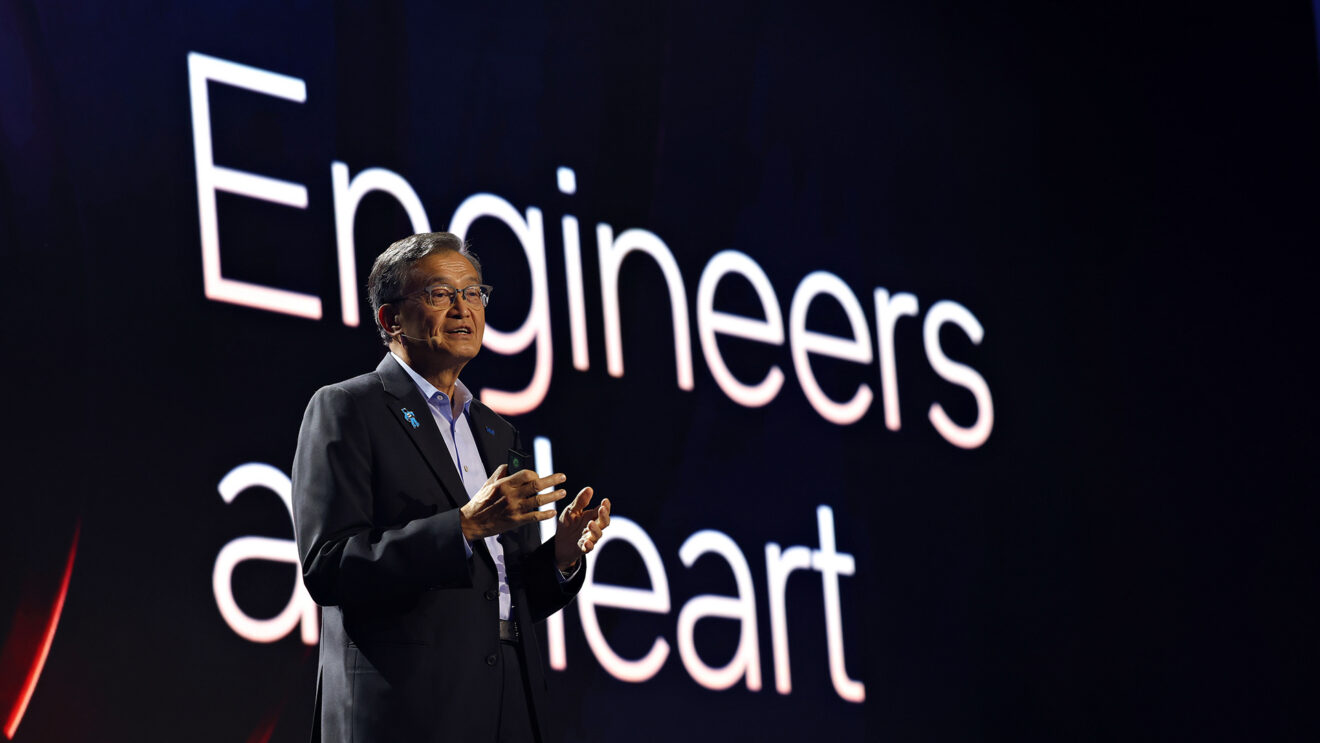
By Computex in June 2026, Tan was presenting Intel's plans onstage in Taipei. Foxconn's Jerry Hsiao, SambaNova's Rodrigo Liang and Perplexity's Aravind Srinivas were among the people who joined the keynote. The program connected processors with systems, software and the companies that might put them to work. His career's recurring cast of partners had become part of Intel's public pitch.
In a September 2026 conversation with Jodi Shelton, the personal quality that drew attention was his quietness. Shelton, who had known him for years, described a gentle manner alongside a willingness to take substantial risks. That combination is useful to remember when reading his instructions about factories and spending. A soft voice can deliver a very expensive decision.
His commitments also extend to the places that educated engineers. In 2024, he gave S$3 million to establish an AI professorship at NTU. He has served as a Carnegie Mellon trustee, and the university awarded him an honorary doctorate in 2025. These activities put some of his attention toward the people who will eventually enter the laboratories and companies he knows.
Intel's outcome will require more than a familiar management style. Engineers have to deliver, customers have to order, and manufacturing investments have to earn their place. Tan's career offers evidence of how he approaches such work: he changes fields, asks for help, reads the books and keeps asking questions. The three-month CEO learned to stay. Now he has to make that patience count on a factory floor.