Before SK Fong asked other engineers to leave established careers, he had to consider what the move would cost them. He was comfortable taking a risk. Some prospective colleagues were younger, with different commitments. They examined the market together before committing to SkyeChip. It is an unusually practical beginning for a company whose work involves the invisible machinery inside artificial intelligence. The first design problem was getting people to believe a business was worth building.
A call from an officer at Malaysia Digital Economy Corporation helped set things moving. Potential customers in China were asking about Malaysian semiconductor capabilities. Fong checked the demand himself. The opening brought a longstanding ambition into reach: a Malaysian company developing its own advanced chip technology. He recruited Teh Chee Hak as co-founder and chief technology officer. Even the company name carries their partnership, combining SK and CH.
Thirty-three years before the start
Fong graduated from Universiti Teknologi Malaysia in 1986 with first-class honours in electrical engineering. That year, he joined Intel as an engineer. He stayed until 2011, eventually directing the Intel Penang Design Center and overseeing work on processors, chipsets and intellectual property. A quarter-century inside the company gave his later venture a substantial apprenticeship.
The scale matters. Fong helped establish Intel’s Malaysian design centre, an organisation that grew to 1,500 people. His work included technical and management positions in Malaysia and the United States. The semiconductor industry association also records his later responsibility for a Broadcom division with global operations worth US$1 billion. Before leading a small company, he had learned how large engineering organisations worked.
Running a design organisation involves a peculiar kind of responsibility. The product is intricate, the work is divided among specialists, and the result has to function as a whole. A leader needs to understand both the engineering and the relationships between the people doing it. Fong’s career placed him in positions where those concerns met. His eventual move into entrepreneurship carried the experience of assembling capabilities, as well as developing individual ones.
In 2011 he joined Altera Malaysia as vice-president of design engineering, leading its Malaysian research and development operations. After Intel acquired Altera, his final role there was vice-president of engineering in the Programmable Solutions Group. In 2016 he moved to Avago Technologies, part of Broadcom, managing operations and new product introductions. He left in 2019, the year SkyeChip was founded; its business operations began in 2020.
Joins Intel
Design leadership
Global operations
Co-founder
Main Market listing
That sequence gives the founding date a different meaning. A new legal entity can arrive quickly. The knowledge behind it takes much longer. Fong entered the venture with experience of research, development and operations, including the transition from a design to a product that can be introduced into production. His co-founder brought another set of technical capabilities. Together, they could ask a more concrete question than whether Malaysia had talented engineers: what business could those engineers sustain? The answer had to connect their abilities to something customers would choose to buy, and keep choosing as their own needs changed.
The idea has an owner
Fong’s explanation of SkyeChip’s business has an unexpected literary guest: J K Rowling. An author creates a book that can become a film. In his version of the comparison, a semiconductor business develops intellectual property that can become a chip. The attraction is ownership of something that can support more than one finished product.
“For us, our IP can eventually become a chip.”
SK Fong, May 2026
He has described the company’s ambition through another reference, Broadcom. Its combination of IP and custom silicon offers a model for the business he wants to build. SkyeChip secured its first memory-interface and custom-IP contract in 2020, began coherent network-on-chip design in 2021, secured a NoC development contract in 2022 and won two custom ASIC contracts in 2023.
There is a pleasing incongruity in a semiconductor executive reaching for a novelist to explain his economics. The comparison also makes the question of authorship accessible. When a customer pays for work, who retains something useful after the work is delivered? A business built around intellectual property keeps returning to that question. Each new application gives the owner another reason to refine the underlying design.
SkyeChip’s portfolio includes high-bandwidth memory interfaces, low-power memory interfaces, networks on chips and connections between chip dies. In everyday terms, these concern how information moves into a processor, around its internal components and between pieces of silicon. They are part of the supporting architecture of AI and high-performance computing. A chip’s usefulness depends on the movement of data as well as the calculations it performs.
Three parts of SkyeChip’s IP portfolio. The arrows explain relationships; they do not represent a specific product architecture.
A lecture hall is part of the business
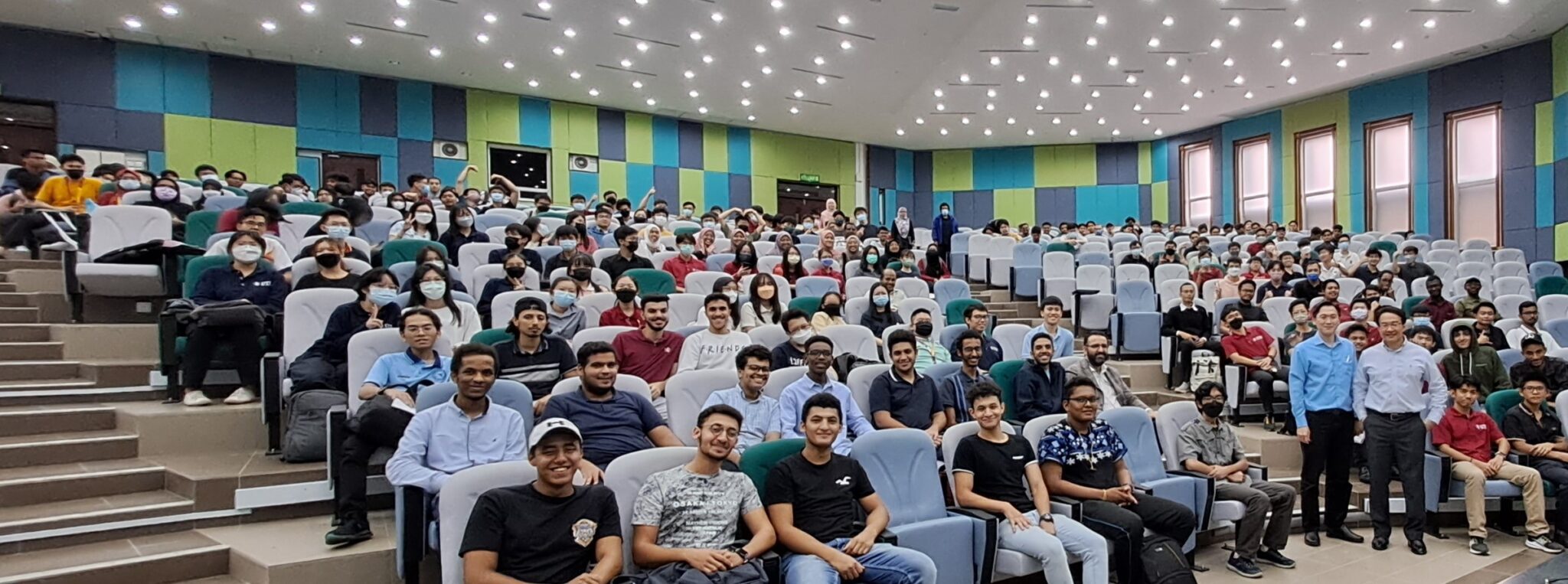
On 3 January 2023, Fong returned to UTM to speak to electrical engineering undergraduates. The seminar concerned the future of semiconductors and careers in integrated-circuit design. His message was that engineers needed a sound foundation and continued acquisition of knowledge. A degree begins the process. An industry that keeps changing gives its practitioners plenty of homework afterward.
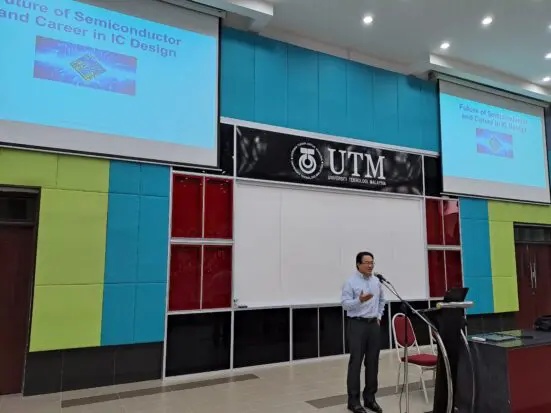
There is a business reason to spend time in that room. The company’s prospects depend on people who can do difficult technical work, and a university is one place those careers begin. Fong discussed engineering opportunities at SkyeChip, including advanced integrated circuits for AI and high-performance computing. For students, the speaker offered a visible route from their own degree into the industry.
His connection to education also includes a return to being a student. In 2010, long after completing his engineering degree, he earned an Executive MBA through Washington University’s Olin Business School and Fudan University. The distance between the two qualifications spans much of his Intel career. Technical experience and business education accumulated over time, before the decision to start SkyeChip.
By March 2026, he was again participating in a UTM discussion about Malaysia’s semiconductor ecosystem. There he stressed the economic value of developing and owning technology. The subject connects his university visits with his commercial choices. Preparing graduates, building a team and deciding what that team should own all belong to the same longer project.
The numbers acquire a public audience
SkyeChip listed on Bursa Malaysia’s Main Market on 20 May 2026. The IPO raised RM352 million through new shares. At the listing, Fong outlined the next stage: extending the company’s work from silicon IP into silicon products, including custom chips and AI computing solutions. The listing gave those ambitions a public audience and a larger pool of capital.
The business already had measurable operating results. For the financial year ended 31 March 2026, revenue reached RM155 million, up from RM119.5 million a year earlier. Profit after tax rose from RM35.9 million to RM48.5 million. The company served 26 customers, compared with 14 the preceding year. Silicon IP accounted for about 77% of annual revenue.
Financial years ended 31 March. Company revenue, separate from Fong’s personal wealth.
New revenue from the United States and South Korea together represented 24.1% of that year’s total. These figures give the story a useful change of scale. The founder’s original proposition was that a Malaysian team could sell advanced technology internationally. Customer growth and overseas revenue show that proposition entering the ordinary, demanding world of commercial delivery.
For a founder, a listing makes more people participants in the future of the business. Engineering plans become capital allocation decisions. Recruitment becomes a question of whether the company can deliver its programme. The numbers are an account of work already done; they also establish expectations for what follows. A good circuit does not excuse an undisciplined business plan.
Permission to proceed is a decision to make
Fong’s comments on access to Arm’s technology show a careful side to the expansion. In May 2026, SkyeChip had received conditional approvals for a Compute Subsystems platform and a Flexible Access platform. He said the company was conducting further due diligence on the larger undertaking. He also wanted a system partner to support the investment with a customer.
That qualification deserves attention. Access to sophisticated technology creates possibilities, but a possible product still needs a buyer and a viable development programme. At the listing, he described opportunities in custom computing, AI accelerators and input/output die technologies for advanced packaging. These were areas the company intended to pursue, rather than a claim that every proposed product had already reached the market.
Other relationships were becoming concrete. SkyeChip joined the Intel Foundry Accelerator IP Alliance in April 2025, bringing Fong’s new business into an ecosystem associated with his first employer. In July 2026, the company announced an ongoing engineering engagement with Cerebras, supporting custom high-speed interface IP for its next-generation computing initiatives. The work concerned a defined technical contribution to a customer’s programme.
By October 2026, Fong was participating in the Khazanah Megatrends Forum’s discussion of firms and transformation. His career now reaches from individual engineering work to debates about how organisations build capabilities that endure. The scale has changed several times. The recurring concern is who can do the work, and how an organisation gives them a reason to keep doing it.
SkyeChip remains a business with development commitments to meet and customers to satisfy. Fong’s aspiration is to build a globally competitive Malaysian silicon IP and chip company while developing local talent. That is a demanding combination of commercial and national ambition. Its most persuasive expression is the practical work: engineers learning, designs improving, customers choosing to use them. The idea has an owner. Now it has to earn its keep.