In 2020, Wally Rhines had a reason to say no. The former Mentor Graphics chief had been investigating fully homomorphic encryption for DARPA. Other semiconductor companies had told him the computing demands put practical deployment years away. Then his friend Gordon Campbell invited him to look at Cornami. Another machine-learning processor? Rhines had seen plenty. But co-founder Paul Master mentioned something else: this machine could calculate on encrypted data.
- Cornami pairs reconfigurable hardware with a streaming programming model.
- Its target is useful computation without exposing the underlying data.
- The commercial test is whether privacy justifies the cost of a specialized system.
Rhines doubted it. He spent months examining the company’s emulation data. “By March of 2020, I was convinced,” he recalled in a published interview. He became CEO that year. The appealing detail is the delay between introduction and conviction. A demonstration can impress a visitor in an afternoon. Cornami’s proposition required considerably more homework.
01 The awkward moment when data gets used
Ordinary encryption protects information while it is stored or travelling. Processing commonly requires readable data somewhere in the system. That creates an awkward bargain: an organization may want an answer from another organization’s computer without wanting that computer to see the question.
Fully homomorphic encryption, or FHE, changes the bargain. A machine performs supported operations on ciphertext and returns an encrypted answer. The key holder decrypts the result. Picture a bank seeking a fraud signal from sensitive records, or researchers wanting to learn across institutional datasets. These are illustrative uses, not a roll call of Cornami customers. The attraction is collaboration with less exposure.
The catch arrived before the business opportunity: the arithmetic was expensive. FHE could be mathematically possible and operationally inconvenient at the same time. Waiting for an answer matters. So does the memory required to obtain it. Security that consumes the entire computing budget has a difficult sales meeting ahead.
02 First the program, then the processor
Campbell, Master and Fred Furtek began with software. Their programming environment divided applications into independently executable streams of data and control. In a 2024 interview, Rhines described seven years spent optimizing the software before developing the chip. The order deserves attention: the team worked out how to distribute computation, then designed hardware to serve that arrangement.
TruStream is the programming model; FracTLcore is the compute fabric. The language can sound like a parts catalogue, but the distinction is useful. One describes the work. The other supplies a reconfigurable place to do it. Cornami describes pipelines that operate continuously, without the threads, locks and shared-memory coordination familiar in conventional parallel programming.
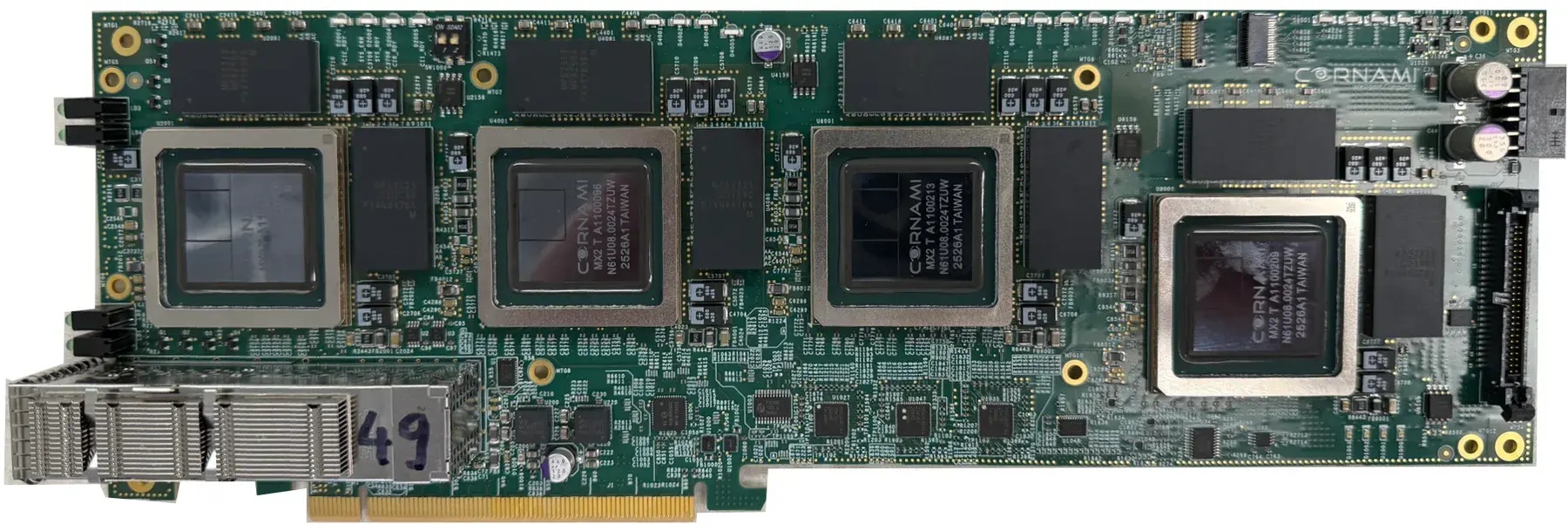
Its expertise therefore spans compilers, processor architecture and workload mapping. It is selling an arrangement of those parts. A faster chip alone cannot rescue every inefficient computation. A clever compiler still needs memory and connections that let its plan survive contact with hardware.
03 The mathematician joins the machine
In September 2024, Craig Gentry joined Cornami as Chief Scientist, Algorithms. Gentry produced the first fully homomorphic encryption construction in 2009. His arrival gave the company a particularly direct connection to the problem it was trying to commercialize.
With DESILO researcher Yongwoo Lee, he developed an FHE scheme tailored to matrix arithmetic. Matrices sit inside many AI calculations. Their paper reduces expensive auxiliary operations around encrypted multiplication, including conversions and rotations. The point is to rearrange the mathematics so the machine spends more time on the calculation that matters.
A faster chip alone cannot rescue every inefficient computation.
In November 2025, the companies reported up to 80 times faster encrypted matrix multiplication against representative baselines. That is a result for an operation, not a promise that every private AI application runs 80 times faster. In 2026, joint work on bootstrapping - refreshing ciphertext so further computation remains possible - continued the same effort. Faster arithmetic and better hardware are complementary bets.
04 Privacy acquires a price tag
Cornami announced $26.4 million in Series B funding in 2020. Its completed Series C exceeded $68 million in May 2022, led by SoftBank Vision Fund 2, with participation from Impact Venture Capital, Octave Ventures and Applied Ventures. This was a costly route from programming ideas to physical systems.
The purchase price is the beginning of the economic calculation.
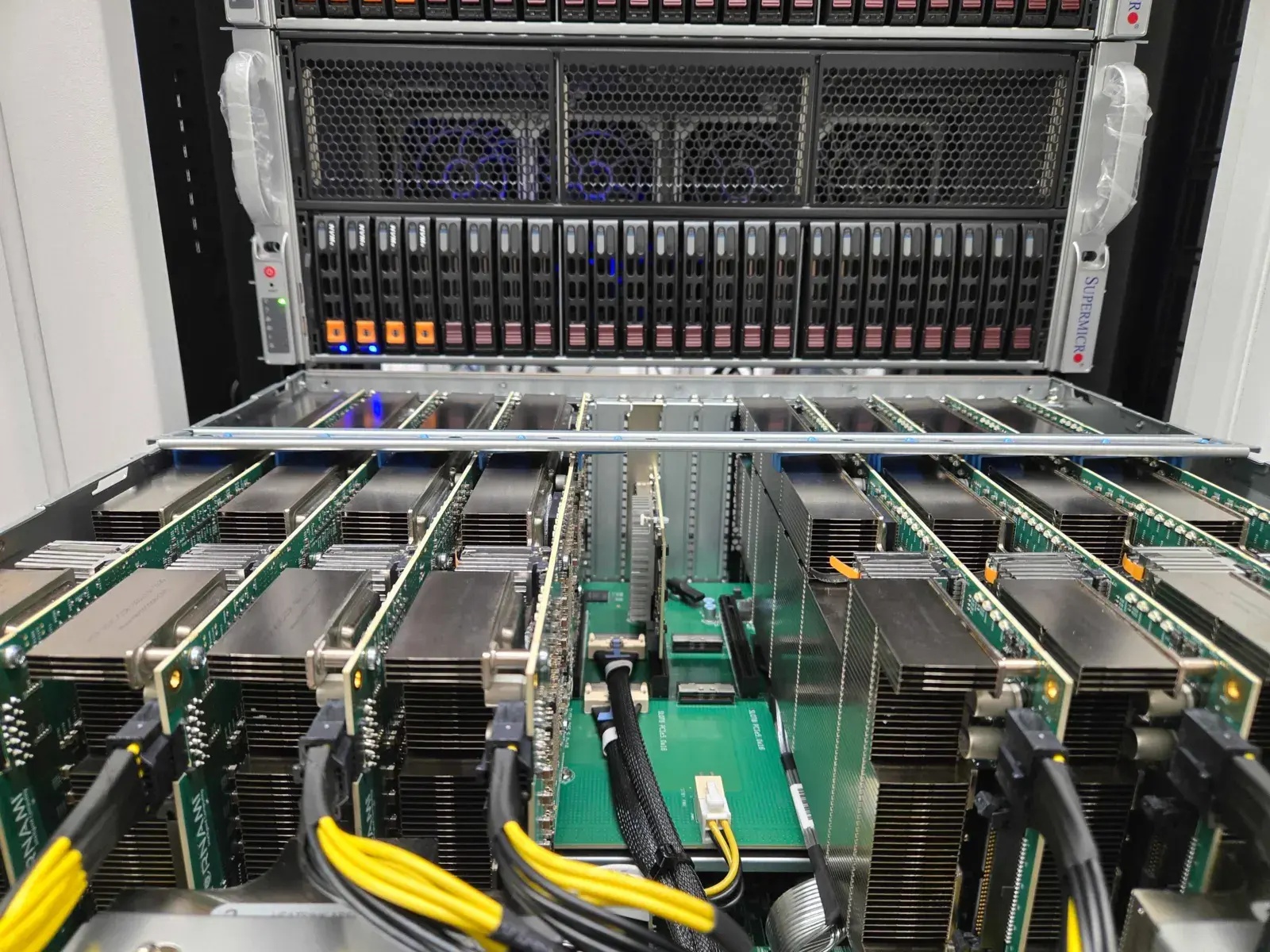
In May 2026, Cornami named Jan Geldmacher CEO and chairman and reported paying customers across defense, fintech and enterprise. The same announcement priced its flagship MX64 at $500,000 per unit. That places the business firmly in enterprise infrastructure: integrated silicon, system software and deployment around particular workloads.
05 A fabric needs partners
DESILO supplies cryptographic software and collaborates on the algorithms. Ingonyama brings another application: zero-knowledge proofs, which allow claims to be verified without revealing their underlying secrets. Its May 2025 collaboration integrates the ICICLE library with Cornami’s fabric; Brevis Pico was named the first design partner. These relationships connect a compute architecture to people with specific calculations to accelerate.
Cornami also faces alternatives. Developers can run FHE software on conventional processors and GPUs. Zama offers an open-source FPGA hardware backend integrated with TFHE-rs. The options use different schemes and serve different workloads. A buyer needs a relevant comparison, including integration effort, rather than a contest between impressive-looking numbers.
06 What to borrow before buying
The useful lesson is Cornami’s sequence: study the workload, improve its execution model, and only then decide what hardware it deserves. For an enterprise evaluating encrypted computing, the equivalent is a narrowly defined pilot. Measure the full journey: encryption, transfer, computation and decryption, at the required security settings and accuracy.
DESILO’s own documentation makes the tradeoff concrete: one matrix-multiplication method uses less memory but runs slower; another gains speed by preparing additional structures. The right choice depends on the data. FHE also cannot stop an authorized recipient mishandling a decrypted answer. Cornami’s case is strongest where sensitive computation has enough value, volume and structure to repay the machinery. The secrets may remain sealed. The economics should be open.