For most of its life, AMD could be explained with one reflexive phrase: the other x86 chip company. The label was not wrong, but it was lazy. Walk through AMD's portfolio today and the old shorthand collapses. A Ryzen processor may sit in a student's laptop. A semi-custom system-on-chip runs a PlayStation 5 or an Xbox Series X. EPYC processors fill cloud servers. Instinct accelerators train and serve artificial-intelligence models. Adaptive chips react inside factories, cars and telecom equipment. Pensando silicon moves data through a network. ROCm software tries to make all that computing usable.
The connecting idea is less glamorous than a benchmark chart and more consequential: AMD wants to supply the right engine for each workload, then make the engines cooperate. That puts the Santa Clara company in a strange new position. It still contests Intel's familiar territory, but it also meets Nvidia in accelerators, Arm designs in clients and servers, and custom chips built by the largest cloud companies. The rivalry is no longer about one socket. It is about the architecture of the whole machine.
A comeback built one beachhead at a time
AMD was founded in 1969 by Jerry Sanders and seven colleagues from Fairchild Semiconductor. It survived cycles that erased many peers, created the backward-compatible AMD64 extension that pushed x86 computing into the 64-bit era, bought graphics specialist ATI in 2006 and later separated its factories. That last move made AMD fabless: it would concentrate on design while partners, chiefly TSMC for leading-edge wafers, handled manufacturing.
The defining modern chapter began under Lisa Su, who became chief executive in 2014. AMD narrowed its attention, rebuilt its CPU architecture and released Zen-based Ryzen and EPYC processors in 2017. Ryzen restored relevance in personal computers; EPYC gave cloud providers and enterprises a credible second source for server CPUs. The same modular, chiplet-heavy design philosophy let AMD assemble products from smaller pieces instead of forcing every complex processor into one enormous die.
The useful lesson in AMD's comeback is not “make a faster chip.” It is win a beachhead, reuse the architecture, then widen the map.
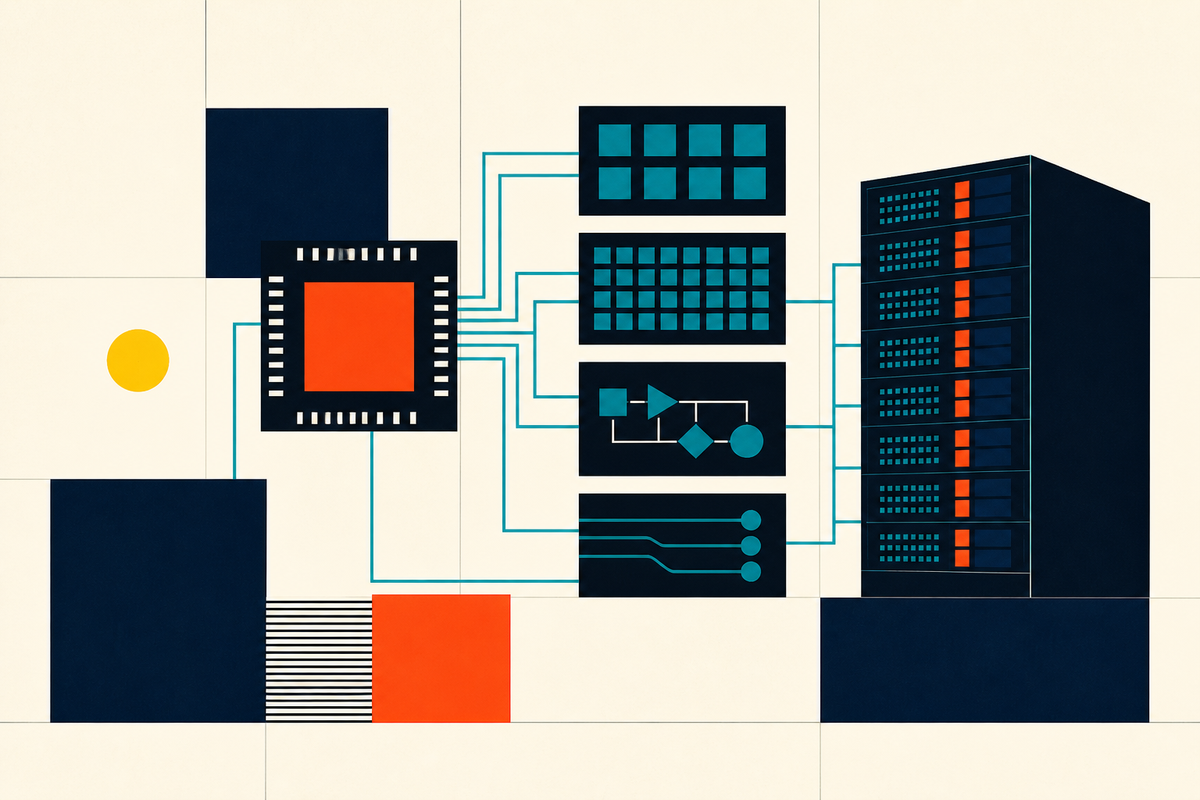
The map widened quickly. Xilinx, acquired in 2022, brought field-programmable gate arrays and adaptive systems-on-chip - silicon whose behavior can be tailored after manufacturing. Pensando added programmable data-processing units and networking. Silo AI added model and software expertise. ZT Systems contributed engineers who know how hyperscale AI servers are designed, even as AMD sold ZT's manufacturing operation to Sanmina. These deals were not a random shopping trip. They filled boxes in a system diagram.
Up 34% year over year
Nearly 48% of total
Across a global design business
What AMD actually sells
For consumers, the catalogue begins with Ryzen CPUs for desktops, laptops and handheld gaming PCs, plus Radeon graphics cards. Ryzen AI products place neural-processing hardware inside the PC so some inference can run locally. Radeon PRO serves workstation users. AMD also supplies the semi-custom chips at the center of Sony and Microsoft consoles, a delightful bit of industrial diplomacy: two fierce gaming rivals share a silicon architect.
Enterprise buyers see a different AMD. EPYC CPUs host databases, virtual machines, web services and the CPU side of accelerated systems. Instinct GPUs handle parallel workloads in AI and high-performance computing. Versal adaptive SoCs, FPGAs and embedded processors go into communications, aerospace, automotive, industrial and edge equipment. Pensando products address networking and infrastructure processing. Developers meet ROCm, Vitis, graphics drivers, libraries, compilers and increasingly polished documentation.
Customers buy through PC and server manufacturers, cloud providers, distributors and direct relationships. Dell, HPE, Lenovo and Supermicro build systems around AMD parts. Microsoft spans Azure and Xbox. Sony uses AMD in PlayStation. Meta has described broad deployment of MI300X for Llama inference, while OpenAI has used AMD accelerators through Azure and entered a multi-generation deployment agreement with AMD. National laboratories run some of the largest machines on Earth with combinations of EPYC and Instinct.
The problem is compute - and the electricity around it
A processor buyer is rarely shopping for abstract speed. A cloud operator wants more virtual machines per server and fewer watts per unit of work. An AI lab wants models trained or served sooner without being trapped by memory limits. A gamer wants smoother frames at a price that leaves money for games. An industrial designer may need deterministic response, a long product life and hardware that can change after deployment. AMD sells different devices because those problems do not want the same engine.
Energy has become a design constraint rather than a corporate-responsibility footnote. AMD set a goal to improve the energy efficiency of processors and accelerators used for AI training and high-performance computing thirtyfold from 2020 to 2025. It reported a 38-fold improvement. The claim uses a defined internal methodology rather than a promise that every data center's electricity bill fell by the same factor, but the direction is unavoidable: when thousands of processors run together, performance per watt determines what can be built.
Open is a strategy, not a charitable gesture
Nvidia's advantage in AI is not merely a fast GPU. CUDA, its mature programming environment, has accumulated years of developer habits, tuned libraries and production code. AMD's answer is ROCm, an open-source platform that supports major frameworks and gives customers more visibility and portability. “Open” does not automatically mean effortless. Software compatibility, documentation and day-one optimization can decide a purchase before hardware specifications enter the meeting.
That is why AMD contributes to projects such as Linux, PyTorch and TensorFlow, publishes playbooks and works with cloud providers and model builders. Its differentiation is choice: CPUs, accelerators, adaptive silicon and networking built around industry standards rather than a single proprietary garden. For buyers worried about supply concentration or lock-in, a viable second ecosystem has value even before it wins a benchmark.
The business model benefits from that breadth. AMD sells chips and boards, licenses elements of intellectual property through semi-custom arrangements, and secures designs that can ship for years. It outsources capital-intensive fabrication while spending heavily on architecture, validation and software. That keeps the company relatively focused, but it also ties execution to foundry capacity, packaging and a complicated global supply chain. Fabless is not frictionless.
When the rack becomes the product
AI makes AMD's portfolio strategy easiest to see. A useful cluster needs more than accelerators: host CPUs, high-bandwidth memory, fast links between GPUs, network interfaces, cooling, power delivery, system software and a rack design that can be deployed repeatedly. AMD's Helios design combines Instinct MI400-series GPUs, EPYC CPUs, Pensando networking and ROCm. It is the moment the boxes in AMD's acquisition diagram become a physical product.
The customers here are hyperscalers, model builders, governments pursuing sovereign AI, enterprises deploying inference and research institutions running simulations. AMD said in 2025 that seven of the ten largest model builders and AI companies were running production workloads on Instinct. Its OpenAI agreement contemplates deployments totaling six gigawatts of AMD GPUs, beginning with MI450-series products, subject to a long list of commercial and technical conditions. This is demand measured like a power station, not a PC shipment.
AMD's biggest product may turn out to be the connections between its products.
There are limits to the tidy story. Nvidia remains a formidable accelerator and software incumbent. Intel is rebuilding its manufacturing and product road maps. Cloud operators increasingly design their own chips. Arm architectures continue to spread. Serving consumer PCs, consoles, embedded designers and frontier AI labs also creates an unforgiving coordination problem. A broad portfolio is useful only when road maps arrive on time and software makes the hardware feel coherent.
Where AMD fits now
AMD occupies an unusual middle ground. It is broader than a specialist accelerator vendor, less vertically integrated than a company owning leading-edge fabs, and more merchant-oriented than cloud companies building silicon for themselves. Its products give OEMs and enterprises an alternative source across several crucial categories. Its adaptive portfolio reaches markets where a fixed CPU or GPU is not enough. Its console work proves it can tailor complex systems for customers with long horizons.
For a person choosing a laptop or graphics card, this strategy appears as competition - another price, power and performance point. For a developer, it appears as ROCm, drivers and access to different kinds of compute. For a cloud or enterprise buyer, it can mean negotiating leverage and freedom to match workloads to hardware. For scientists, it can mean machines such as El Capitan, which led the November 2025 TOP500 ranking.
The old description of AMD depended on Intel because AMD itself seemed smaller than the comparison. The new company is harder to compress. It is a designer of engines and the connective tissue around them, selling from the edge of a sensor to the back of an AI rack. That makes the challenge clearer too. AMD has assembled the pieces of an everything-chip company. Now it has to make the everything feel like one thing.