The loudest contest in technology is being conducted inside quiet black boxes. One side has Nvidia, the company whose GPUs and CUDA software became the default tools of the AI boom. On the other is a crowded field of chipmakers searching for a useful reason to exist. Tenstorrent has chosen an interesting one: the future will change too quickly for a fixed machine.
The Toronto-born company designs AI accelerator chips, RISC-V processors, workstations and rack-scale systems. It also licenses the blueprints for customers who would rather build their own silicon. Much of the software is on GitHub. The pieces connect from core to core, chip to chip and server to server. A developer can begin with a PCIe card, move to a liquid-cooled workstation, and eventually run the same architecture across a room of machines.
That range is not tidy. It is the strategy. AI models are moving faster than semiconductor design cycles, while buyers are increasingly sensitive to power, cost and dependence on one vendor. Tenstorrent wants to sell them optionality.
A grid built around moving data
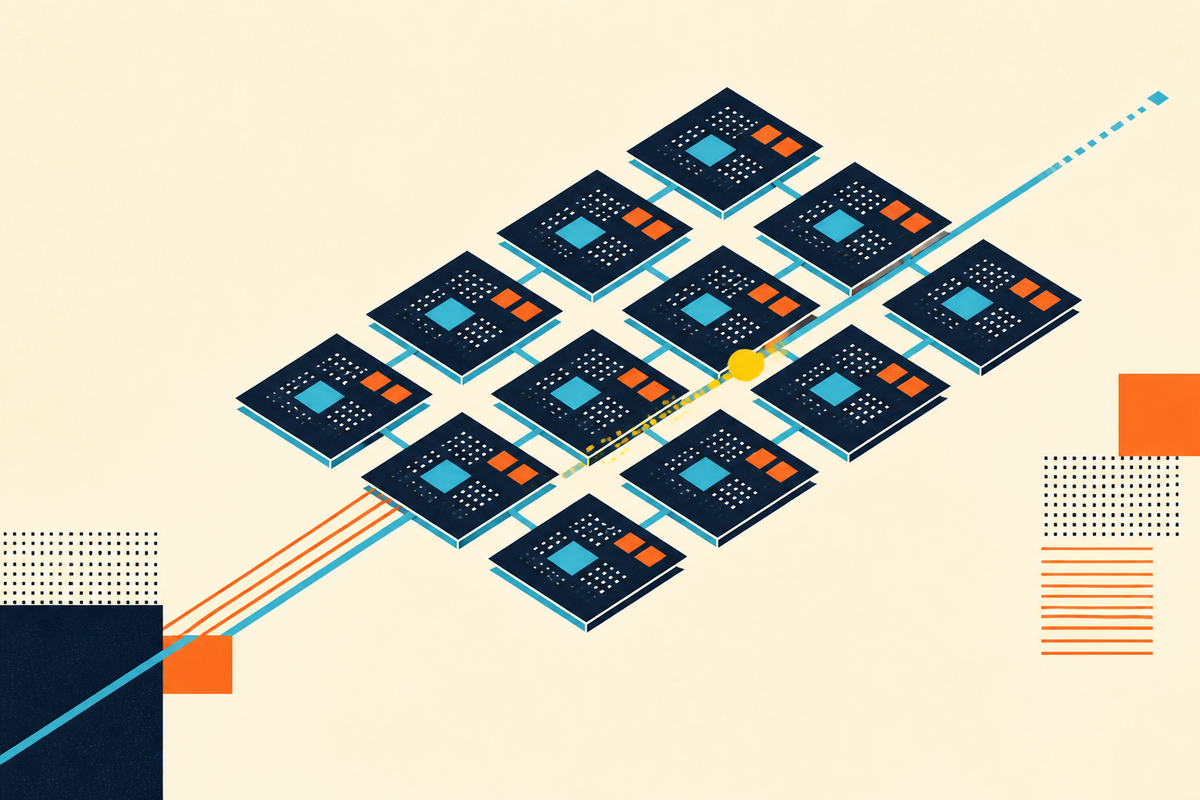
Tenstorrent's basic unit is the Tensix core. Each core combines small RISC-V processors for control with dedicated matrix and vector engines, local SRAM, and machinery for packing and unpacking data. Cores exchange work over a network on the chip. The emphasis is less on presenting one enormous pool of brute force than on putting computation and memory close together, then programming the traffic between them.
This matters because modern AI workloads spend an awkward amount of time moving model weights and activations. Arithmetic is only useful when the numbers arrive. Tenstorrent's chief AI architect, Jasmina Vasiljevic, condensed the thesis at the company's 2026 deployment event: “AI is all about data movement.” It is a very engineer's sales pitch - and a revealing one.
At product level, the catalogue now spans Wormhole and Blackhole accelerator cards, the aptly named LoudBox, two generations of liquid-cooled QuietBox workstations, and Galaxy servers. A Galaxy Blackhole puts 32 accelerator chips into one air-cooled system. Tenstorrent says those systems can then be cabled together over standard Ethernet, with its own fabric software routing traffic across the cluster.
The naming has comic-book confidence, but the pricing is deliberately concrete. A Wormhole n150 card has listed around $999. Galaxy Blackhole starts at $110,000, while a base four-Galaxy supercluster starts at $440,000. The customer can buy a desk-side experiment or a data-center installation without changing architectural families.
“We are not trying to be a narrow provider. We're not trying to be a point solution. We want to solve a lot of different problems.”Jim Keller, CEO, at TT-Deploy 202602 / The stack
Open software is the invitation
Hardware challengers do not merely compete with Nvidia's silicon. They compete with years of developer muscle memory. CUDA has libraries, tools, documentation and a huge population that knows where the sharp edges are. A faster benchmark cannot reproduce that accumulated convenience.
Tenstorrent's answer is visibility. TT-Metalium gives programmers low-level control of kernels and data movement. TT-NN offers a higher-level neural-network operator library. TT-Forge handles model compilation, while TT-Lang provides a Python-based route for writing custom kernels. Model serving connects to familiar projects such as vLLM, and a simulator lets developers explore the architecture without owning a card.
The repositories are not decorative samples. The main tt-metal project contains the operator library, kernel model, benchmarks, issues and model work. Public documentation walks through the memory hierarchy and the unusual division between reader, compute and writer kernels. This openness lowers the cost of inspection. It does not eliminate the cost of porting or optimization, but it lets a skeptical engineer see what must be done.
For teams that need local inference, private deployment, custom silicon or a path beyond one proprietary accelerator stack, Tenstorrent offers a machine they can buy and a design they can alter. The benefit is control; the tradeoff is joining a smaller and less mature ecosystem.
Sell the computer - or sell the blueprint
Tenstorrent is unusual because it can meet a customer at several layers. Developers and labs can buy cards. Enterprises and cloud providers can buy systems. Electronics companies and automakers can license AI cores, Ascalon RISC-V CPUs or related chiplet technology for their own products. Custom engineering connects those pieces.
LG Electronics has worked with Tenstorrent on AI and RISC-V chiplets for future televisions and other devices. Hyundai Motor Group is both an investor and a strategic collaborator. Samsung has appeared on three sides of the table: its investment organizations backed the company, while Samsung Foundry was selected to manufacture a next-generation Tenstorrent chiplet. In Japan, LSTC selected Tenstorrent IP for a 2-nanometer edge AI program involving Rapidus.
The disclosed deployment list has widened. Cirrascale offers Blackhole infrastructure. Koyeb has offered Wormhole cloud instances. Prodia demonstrated image and video generation. Japan's ai& is building what Tenstorrent described in June 2026 as its largest deployment, mixing Galaxy superclusters with other compute. Infinia Technologies is working with the company on sovereign AI systems for government, finance and critical infrastructure in the Gulf.
This is a broad market position: part AI accelerator vendor, part systems company, part RISC-V licensor and part custom-silicon shop. Breadth gives Tenstorrent more ways to win a design. It also gives the company more fronts on which to execute. Cards need drivers and inventory. Servers need validation and support. IP customers expect roadmaps that last longer than a fashionable model.
04 / The differenceAn alternative with the lid left open
Tenstorrent's competitive distinction comes from a combination, not one miraculous component: open-source software, licensable RISC-V and AI IP, high local-memory bandwidth, and native scale-out over familiar networking. The architecture aims to cover inference and training, small development setups and large deployments, without requiring a customer to commit to a single sealed appliance.
That makes Nvidia the obvious comparison, but not the only one. AMD and Intel sell alternative accelerators. Google and Amazon design chips for their clouds. Cerebras and Groq pursue specialized AI systems with their own architectural arguments. Arm, SiFive and others compete for processor IP. Tenstorrent sits where those categories overlap.
Its most durable advantage may be the team assembled around computer architect Jim Keller, whose résumé includes important work at AMD, Apple, Tesla and Intel. Founder Ljubisa Bajic built the original company in 2016; Keller was its first investor, joined as CTO in 2021 and later became CEO. The company has since expanded across Toronto, Austin, Silicon Valley, Belgrade, Seoul, Tokyo and Bangalore, gathering expertise in compilers, physical design, systems and RISC-V.
The hard part is not proving that another chip can run AI. It is proving that another ecosystem is worth learning.05 / The stakes
Capital buys time, not habit
Semiconductors consume patience and cash. Tenstorrent raised more than $200 million in 2021 at a $1 billion valuation, added a $100 million strategic round led by Hyundai Motor Group and Samsung Catalyst Fund in 2023, then closed more than $693 million in late 2024. That Series D valued the company at $2 billion before the new money.
The funding pays for tape-outs, software work, boards, cooling, manufacturing relationships and the systems engineers who make 32 chips behave like one computer. Tenstorrent also brought a critical piece inward in 2025 by acquiring Blue Cheetah Analog Design, a specialist in analog and die-to-die interconnect IP. Later that year it launched Open Chiplet Atlas, an attempt to define an interoperable chiplet architecture with more than 50 participating organizations.
The market fit is clearest where control has economic value: private AI, sovereign infrastructure, automotive systems, robotics, edge devices and cloud operators looking for differentiated capacity. These buyers care about energy, supply, customization and who owns the roadmap. A developer merely seeking the easiest way to run a common model may still choose the established GPU stack. A manufacturer designing a product for the next decade asks a different question.
Tenstorrent's bet is that enough customers will ask that second question. Its chips have moved from roadmap slides to purchasable cards and production systems. Its software is visible, warts and commit history included. Its partners span foundries, automakers, electronics groups and infrastructure providers. None of that guarantees a new default. It does establish a credible alternative - one built for the possibility that the next useful AI model will not resemble the last.