A server is a wonderfully unromantic way to test a grand idea. Slide it into a rack, load the software, give it work. In August 2026, SiFive introduced BigSky, a development machine built around 32 of its RISC-V processor cores. The company says lead customers are already running workloads on it. After years of arguments about whether an open processor architecture belongs in the data center, customers have something more useful to do: try their code.
SiFive’s main business is selling the designs that go inside other companies’ chips. BigSky gives those potential buyers a place to experiment before committing to silicon. It also gives a tangible shape to an expensive ambition. In April, SiFive raised $400 million at a $3.65 billion valuation to accelerate its data-center roadmap. NVIDIA joined the financing. The GPU company has a reason to care about what sits beside its accelerators.

The instructions are open. The designs earn money.
To understand SiFive, separate two things that often get bundled together. An instruction set architecture, or ISA, defines the operations a processor understands. A processor implementation is the actual engineering that executes those instructions. RISC-V supplies the open standard. SiFive sells proprietary implementations, with upfront licensing fees and royalties tied to the selling price of customers’ chips.
A customer can license a core and integrate it into a system-on-chip alongside memory interfaces, security features and its own specialized circuitry. SiFive supplies supporting system IP, too. The commercial proposition is straightforward: buying experienced processor engineering lets a chip team concentrate its effort on the part of the product it wants to make distinctive. The customer still has a chip to design, validate and manufacture.
That places SiFive in the processor-IP market alongside alternatives such as Arm. Within RISC-V, Andes Technology offers competing cores. A company with enough expertise can also develop its own implementation. Openness creates choices for buyers, including choices that do not pay SiFive. Its founders’ connection to the architecture earns attention; a useful design and dependable support must earn the contract.
A Berkeley project learns to sell
The intellectual roots reach back to UC Berkeley in 2010. Krste Asanović, Andrew Waterman and Yunsup Lee worked on RISC-V with support from computer-architecture researcher David Patterson. The three later founded SiFive in 2015. RISC-V is pronounced “risk five,” a nod to the fifth major Berkeley RISC iteration. A name that sounds like a wager has turned out to travel well.
“We wanted to make RISC-V the standard instruction set architecture for all computing.”Andrew Waterman, co-founder and chief engineer
SiFive’s first commercial steps included the 2016 HiFive1 development board. Putting hardware on desks helped turn an architectural specification into something programmers could use. That habit continues through the HiFive Premier P550 and now BigSky. The scale changes; the need for software developers to get their hands on a working machine remains.

The organization retains a conspicuously technical identity. Its company page says 85 percent of employees are engineers and cites 180 PhDs. Recruitment materials describe small teams, access to leadership and autonomy in how work gets done. Those are the company’s own descriptions, but they fit the product: customers are buying decisions about processor pipelines, memory behavior and software compatibility, packaged as reusable intellectual property.
Focus came with a $210 million sale
The route here involved subtraction. In 2022, Alphawave acquired SiFive’s OpenFive business, which supplied connectivity IP and custom-silicon capabilities. The announced price was $210 million in cash, subject to customary adjustments. The sale narrowed SiFive’s business around processor IP. A company associated with making custom chips more accessible was choosing which part of that work it wanted to own.
Then came a restructuring in October 2023. SiFive publicly acknowledged the reorganization and the difficult personnel decisions it involved. Management’s explanation was that resources needed to follow the most promising opportunities. That episode belongs beside the funding announcements: architectural adoption does not spare a business from revising its organization.
The later shift toward data centers has an explicit customer rationale. In its April 2026 financing announcement, SiFive said hyperscalers were asking for customizable CPU solutions delivered as IP. The new capital is intended for processor and system research, software development and customer deployment work. Read together, these decisions suggest a more concentrated business: sell reusable compute designs, then invest in the tools that help demanding customers adopt them.
Round sizes, not revenue or total spending. The OpenFive sale was a separate transaction.
Four families, different jobs
SiFive’s portfolio makes more sense as a collection of assignments than as a ladder of bigger numbers. Essential covers embedded work, including small controllers and real-time processing. In those applications, predictable response and modest area can matter more than the ability to run a complicated operating system. A processor embedded in another subsystem may never get a consumer-facing product name.
Performance addresses application processing. The data-center-oriented P870-D sits within this family; SiFive also introduced P550 Gen 3 and P570 Gen 3 in May 2026 for consumer, edge and commercial IoT uses. P570 supports the RVA23 instruction profile and vector processing. P550 Gen 3 serves tighter area budgets without vectors. The choice depends on the work, the software and the space available on the chip.
Intelligence concentrates on vector and matrix computation for AI, as well as controlling customers’ own accelerators. Vector engines apply operations across multiple data items; matrix engines target the arithmetic central to many neural networks. The XM series combines scalar, vector and matrix processing. SiFive expanded the family in September 2025 with second-generation designs spanning small edge devices through larger compute systems.
Automotive adds another set of obligations. Its processor offerings include real-time and application-oriented designs supported by functional-safety packages. The ecosystem matters here as much as the core. In May 2026, SiFive announced a HighTec collaboration combining its safety-focused IP with LLVM-based Rust and C/C++ toolchains. Developers need an environment in which they can build and assess safety-oriented software, not simply a processor diagram.
Customers build the chips you actually meet
The buyer is usually a semiconductor company or a system designer with a custom-silicon program. The resulting chip can land in storage, a consumer device, industrial equipment or AI infrastructure. In September 2024, SiFive said it was supplying five of the “Magnificent Seven” technology companies. That broad claim establishes claimed reach without identifying every customer or revealing what each one bought.
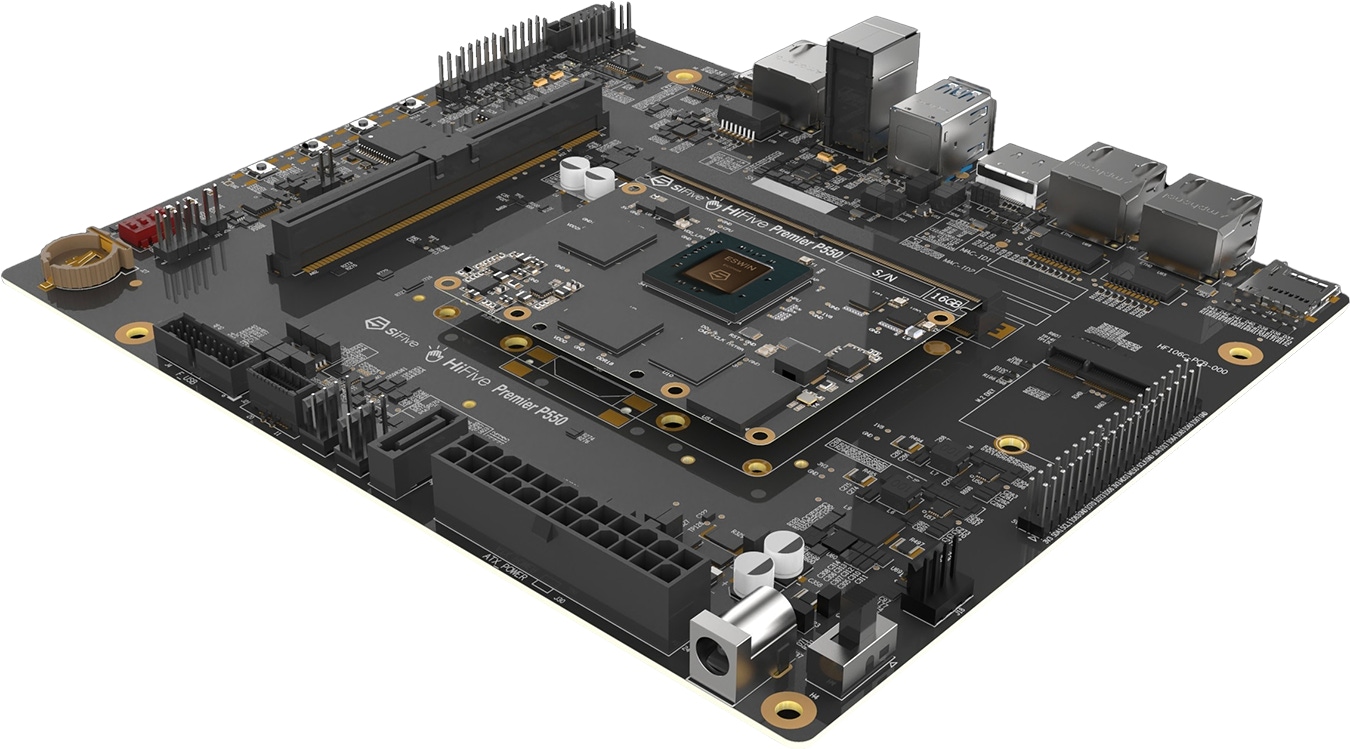
More concrete examples are easier to understand. The HiFive Premier P550 board uses ESWIN’s EIC7700 system-on-chip with four SiFive P550 cores. A developer can use the board to work on Linux software and explore a RISC-V environment. The board also illustrates the supply chain: SiFive processor IP inside another company’s chip, inside a development product.
NASA’s High-Performance Spaceflight Computing project offers a very different destination. SiFive announced in 2022 that its cores, including the X280, had been selected for the processor. Microchip is developing the HPSC technology with NASA. The program concerns computing capability, energy management and fault tolerance for future missions. Selection for that processor is a specific engineering role; it should not be mistaken for a claim that every SiFive core is space-qualified.
The CPU beside the GPU
SiFive’s NVIDIA relationship explains its current positioning particularly well. In January 2026, it announced plans to integrate NVLink Fusion into data-center-class solutions, connecting customizable RISC-V CPUs with NVIDIA accelerators. The aim is closer coordination and more efficient data movement. A CPU can have a valuable role managing a system whose headline arithmetic happens elsewhere.
BigSky supplies an intermediate step. Its listed configuration includes 32 P870-D cores at 2.0 GHz, 256GB of DDR5 memory and PCIe Gen5 connectivity in a rackable 2U chassis. It is designed for porting, tuning and validation. These specifications describe a development platform that customers can investigate, rather than a promise about how every eventual SiFive-based server will perform.
At the August launch, SiFive said CUDA was running on BigSky, with the platform acting as a head node for large-language-model workloads on NVIDIA GPUs. It also described support for Ubuntu 26.04 LTS and RHEL 10. NVLink Fusion remained part of future platform integration. Keeping those milestones separate matters: demonstrated software, limited development-system availability and future interconnect plans are different stages of delivery.
Run the workload before buying the argument
For a prospective user, the practical lesson is to start with the workload. Put representative code on suitable hardware or models. Check the compiler, libraries, memory demands and debugging workflow. Compare complete systems under the constraints that matter to the product. An open instruction set gives engineers freedom to choose implementations; it does not, by itself, establish a performance-per-watt advantage.
This approach is less attractive when essential software depends on another architecture, a team cannot fund the port, or the product needs an off-the-shelf chip on a short schedule. Customization also creates verification work. Those conditions should influence the buying decision before a core specification becomes a commitment.
SiFive’s business offers a useful lesson beyond semiconductors: build something reusable, then make it easier for customers to prove its value. Its early boards and latest server put that principle into hardware. BigSky’s next important results will come from the people loading their own software onto it. They have budgets, deadlines and tests to run.