In August 2019, Bo Wang finished a run at Intel that had lasted almost twenty-four years. The next month, he was at a new company in Beijing with a title that implied both urgency and breadth: chief operating officer. ESWIN Computing was being assembled around a proposition that would have sounded improbable during much of his earlier career. A young chip company could build serious products on an instruction set that no single company owned.
The jump is neat enough to fit on a timeline, but its meaning sits in the contrast. Intel represented a vertically coordinated computing world: architecture, products, tools, manufacturing discipline and an immense base of software. RISC-V offers something different. Its open standard lowers the permission barrier, allowing companies to design processors around their own requirements. What it does not provide automatically is everything around the processor. That must be built, persuaded, tested and maintained.
Wang had spent his Intel years moving through research and development, product management, marketing and sales, eventually becoming a product director. By the time he joined ESWIN, his value was not confined to knowing how chips work. He had seen the full distance between a design decision and a customer decision. The new job would ask him to travel that distance again, this time without the inherited gravity of an established platform.
01 / A platform is more than permissionThe ecosystem is part of the product
RISC-V is often introduced by what it removes: license constraints around an instruction set. Wang talks more often about what still needs to be added. At a 2024 industry event, he put the difficulty in five words: “The difficulty of RISC-V lies in ecological promotion.” The phrasing sounds almost bureaucratic. The underlying problem is vivid. A processor architecture lives or dies through compilers, operating systems, development tools, reference boards, application support, customers and the confidence of other companies.
“The difficulty of RISC-V lies in ecological promotion.”Bo Wang, 2024
That helps explain ESWIN’s layered approach. The company describes itself as a fabless provider of RISC-V-oriented chip products. Its work spans chips, chipsets and boards, accompanied by software for smart-device and embodied-intelligence applications. One branch serves human-machine interaction and multimedia tasks across homes, offices and portable devices. Another targets vehicles, robots and industrial equipment that must sense, process and act in the physical world.
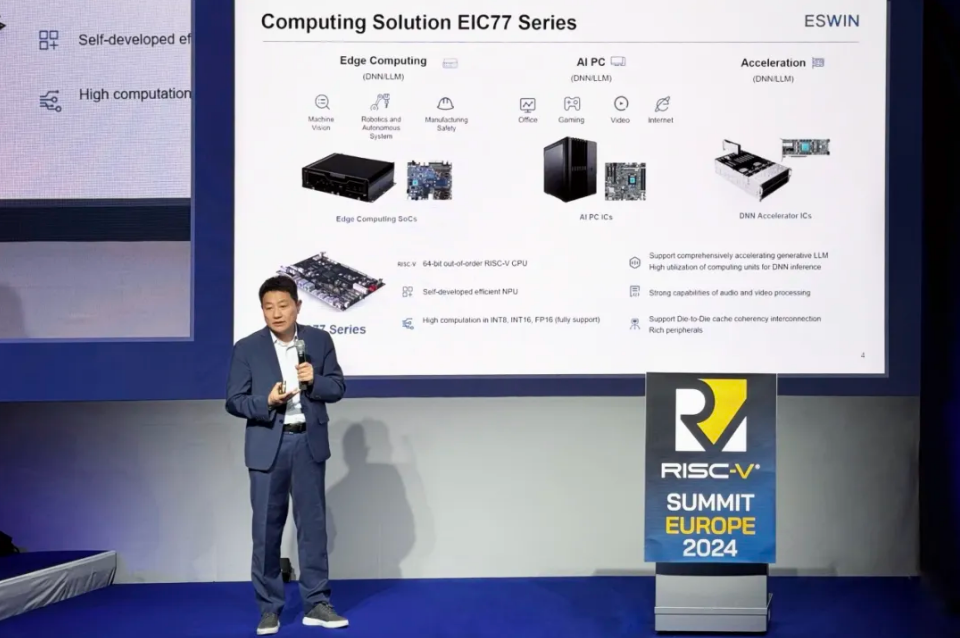
In this model, openness is the beginning of the design conversation, not the end of it. Different workloads can ask for different combinations of general-purpose processing and specialized acceleration. The EIC77 family that Wang presented in Munich makes the idea concrete: 64-bit RISC-V CPU capability, graphics technology and ESWIN’s own neural processing unit arranged for edge computing, AI PC and acceleration workloads.
The architecture is heterogeneous because the world is. A machine-vision system, an office computer and a robot do not make identical demands. General processing provides flexibility. Dedicated blocks provide efficiency for recurring work. Software connects the pieces. The customer buys the behavior of the whole system, not the ideological purity of any one component.
02 / Learning to widen the frameFrom engineering degree to operating system
Wang’s education began with automation engineering, completed through correspondence study at Northeast Electric Power University in 1988. He later earned a master’s degree in electronic engineering from California State University, Chico, in 1995. That same year he joined Intel. The sequence matters because his career did not begin as a story about open architecture or corporate strategy. It began with the technical disciplines that make electronic systems controllable and useful.
His time at Intel widened the frame. R&D asks whether something can work. Product management asks which version should exist. Marketing asks which problem it means to a buyer. Sales asks whether the buyer will act now. A leader fluent across those functions can translate among groups that otherwise use the same nouns to mean different things.
That translation is particularly valuable in semiconductors, where decisions are expensive, lead times are long and an elegant component can fail for reasons far outside the transistor budget. Software may lag. A board may arrive late. A partner may hesitate. The end product may move to a different requirement before the chip is ready. Technical execution remains central, but coordination compounds it.
Wang starts a nearly 24-year run that eventually leads to product director.
He joins in September as COO, one month after leaving Intel.
President and director, then CEO, then vice chairman of the board.
International RISC-V presentations, strategy work and overseas market expansion.
At ESWIN, the titles changed quickly enough to show an organization still defining its shape. Wang became president and a director in May 2022, CEO in May 2023, and vice chairman that December. In April 2025, he was redesignated as an executive director and vice chairman of the board’s Strategy and Investment Committee. Mi Peng now holds the chairman and CEO roles, while Wang’s remit centers on international expansion and support for strategy planning.
Read narrowly, this is corporate housekeeping. Read operationally, it shows a company moving experienced people to the problems that require them. Formation needs an operator. Scaling needs a president. A period of executive leadership needs a CEO. International partnerships and long-range choices need a vice chairman who can speak both product and market.
03 / The second actTrading installed base for possibility
Leaving a company after almost a quarter-century can look like a rejection of the institution left behind. Wang’s move makes more sense as an application of what it taught him. Mature platforms demonstrate the value of compatibility, tools and repeated delivery. An open architecture does not make those lessons obsolete. It makes them available to a larger set of builders, while forcing each builder to decide where it will contribute.
ESWIN’s answer is broad but specific: focus on smart devices and embodied intelligence; design RISC-V chips and related products; add domain-specific intellectual property; support them with software; and cultivate alliances where external expertise is stronger. In the EIC77 products, ESWIN combined processors from SiFive, graphics technology from Imagination and its own NPU. The combination is a declaration of operating philosophy. Own the piece where you intend to differentiate. Partner for the pieces where the ecosystem can move faster together.
“Computing power is the core driving force of AI.”Bo Wang, 2024
Wang’s public language around AI is similarly grounded in systems. Computing power is the driver, but raw throughput is only useful when matched to an application, power envelope and software stack. Edge machines add their own constraints. They may need to interpret video, respond with little latency, operate within a fixed thermal budget and keep functioning without sending every decision to a distant data center.
This is why the words “open” and “specific” can coexist. RISC-V provides a shared base. Domain-specific modules and algorithms shape that base for actual work. The open standard encourages more participants; the specialized layers give a product a reason to be chosen. Wang’s job sits at the junction, where architecture becomes a road map and a road map becomes a set of commitments.
04 / The long gameWinning by making other builders comfortable
In Munich, Wang did two talks in one afternoon. The longer session walked through the EIC7700X and EIC7702X. The other was a lightning talk, compressed to two minutes, on ESWIN’s RISC-V innovation. The pairing captures his role. One conversation is detailed enough for engineers evaluating a board. The other is concise enough for an ecosystem deciding whether a company belongs in its future.
An ecosystem executive has to make multiple audiences comfortable at once. Developers need documentation and working tools. Customers need stable supply and support. Technology partners need a credible route to volume. Investors need a strategy that extends beyond one chip cycle. Employees need to understand what the company will insist on doing itself and what it will gladly build with others.
Wang’s career offers no shortcut through that work. Its lesson is almost the opposite. An open standard can reduce the cost of permission, but it increases the importance of orchestration. Somebody still has to assemble the stack, make tradeoffs visible, earn partner trust and return with a better product generation. Thirty years in semiconductors can prepare a person for that task without making it easy.
His second act is therefore less about predicting that RISC-V will rise than about helping it become ordinary. The destination is a world where customers choose a system because it solves the problem, with the open architecture operating underneath as an advantage rather than a slogan. That kind of success can look quiet. A board boots. The software works. A partner ships. A customer returns. The ecosystem has one more reason to believe.
Keep exploring
Wang’s public record is most detailed where engineering meets the market: company materials, conference talks and the products built around ESWIN’s RISC-V platform.