In 2017, Dave Ditzel went public with a plan that sounded like a typo: put 4,096 little RISC-V processors on one piece of silicon. Four thousand and ninety-six. A whole crowd of computers in a space smaller than a biscuit. The eventual chip contained 1,088 worker cores, still enough to make a conventional CPU look like a committee of four. Esperanto Technologies wanted them to do artificial intelligence work while sipping power. The ambition was architectural; the obstacle, as it turned out, was commercial.
The short version
- The product: ET-SoC-1, a 7nm chip with 1,088 ET-Minion compute cores and four ET-Maxion control cores.
- The customer: data centers, HPC teams and enterprises testing AI inference, including private language-model applications.
- The business: chips, PCIe cards, rack servers, appliances and development tools, sold through direct and partner channels.
- The ending: Esperanto ceased operations in 2025; Ainekko acquired its intellectual property and selected assets.
The good idea inside the crowd
Ditzel, who had previously founded Transmeta, started Esperanto in 2014. Its chosen language was RISC-V, the open instruction-set standard that lets designers make processors without committing to one vendor’s proprietary instruction set. The company’s idea was to give each small core enough vector and tensor machinery for machine-learning mathematics, then multiply. Four larger ET-Maxion cores could handle operating-system and control work while 1,088 ET-Minion cores took the parallel jobs.
This was not a scheme to make one web page load faster. The early target was recommendation inference: the behind-the-scenes prediction work that helps a service decide which product, video or article to show next. Such models use a great deal of memory movement and run at enormous volume. For a buyer doing millions of predictions, power per result matters as much as the drama of peak speed.
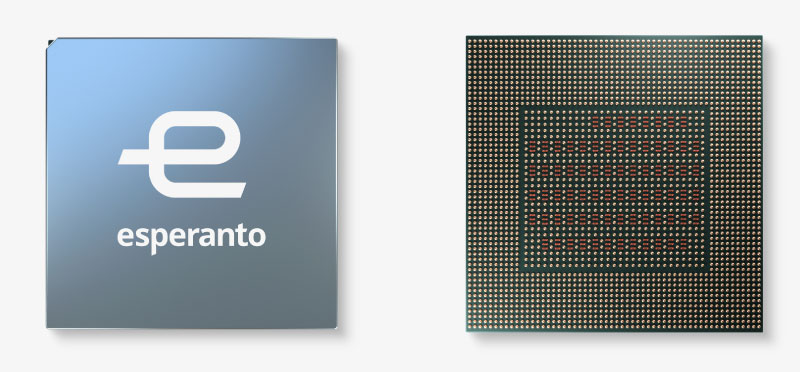
The ET-SoC-1 that Esperanto presented at Hot Chips in 2021 was manufactured on a 7nm process. A company technical paper described a target below 20 watts for recommendation workloads; a later company announcement described typical use below 30 watts. Those numbers concern the chip, not an entire server. The distinction is less romantic than a headline, but more useful if you pay the electricity bill.
A silicon purchase is a software decision
A new processor cannot simply arrive in a rack and expect a model to understand it. Someone must compile the model, schedule the work, manage memory, monitor the board and produce results that agree with the old system. Esperanto built machine-learning and general-purpose SDKs around the chip. Its product brief described a compiler path from PyTorch or ONNX models to RISC-V executable code. In 2025, engineers described a custom ONNX Runtime backend for small language models. The chip was the object; the software was the permission to use it.
Esperanto wrapped that work in increasingly complete products. A compact PCIe card added 32GB of LPDDR4x memory. A 2U server could hold eight or sixteen cards, putting roughly 16,000 RISC-V processors within reach of one system. The company also offered remote evaluation access. This was an attempt to make a strange architecture feel like an ordinary procurement decision: card, server, software, models, support. Pricing was handled by inquiry rather than a public list.
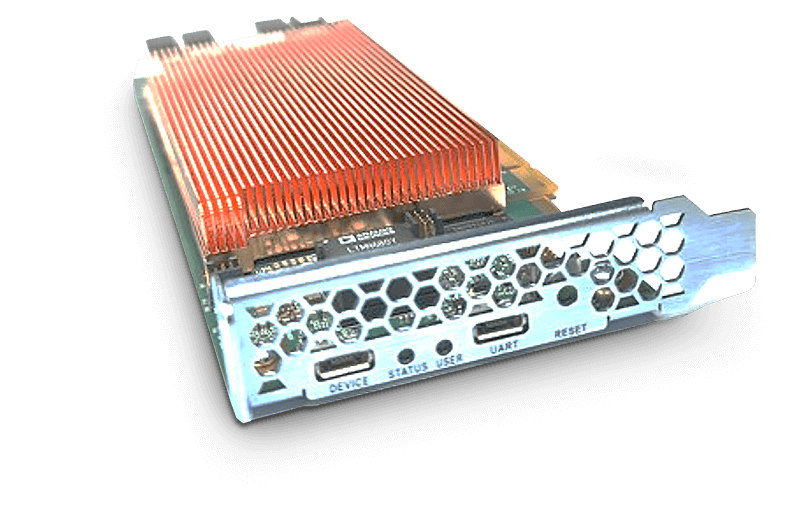
System partners did some of that translation work. Penguin Solutions jointly developed and certified the PCIe card. E4 Computer Engineering, MEGWARE and Elematec broadened the company’s reach in Europe and Japan. In 2024, Esperanto announced a memorandum with Rapidus on future efficient semiconductor designs and a cooperation with NEC on RISC-V chips and software for high-performance computing. These were relationships and roadmaps, not evidence of mass deployment. Public customer counts were never given.
The market moved; the pitch moved with it
By 2023 the AI conversation had shifted from recommendation engines to language models. Esperanto followed it. Its generative AI appliance put four ET-SoC-1 cards, software and preloaded models into a standard 2U machine. The suggested jobs were concrete: summarize documents, query internal knowledge, generate code and create images. A hospital or law office might value keeping those tasks inside its own building. A company with a private data requirement could also compare the appliance with a cloud GPU service on cost and control.
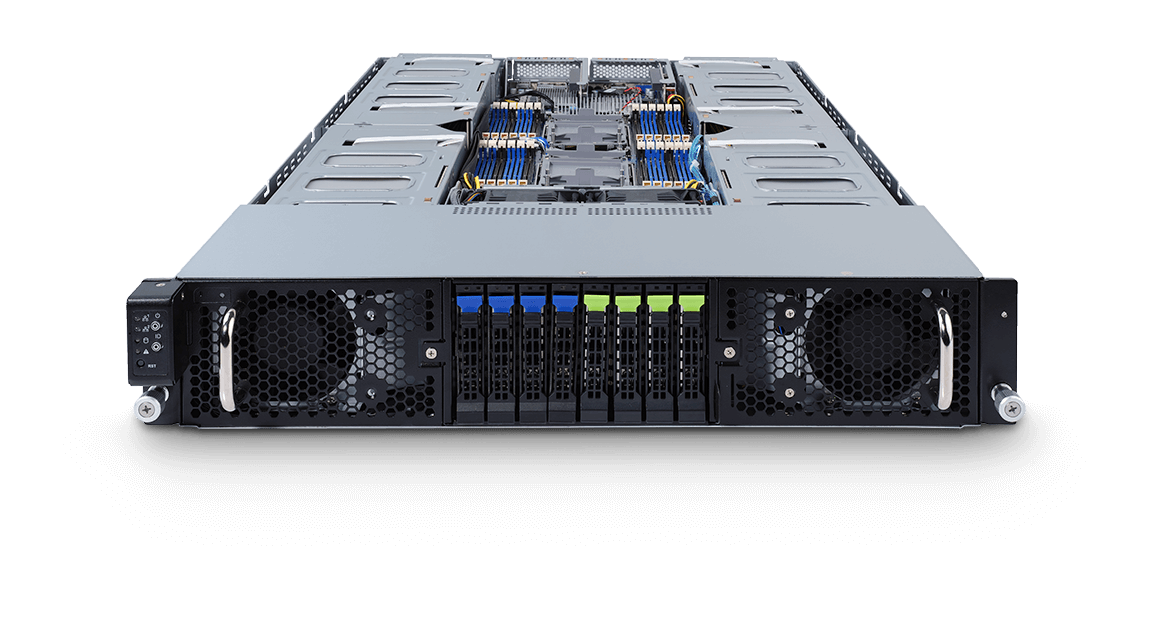
The appliance also revealed the burden of being different. Esperanto competed with CPU servers already installed everywhere, specialized AI chips from other startups, and the Nvidia GPU ecosystem with its familiar software and abundant developers. Energy efficiency was an attractive chart. An application team still had to ask whether its models would run, what it would cost to port them, and who would be there to help in three years. No independent, universal answer to those questions appears in the company’s public materials.
“Energy efficiency has always been a difficult sell because if there’s a power budget that’s unlimited, then energy efficiency doesn’t really matter.”Art Swift, Esperanto CEO, speaking to EE Times in July 2025
The first thing to go was the team
By July 2025 Esperanto was winding down. CEO Art Swift told EE Times that larger competitors had offered engineers packages two, three or four times what the startup could pay. Its European subsidiaries were closing; Mountain View headcount had been cut by 90 percent. Swift also said that, despite a strong lead customer and a building pipeline, data-center buyers had proved unexpectedly indifferent to the energy-saving argument. A technically capable chip can lose its company in two markets at once: the one for customers and the one for people who can build it.
The money deserves precision. Esperanto announced a $58 million Series B in 2018; company-data sources list about $63 million raised through that round, including an earlier $5 million. That is funding, not the price of the ET-SoC-1 or a measure of what it cost to design. Public prices, revenue and a reliable bill for the whole venture have not been disclosed. For a buyer, the price was also bigger than a card: porting, validating and maintaining a nonstandard AI stack had to fit the same calculation.
What survives a closure
In November 2025, Ainekko announced that it had acquired Esperanto’s intellectual property and selected assets, including chip designs and software tools. Its plan shifted attention from Esperanto’s large data-center deployments toward open, adaptable edge-AI systems. The old ET-SoC-1 architecture became raw material for another organization. There is a neat irony here: a company named for a common language left behind hardware that another company wants more people to speak.
The copyable part of Esperanto’s story is not “put a thousand cores on a chip.” Few teams have the money or engineers for that. It is the sequence of questions the company gradually answered: which workload genuinely values power efficiency; what software lets a customer test that claim; which familiar form factor removes an installation objection; and what a partner can distribute that a small vendor cannot. The failure condition is equally clear. If a buyer values ecosystem certainty and immediate raw throughput more than watts, an elegant efficiency curve is a supporting argument, not a purchase order.
Esperanto made something real: silicon, cards, servers and a software path. It also learned that the market does not award points for elegance alone. The company has stopped. Its thousand-core idea has not.