There is a spreadsheet somewhere in Mihai Raneti's history with a very long column of disappointment. Investor after investor passed. The count climbed to 1,213. Over eight years, he says, roughly 16,000 emails went out. Then number 1,214 picked up the idea. Tim Draper, the American venture capitalist, backed Raneti's new company with a reported $1 million. In founder mythology, this is where the orchestra swells. In semiconductor reality, it is where the waiting begins.
Raneti founded CyberSwarm in 2017, but the premise had been forming through earlier, less tidy attempts. He had discovered computers in a Romanian internet cafe around the beginning of the millennium. He learned programming there, later worked in IT management, built a consulting business and tried startups that failed. One of them, CyberFog, made proactive cybersecurity software designed to confuse an attacker about the system being targeted. It was an inventive answer that produced an inconvenient conclusion: software alone could not deliver the kind of protection he wanted.
So he moved the problem down a layer. Then another. The answer, he decided, belonged in hardware, in the physical behavior of components rather than another defensive program piled onto a conventional machine. This is the pivot that defines Raneti's work. Plenty of founders change markets. He changed material.
A neuron in a piece of material
At a business-club presentation in Ploiești in 2018, Raneti held up what one reporter described as a piece of plastic. He presented it as material that behaved like a neuron. The prop had the appealing modesty of early deep tech: an object small enough to look trivial, attached to a claim large enough to sound like science fiction.
The component at the center of CyberSwarm's approach is the memristor, shorthand for a resistor with memory. Its resistance changes according to the electrical activity that has passed through it, and it can retain that state. Arrange such components into networks and computation can happen where information is stored. Conventional machines constantly shuttle data between processor and memory. That traffic costs time and power. CyberSwarm's proposed alternative is analog, parallel and local.
Raneti often reaches for nature to explain the design. Nature is analog, he argues. It tolerates randomness, distributes work and manages astonishing complexity on slight amounts of energy. A brain does not resemble a data center with a cooling tower. CyberSwarm is not copying a brain cell by cell; its engineering takes biological efficiency as a constraint and a provocation.
“Failure doesn't scare me; it motivates me.”Mihai Raneti, reflecting on the ventures before CyberSwarm
The useful part of failure
Raneti speaks about his failed companies without the polished euphemisms founders tend to acquire. He says they failed. He also says the failures became experience. This is more than agreeable startup folklore because one of those disappointments changed the technical direction of everything that followed. CyberFog's limits led toward CyberSwarm's architecture. A software venture did not merely precede a hardware venture; it supplied the objection the hardware venture was built to answer.
His biography is similarly cross-wired. Public profiles list studies in electromechanical engineering and psychology during overlapping years. Before running a semiconductor company, he coordinated PCs, sold computers, managed networks and repaired equipment. None of those jobs looks like a straight road to neuromorphic silicon. Together, they describe someone who met computing first as a practical object, encountered security as a systems problem and learned to sell ideas long before the ideas came with wafers.
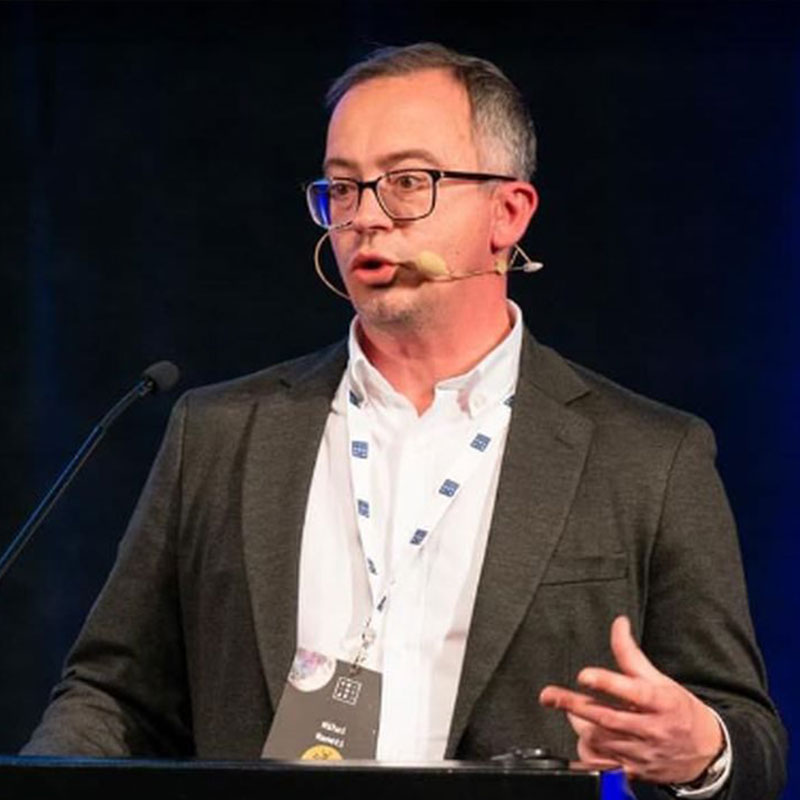
In 2019, he offered a candid inventory of what building the company in Romania felt like. Capital was scarce, innovation met habitual skepticism and assembling a team with both skill and vision was difficult. He had also become, in his words, more realistic and more detached. The apparent contradiction fits deep tech. The vision must remain immodest; the daily expectations must survive a prototype that refuses to behave.
He wanted a headquarters in the West and a technology laboratory. CyberSwarm eventually established its headquarters in San Mateo while keeping its research and engineering roots in Bucharest and Ploiești. The arrangement gave the company two coordinates: proximity to American capital and access to Romanian scientific talent. It also made Raneti a translator between different tempos. Investors work in rounds. Materials work when they work.
What patience bought
A hardware company grows out of the limits Raneti encountered in cybersecurity software.
A reported $1 million seed investment provides early support for the neuromorphic bet.
Raneti discusses automotive work, while industry reporting later describes prototypes in early trials.
Falanga Invest Perton leads a round intended to expand engineering and support commercial deployments.
By 2024, Raneti said the company had attracted more than $4 million and was working with a customer in the automotive industry. In 2025, reporting described memristor-based prototypes entering early customer trials. Along the way, CyberSwarm's story widened beyond security. If intelligence can run locally on slight power, the possible homes include vehicles, robots, industrial machines and other autonomous devices that cannot always wait for a distant server.
The timing helped the thesis become legible. When CyberSwarm started, energy-efficient AI hardware was a specialist concern. Then generative AI made computing appetite visible to everyone. Larger models required more accelerators, more electricity and larger data centers. Raneti's response had been incubating from the opposite direction: instead of making the central machine ever larger, make the edge device more capable.
In May 2026, CyberSwarm announced a $50 million Series A led by Falanga Invest Perton. Raneti described a company with more than 30 patents and engineering in Bucharest and Ploiești. Jan Imrisek of Falanga had traveled to Ploiești, inspected the hardware, watched how the team worked and chose to invest. It is a fitting detail. After years of selling a future architecture in words, the decisive meeting took place beside the thing itself.
“The work will say it louder than I can.”Raneti, announcing CyberSwarm's Series A
A different kind of ambition
The financing is a milestone, not a verdict. Analog computing has long offered elegance and efficiency while making commercial engineers earn every adjective. Semiconductor development is expensive. Manufacturing is unforgiving. Customer qualification takes time. A brain-inspired chip must still become a chip that can be made reliably, integrated into products and trusted outside a laboratory.
Raneti's aspiration nevertheless stays consistent across his interviews and essays. He wants machines to understand, learn and adapt locally. He wants AI to reduce dangerous work rather than merely automate for spectacle. He has argued that Romania should become a producer of critical technology, not simply a user of inventions made elsewhere. He thinks the future needs more mathematics and physics, a belief that sounds almost quaint until a software boom runs into the walls of energy and silicon.
There is personality in the architecture. Digital computing prefers certainty, crisp categories and repeated instructions. Raneti writes admiringly about randomness, resilience and natural patterns that are subtler than they first appear. His company is trying to make hardware that can absorb variation and learn from it. The founder's own route has done much the same: internet cafe, repair work, failed ventures, rejected emails, one consequential call, years of laboratory progress.
The stealable lesson is not to send 16,000 emails. Volume without a thesis is just an inbox problem. The useful lesson is to let rejection coexist with revision. Raneti persisted, but he also changed layers when the evidence demanded it. He kept the large ambition and replaced the mechanism beneath it.
He also learned to be selective about who joined the argument. In his 2019 reflections, Raneti said that building a team was difficult because vision could be harder to find than credentials. Investors, in his view, needed a compatible horizon too; otherwise every conversation collapsed into risk. That attitude can become founder stubbornness, but it explains CyberSwarm's pace. A neuromorphic processor cannot be managed as a seasonal feature. The chemist, device engineer, software developer, customer and financier must tolerate different kinds of uncertainty at once. Raneti's emphasis on authenticity and thought was his practical filter for a project whose result could not be demonstrated on a tidy quarterly schedule. The team had to believe in the destination while remaining argumentative about the route.
Now comes the less cinematic chapter. The Series A is meant to expand engineering, strengthen industrial partnerships and move toward initial commercial deployments. The work ahead involves architecture, manufacturing, customers and proof. For a founder who spent years trying to make matter remember, patience has become a kind of corporate memory. The spreadsheet of noes did not predict the chip. It trained the person who kept building it.