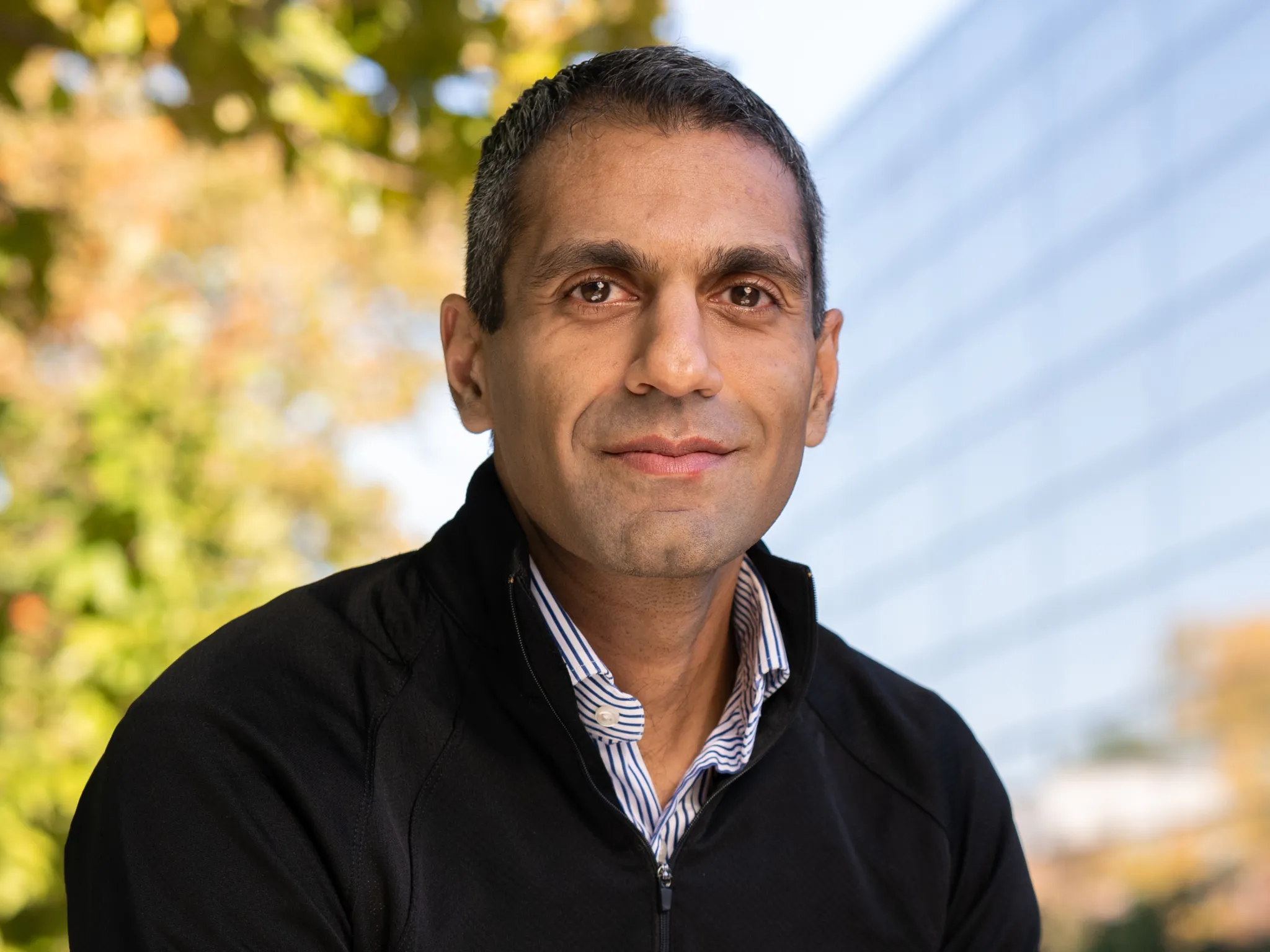
A quiet bet against the most crowded market in tech
Most AI companies are racing to build bigger models that eat more power. Naveen Verma went the other way. He decided the problem was the chip itself - and that the fix was buried in physics everyone had written off decades ago.
EnCharge AI, the company he co-founded in 2022 and runs as CEO, does something that sounds like a footnote and behaves like a revolution: it computes with electric charge held in tiny metal capacitors, instead of shuttling bits through transistors that leak, heat up, and waste energy. Capacitors are boring, predictable, and old. That is exactly why they work. "Instead of communicating individual bits, you communicate the result," Verma has said - and in that one sentence sits the whole idea.
The payoff is stark. EnCharge says its analog in-memory computing chips run AI inference at roughly twenty times less energy than a typical GPU. That is not a spec-sheet flourish. It is the difference between AI that only lives in a humming, water-cooled data center and AI that runs on the laptop already sitting on your desk.
The company has shipped its first commercial accelerator, the EN100, and raised more than $144 million to put it in the world. But the interesting part is not the money. It is how long Verma waited before taking any.
Six years of saying "not yet"
The core breakthrough landed in Verma's Princeton research group around 2017. A lesser story would spin it out the next morning. Verma spent roughly six more years de-risking the technology - much of it on DARPA and Department of Defense funding - before letting it leave the university as a company in 2022.
Analog computing had a reputation, and the reputation was "too noisy to trust." Push signals through analog circuits and errors pile up until the answer is mush. Verma's group attacked the noise problem at its root by moving computation into the charge domain, where metal capacitors behave with almost stubborn precision. Solving that noise is, by his own account, one of the biggest advantages of the approach - and the reason it works when older analog attempts did not.
That patience shows up in the patent record too. Verma is a named inventor on the foundational "Configurable In-Memory Computing Engine" - the design that powers EnCharge's technology and won him the 2024 Edison Patent Award in Computing Technology from the Research & Development Council of New Jersey.
UBC to MIT to Princeton - then, unexpectedly, to CEO
Verma's path reads like a straight line until the last turn. He earned his B.A.Sc. in electrical and computer engineering from the University of British Columbia in 2003, then his master's (2005) and Ph.D. (2009) in electrical engineering at MIT. In July 2009 he joined Princeton, where he is the Ralph H. and Freda I. Augustine Professor of Electrical and Computer Engineering and directs the Keller Center for Innovation in Engineering Education.
His research spans advanced sensing systems, large-area and flexible sensors, energy-efficient computing architectures, and the machine-learning algorithms that ride on top of them. The through-line, for two decades, has been making machines that do more with less power.
Then came the turn most professors never take. Verma became a startup CEO - and, notably, kept the professorship and the directorship at the same time. He runs a venture-backed chip company while still standing in front of Princeton students, at a center whose entire purpose is teaching engineers how to innovate. He simply did the assignment himself.
Fundraising without a network
Verma did not arrive in venture capital with a Silicon Valley rolodex. He was an academic learning a new game in real time. Not all money understands deep tech - hardware and fundamental research demand investors who can sit with complexity - and the early work was finding the ones who could.
They came. In February 2025, EnCharge closed an oversubscribed Series B of more than $100 million led by Tiger Global, pushing total funding past $144 million. The cap table is a tell: Tiger Global and Maverick alongside RTX Ventures, Samsung Ventures, In-Q-Tel (the CIA-linked fund), Anzu Partners, Scout Ventures, AlleyCorp and more. Defense, consumer electronics, and intelligence all wrote checks to the same charge-based idea.
He co-founded the company with two heavyweight operators: CTO Kailash Gopalakrishnan, a former IBM Fellow with two decades in AI and chip design, and COO Echere Iroaga, a 25-year semiconductor veteran. The professor supplied the physics. The team supplied the road to market.
Five things that tell you who he is
His company's secret weapon is the humble capacitor - the most unglamorous component in the box, chosen precisely because it does not misbehave.
The technology was seeded with DARPA and Department of Defense money years before it was ever a business plan.
He still holds a full Princeton professorship and directs its innovation center - while running a chip company as CEO.
His pitch is counter-cultural: in an industry obsessed with raw speed, he bets efficiency wins the decade.
He waited roughly six years after the breakthrough before commercializing. Discipline, not hype, is the brand.
Move AI off the cloud and into your hands
Verma's larger goal is almost civic. Today's AI concentrates in enormous data centers that consume staggering amounts of power. He wants to shift inference - the everyday running of AI models - onto local edge devices: laptops, desktops, phones, the machines already in the room. The upside is a stack of wins at once: lower energy, lower cost, better privacy because data stays on the device, and lower latency because the answer does not fly to a server and back.
It is a bet that the future of AI is not only bigger, but closer. And it started, as these things do for him, with a boring, precise, deeply understood piece of physics.