BREAKING   Tensordyne unveils Napier - a 3nm, air-cooled AI inference system Formerly Recogni · rebranded September 2025 Claims 13x throughput & 17x efficiency vs Nvidia GB300 NVL72 Napier chip: 138B transistors on TSMC 3nm Expects $200M+ in orders · Series D on deck Raised ~$176M from Celesta, GreatPoint, Juniper Named for John Napier, inventor of logarithms
Company Profile · AI Hardware · Sunnyvale + Munich

Tensordyne

The chip startup reviving 400-year-old logarithm math to make AI inference cheaper - and pointing it straight at Nvidia.

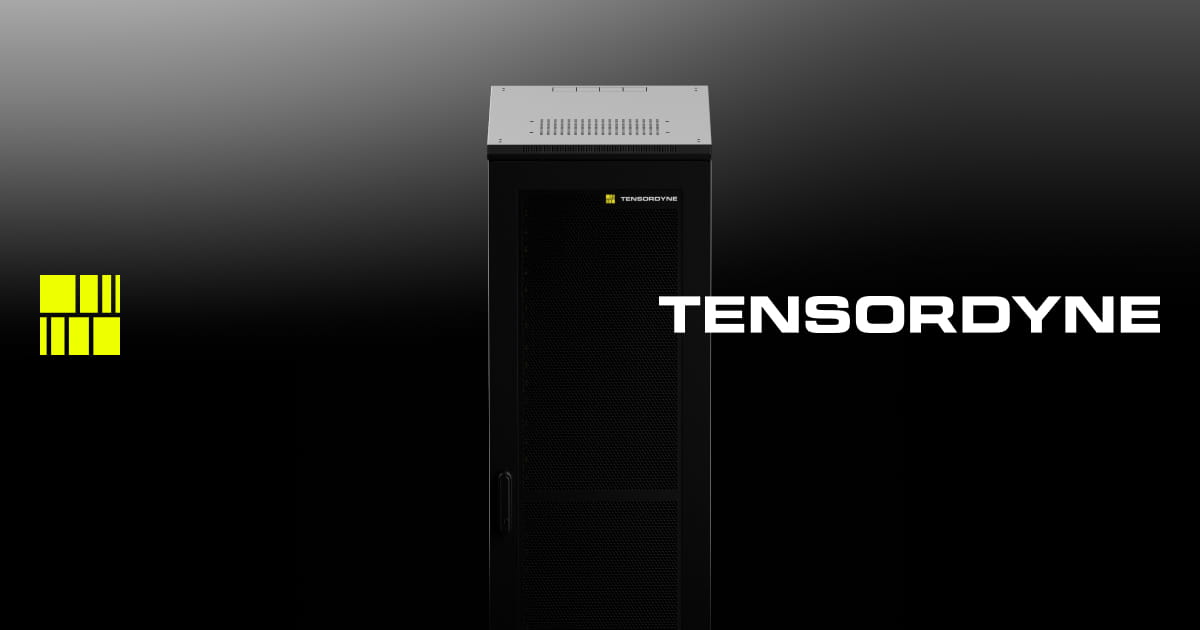
Tensordyne logo and Napier inference rack

The Napier rack stands almost shy in a dark room, the way a very expensive idea often does. The yellow mark to the left is the whole thesis: tensor, plus force. - Tensordyne

3nmTSMC Process
138BTransistors
608PFLOPS / Rack
~$176MRaised
$200M+Orders Expected
The Story

A wager on the oldest trick in mathematics

Here is a fact that sounds like a joke but is the entire business plan of a 150-person company in Sunnyvale: multiplying two numbers is expensive, and adding them is cheap. This has been true since roughly forever, and in 1614 a Scottish mathematician named John Napier published a table of logarithms precisely so that astronomers could stop multiplying and start adding. The insight is that log(A x B) equals log(A) plus log(B). You convert your numbers to logs once, do a pile of easy additions, and convert back.

Tensordyne's pitch is that modern AI has, somewhat embarrassingly, forgotten this. Large models are essentially enormous stacks of multiplications - matrix math, billions of times per token - and every one of those multiplications, done in ordinary floating-point, burns energy and silicon area. Tensordyne builds the logarithm trick directly into the chip. It calls the resulting number format a logarithmic number system, or LNS, and it likes to call the savings the "zeroth scaling law," on the theory that the gain sits underneath every other design decision you might make and compounds with all of them.

The numbers the company puts on this are the kind you have to squint at. For a given process technology, Tensordyne says a traditional 16-bit floating-point multiply costs about 1.1 picojoules and 1,640 square microns of silicon. Its logarithmic version, it claims, does the same work in 0.05 picojoules and 67 square microns - roughly a factor of 22 in energy and 25 in area. If that holds at scale, it is not a tweak. It is a different cost structure for the whole enterprise of running AI.

None of this would matter if the company were still called Recogni, which it was until September 2025. Recogni started in 2017 building custom silicon to help cars see - computer vision, the sensible and slightly boring corner of AI hardware. Somewhere along the way management noticed that the money, and the energy crisis, had migrated to generative AI. So the company did the thing startups do when their technology pulls them somewhere their name doesn't fit: it renamed itself.

"Names should make a promise," said chief executive Marc Bolitho. "Tensordyne captures the system we are building and the force behind it." A tensor is the fundamental data structure of AI. A dyne is a unit of force. Put them together and you get a name that is either a thesis or a slogan, depending on how the silicon performs.

"Multiplying is expensive. Adding is cheap. The whole company is a bet that this centuries-old fact is worth billions."

The product with a mathematician's name

On June 15, 2026, Tensordyne announced Napier - a full AI inference system named, of course, after the man who gave us logarithms. It is not vaporware in the usual sense: the company said it had completed tape-out of the Napier processor and had it in production at TSMC on the 3nm node. That is the point in a chip's life where the design stops being a slide and starts being a mask set, which is expensive to be wrong about.

The Napier accelerator is a large chip - about 138 billion transistors, roughly 2.1 petaflops per die, a 1.33GHz accelerator core paired with a 1.5GHz CPU, 256MB of on-chip SRAM, and 144GB of HBM3E memory. Seventy-two of these get lashed together into a pod: around 68 petaflops and 42 terabytes of high-bandwidth memory. Four pods form a single rack, which the company rates at 608 PFLOPS of dense compute. The interconnect that stitches a pod together is called TDN LINK, and it is pitched as low-latency enough to let the system scale close to linearly.

The design choice that will make data-center engineers raise an eyebrow is cooling. The industry is busy plumbing itself for liquid cooling because AI racks run hot. Tensordyne is going the other way - Napier is air-cooled, running at roughly 30 kW per pod. The bet is that if each operation costs 22 times less energy, you don't need to fight the same thermal war everyone else is fighting.

The 13x claim

Now for the number that will get Tensordyne either funded or fact-checked into oblivion: the company says Napier delivers about 13 times the throughput and 17 times the energy efficiency of Nvidia's GB300 NVL72 rack. It also frames itself favorably against the Nvidia-plus-Groq configuration, claiming multiples on space, speed and cost. These are vendor benchmarks, which is the polite way of saying you should treat them the way you treat a restaurant's description of its own food. The useful thing about the claim is that it is falsifiable and attached to real silicon at a real foundry, which is more than most challengers offer.

"For a challenger to Nvidia, the tape-out is the tell. Slides are free. A 3nm mask set is not."

The demand signals are, so far, encouraging for the company. Tensordyne said it expects more than $200 million in orders for Napier, and named AI infrastructure providers Cirrascale and BlueSky Compute as interested parties, alongside unnamed hyperscalers and cloud outfits. It has raised roughly $176 million to date - including a $102 million Series C in early 2024 - from Celesta Capital, GreatPoint Ventures and Juniper Networks, and is preparing a Series D. Juniper is doubly involved: HPE Juniper Networks is also a networking partner on the system, along with Broadcom on the silicon and TSMC on the fab.

What you can actually do with it

Stripped of the benchmark theater, Tensordyne is selling a fairly concrete thing: a way to run large AI models - the company points to Mixture-of-Experts systems like the DeepSeek-V4 family - at high throughput without the power bill that usually comes attached. It advertises capabilities like 4K video generation at 30 frames per second and 1,000-plus tokens per user for agentic applications. If you run an AI cloud, a neocloud, or a large enterprise inference workload, the promise is more tokens per dollar and per watt. Whether the numbers survive contact with customers is the whole game, and 2026 is when the game gets played.

Napier By The Numbers

Inside the TDN system

138B
Transistors
on the Napier die
144GB
HBM3E / Chip
high-bandwidth memory
72
Accelerators / Pod
~68 PFLOPS, 42TB HBM
608
PFLOPS / Rack
four pods, air cooled
3nm
Process Node
TSMC, tape-out complete
30kW
Per Pod
fully air cooled
256MB
On-chip SRAM
+ 1.33GHz core
~22x
Energy / Multiply
vs 16-bit float (claimed)
Tensordyne's Claims vs Nvidia GB300 NVL72
Throughput advantage13x
13x
Energy efficiency advantage17x
17x
Cost savings (vs Nvidia+Groq)10x
10x
Space efficiency (vs Nvidia+Groq)9x
9x

* All figures are Tensordyne's own published claims, June 2026. Independent benchmarks pending.

"Names should make a promise. Tensordyne captures the system we are building and the force behind it."

Marc Bolitho · Chief Executive Officer
The Road Here

From vision chips to inference systems

2017
Recogni is founded
The company launches building custom silicon for computer vision and autonomous systems.
2019
Logarithmic math patent filed
The foundational patent for a hardware logarithmic number system architecture is filed.
2022
Marc Bolitho named CEO
The former ZF Group SVP joins as chief executive, bringing decades of automotive electronics experience.
2024
$102M Series C
Backed by Celesta Capital, GreatPoint Ventures and Juniper Networks.
2025
Rebrand to Tensordyne
In September, Recogni becomes Tensordyne, signaling the pivot to generative-AI inference.
2026
Napier (TDN) announced
The 3nm inference system is unveiled; tape-out completed at TSMC; $200M+ in orders expected.
The Founders

Who is behind it

R.K. Anand
Co-Founder · Chief Product Officer
Gilles Backhus
Co-Founder · Head of AI
Emily Stuart
Co-Founder
Marc Bolitho
Chief Executive Officer (2022)
Products & Partners

The TDN stack

Flagship System

Napier (TDN)

The 3nm, air-cooled inference system built to run large models at high throughput and lower power. Named after the inventor of logarithms.

Silicon

TDN AIP

The Napier accelerator: ~138B transistors, 2.1 PFLOPS/die, 256MB SRAM and 144GB HBM3E, co-designed with Broadcom.

Interconnect

TDN LINK

An ultra-low-latency scale-up fabric that ties 72 nodes into a pod for near-linear scaling.

The Math

TDN Math (LNS)

The patented logarithmic number system that turns multiplication into addition in hardware - the "zeroth scaling law."

Partners

Broadcom · TSMC

Broadcom co-designed the silicon; TSMC fabricates Napier on its 3nm node.

Networking

HPE Juniper

Juniper Networks is both a networking partner on the system and an investor in the company.

Watch & Read

Demos, interviews & press

Good Questions

FAQ

What does Tensordyne do?

It designs AI inference systems - chips, compute trays, interconnect and software - that use a hardware logarithmic number system to run large AI models with high throughput and lower cost and power than conventional GPUs.

Is Tensordyne the same company as Recogni?

Yes. It was founded as Recogni in 2017 and rebranded to Tensordyne in September 2025 as it shifted from computer vision to generative-AI inference.

What is Tensordyne Napier?

Napier (TDN) is the flagship inference system announced in June 2026. It is built on TSMC's 3nm process, uses logarithmic math, is air-cooled, and is named after John Napier, the inventor of logarithms.

How does it claim to beat Nvidia?

By executing a logarithmic number system directly in hardware - turning multiplication into addition - Tensordyne claims roughly 13x the throughput and 17x the energy efficiency of Nvidia's GB300 NVL72 rack. These are company benchmarks and independent testing is pending.

How much has Tensordyne raised?

Approximately $176M to date, including a $102M Series C, from investors such as Celesta Capital, GreatPoint Ventures and Juniper Networks. A Series D is in preparation.

Spread The Word

Share this profile