Imagine buying an expensive processor and then asking it to wait. The arithmetic is ready. The data is somewhere else. In that small, costly pause sits a large part of Micron Technology’s business. AI systems need places to keep information and ways to move it quickly. The chip that performs the calculation attracts attention; the memory beside it helps determine how much work actually gets done.
- Micron makes working memory and persistent storage, from DRAM chips to data-center SSDs.
- Its AI opportunity lies in feeding processors with more data, faster, within a power budget.
- Capacity is scarce enough to force choices. Micron exited Crucial’s consumer business to prioritize strategic customers.
A basement with a very small ambition
Micron’s beginning was physically modest: a four-person semiconductor design business beneath a Boise dental office in 1978. Ward Parkinson, Joe Parkinson, Dennis Wilson and Doug Pitman founded it. The first contract involved a 64K memory-chip design for Mostek. By 1981, Micron was shipping its own 64K DRAM from a newly completed factory. Some of those chips went into early personal computers, including the Commodore 64.
There is a consequential change hidden in that short history. Designing a chip and manufacturing one are different businesses. Manufacturing means buildings, equipment, process control and money committed before the sale. Micron took on those obligations. Its expertise now spans the design of memory cells, fabrication, packaging and the work of getting products qualified inside customers’ systems.

The queue beside the processor
The product names can make this sound more mysterious than it is. DRAM holds information that a running system needs close at hand. NAND flash retains data when power disappears; SSDs turn that flash into usable storage devices. NOR flash serves embedded applications, including storing code. They occupy different positions in the journey between keeping information and doing something with it.
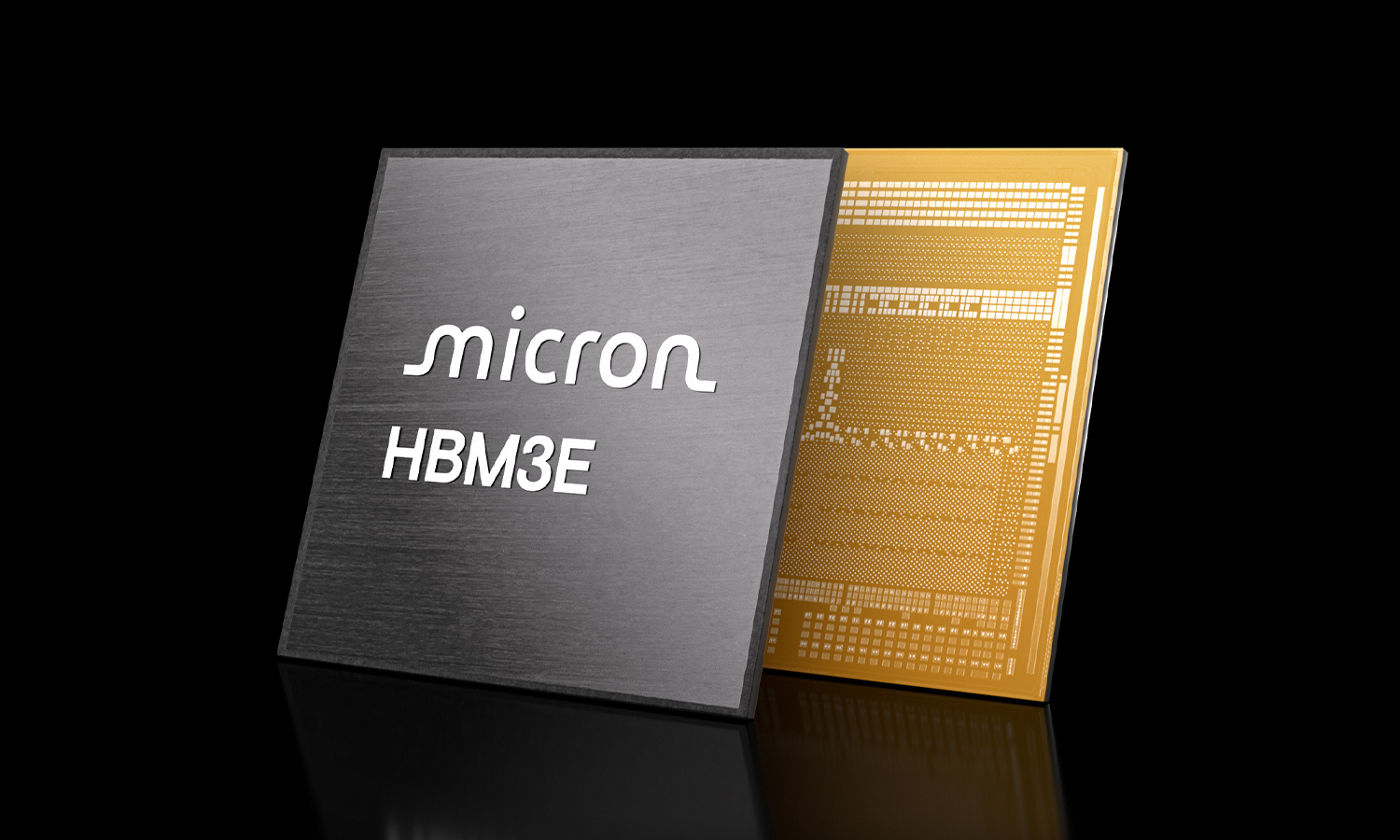
High-bandwidth memory, or HBM, tackles the traffic problem near an accelerator. Stacked memory and a wide interface help move large amounts of data. Micron announced HBM3E volume production in February 2024 for NVIDIA’s H200. In March 2026, it announced high-volume HBM4 designed for NVIDIA Vera Rubin, specifying more than 2.8 terabytes per second of bandwidth per stack. That figure describes the memory interface, not the speed of an entire AI application.
Storage has its own queue. Micron’s 9650 data-center SSD specifies sequential reads up to 28 gigabytes per second and uses PCIe Gen6. Engineers still need compatible systems and a workload that benefits from those speeds. For a cloud operator, the relevant question is whether better data movement improves useful work per dollar and watt. A headline bandwidth number is the beginning of that investigation.
Micron sells into servers, smartphones, PCs, vehicles and industrial equipment. Its customers buy components, modules and drives, often after lengthy qualification. Samsung and SK hynix are major DRAM and HBM alternatives; NAND and SSD competition also includes Kioxia, SanDisk and Solidigm. Micron’s proposition combines memory technology with manufacturing and customer engineering. Its planned HBM4E collaboration with TSMC on base logic dies also shows where outside expertise enters the package.
The year the inventory stopped adding up
Now rewind to fiscal 2023. Revenue fell to $15.54 billion from $30.76 billion a year earlier. Micron recorded $1.831 billion in inventory write-downs and a $5.833 billion GAAP net loss. The failure was economic: inventory could no longer justify its carrying value in a punishing pricing environment. A functioning chip can still be an expensive thing to have made.
Revenue nearly halved in one year. Manufacturing commitments do not shrink so neatly.
That episode matters when reading the current numbers. Micron reported $133.188 billion in fiscal 2026 revenue and $27.37 billion in net capital expenditures. These are results from a particular year, not a promise that memory has escaped its cycle. Selling prices, utilization and product mix can change the economics of the same manufacturing footprint. Building ahead of demand remains a difficult wager.
Goodbye, familiar blue box
The clearest evidence of changed priorities came in December 2025. Micron announced it would leave the Crucial consumer business, continuing consumer-channel shipments through February 2026. Its explanation was direct: support larger strategic customers in faster-growing segments. Consumer enthusiasts had known Crucial through RAM and SSD upgrades. The company was choosing where its finite supply would go next.
“improve supply and support for our larger, strategic customers in faster-growing segments”Sumit Sadana / explaining the Crucial consumer exit, December 2025
For other businesses, the useful lesson is to make the constraint visible. Measure where customers are waiting, then decide which commitments deserve scarce capacity. For computing teams, profile memory use and storage access before ordering more processors. The approach earns its keep when data movement limits the workload. If computation itself is the constraint, extra memory bandwidth may leave the real problem untouched.
Factories run on a different clock
Micron’s July 2026 announcement put expected U.S. fab and technology spending above $250 billion through 2035. That is a plan across years, not money already spent. The same announcement targeted first wafer output from its first new Idaho fab for mid-2027. Concrete, installed equipment, working wafers and qualified customer shipments belong to different stages of the process.
Customers and suppliers have to share that longer view. Ford signed a strategic customer agreement in July 2026 to support future vehicle memory supply. In October, Micron announced funding for Indium Corporation’s New York refining and manufacturing expansion, alongside a long-term supply agreement. Even a memory chip depends on materials well upstream of the cleanroom.
The wager needs sustained demand, successful process execution and customers willing to qualify the output. An AI slowdown, weaker pricing or delayed production can upset it. Micron’s history supplies both sides of the argument: useful memory opens possibilities; excess inventory sends the bill. The interesting place to watch is still that pause beside the processor. How much waiting can Micron remove, and at what cost?