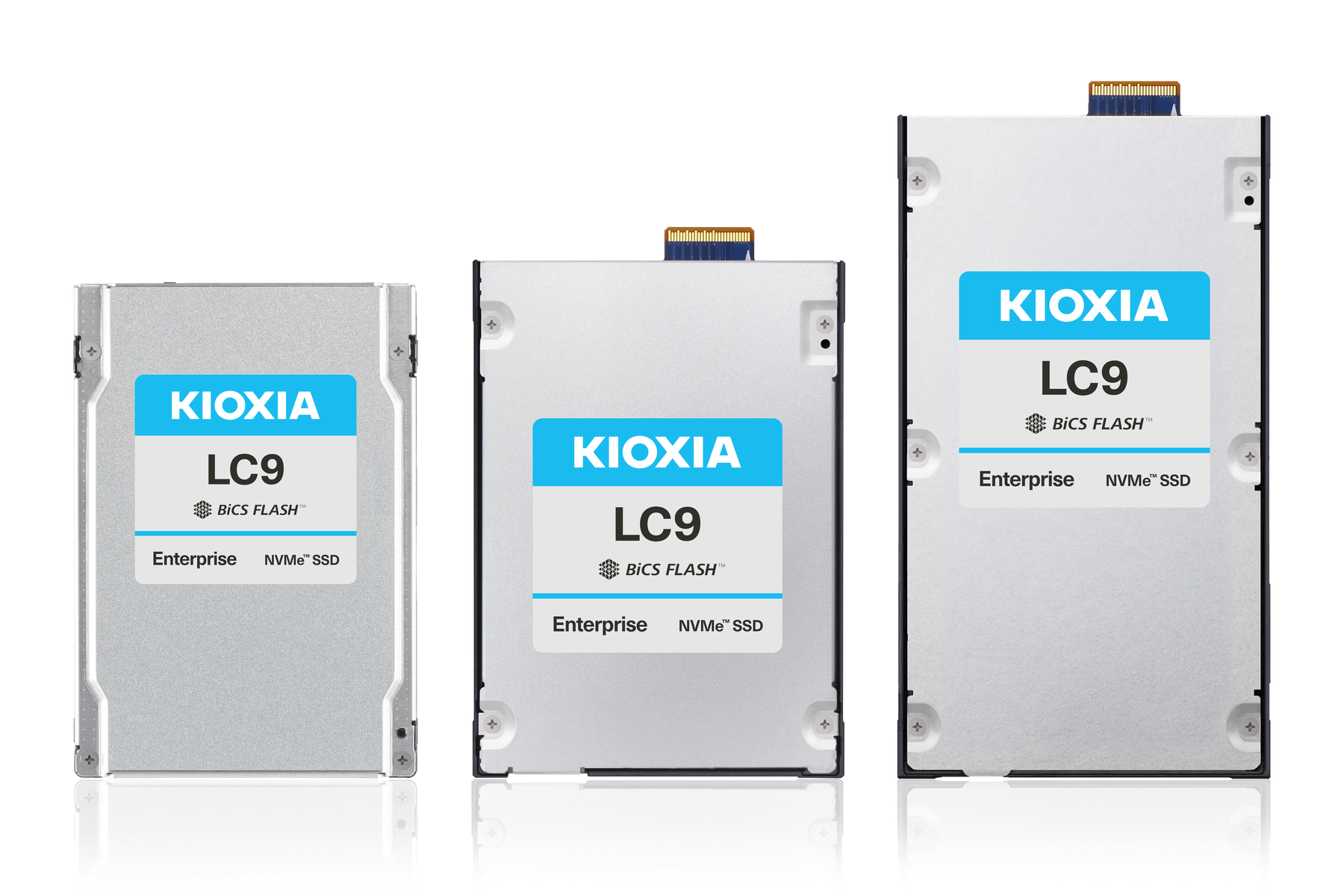
Forty is an ordinary number until you multiply it by 245.76 terabytes. In May 2026, KIOXIA America and Dell Technologies announced a configuration putting forty LC9 solid-state drives inside a Dell PowerEdge R7725xd, a server occupying two rack units. The result was roughly 9.8 petabytes of raw flash storage. That is before formatting or protection overhead, but the physical proposition is striking: a great deal of information in very little rack space.
For anyone buying AI infrastructure, this is a useful place to begin. The processor gets the attention. The data still needs somewhere to live, and a way to arrive when the processor wants it.
- The business: flash memory and SSDs for device makers, enterprises and cloud infrastructure.
- The edge: group expertise spanning NAND, controllers and firmware.
- The buying lesson: count the drive bays, then check the workload.
The invention before the name
KIOXIA America is the U.S. subsidiary of Japan’s Kioxia Corporation, formerly Toshiba Memory. Its responsibilities include introducing products and helping customers migrate to new technology. Sales, marketing and storage research sit close to that work. A component manufacturer needs engineers who can make a device useful inside somebody else’s machine.
The customers include PC and mobile-device manufacturers, automotive systems makers, and companies assembling enterprise and cloud infrastructure. They buy components or drives that must fit a larger design. KIOXIA’s commercial offering therefore includes the work around the hardware: product information, sample requests, technical support and collaboration on integration. Its contact pathways reflect that business. A purchasing team can ask about a sample or a specification before committing a product design to a particular part.
The technical history starts much earlier than the KIOXIA name. In 1987, Fujio Masuoka, then at Toshiba, created NAND flash memory. NAND retains data without continuous power. Toshiba announced three-dimensional flash technology in 2007. Stacking memory cells opened another direction for increasing density: upward.
Toshiba separated its memory business into a Japanese company in 2017. A Bain-led consortium acquired that business in 2018 in an approximately $18 billion carve-out. The KIOXIA name arrived in October 2019. Those dates describe a corporate separation and a rebranding, layered over decades of engineering. They do not make the American subsidiary the inventor of everything it sells.
The factory is part of the product
The LC9 announcement in July 2025 described a 32-die stack of two-terabit QLC flash, with CMOS directly bonded to the memory array. QLC stores four bits per cell. Packaging, materials and wafer processing all contribute to the capacity. An SSD’s metal enclosure gives away very little of this work.
Kioxia’s integration extends to its own controller and firmware architecture. That matters because a storage device must manage how data is written, corrected, protected and retrieved. The company sells into a market containing Samsung, Micron, SK hynix and Solidigm, among others. Its case rests on the combination of flash manufacturing and finished-drive engineering, rather than a capacity number alone.
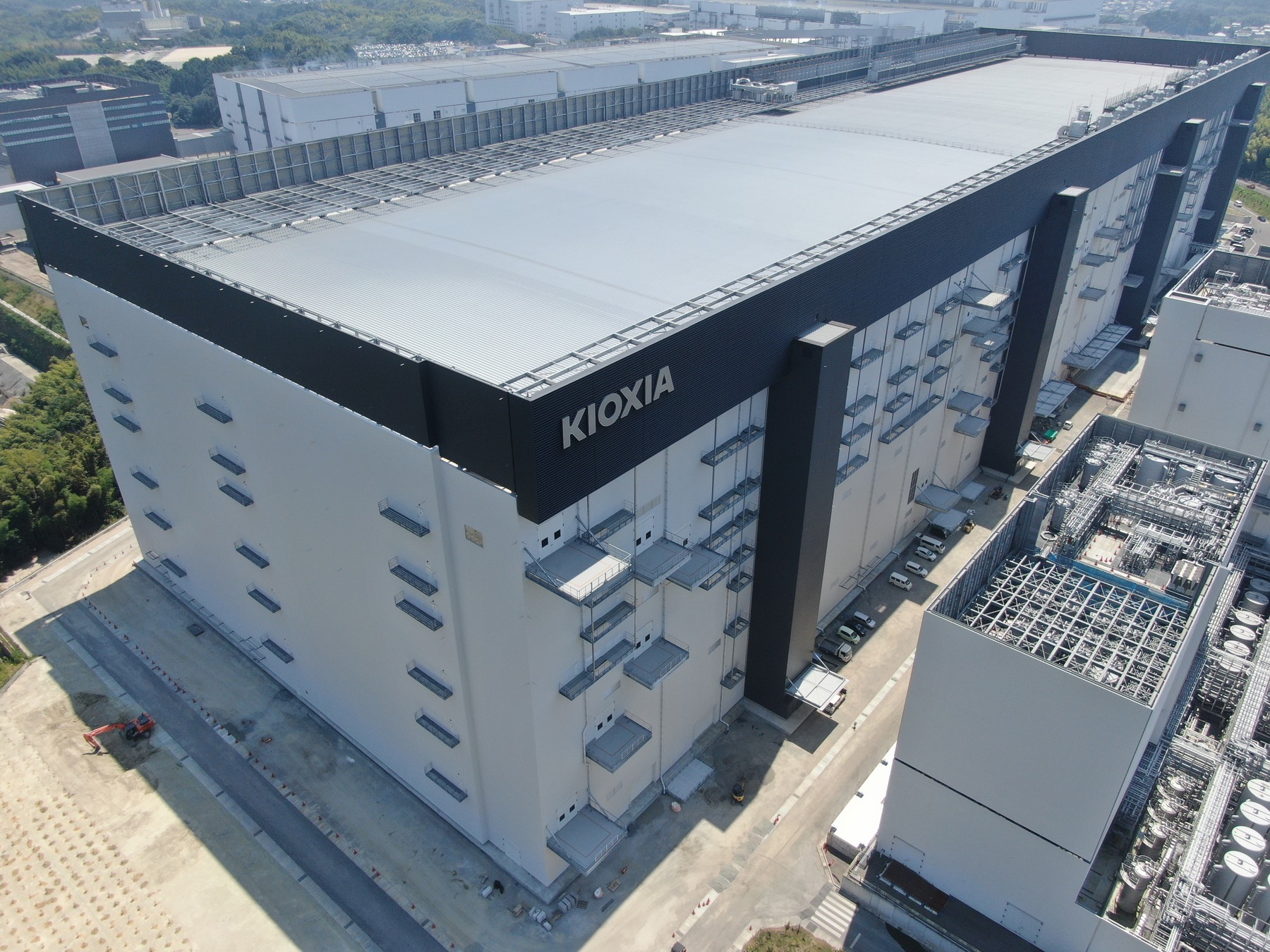
Manufacturing also explains an unusual relationship. Sandisk offers competing storage products while collaborating with Kioxia on NAND development and production. In January 2026, the companies extended their Yokkaichi joint-venture agreements through 2034. Sharing the work helps spread the burden of building the next generation.
The bill is substantial. In August 2026, the partners announced anticipated investments exceeding $31 billion in Japan through 2032, contingent on government support. That is a joint investment plan, not money already spent or the American subsidiary’s budget.
The memory cycle gets a vote
A factory can be technically impressive and commercially underused. In September 2022, Kioxia announced that wafer starts at Yokkaichi and Kitakami would fall by approximately 30% from October. The company cited market conditions and the need to manage production and sales.
That episode puts the investment figures in perspective. More demand for information does not guarantee a smooth demand curve for memory components. Capacity arrives through expensive physical infrastructure; customer purchases move with their own markets. Production adjustments are one way of bringing the two back together.
The current product direction follows different pressures. On October 12, 2026, KIOXIA America introduced CM9 enterprise SSD models supporting cold-plate liquid cooling, alongside conventional air cooling. Four days earlier, it introduced LD4 QLC drives for read-intensive hyperscale systems. Both announcements described sampling to selected customers. Heat, access patterns and qualification remain part of the sale.
Move the question closer to the data
KIOXIA also addresses a less visible limit: the DRAM consumed by vector search. Its open-source AiSAQ technology moves search structures onto SSDs. Integration into Milvus, beginning with version 2.6.4, gives developers a practical way to try that approach in a vector database.
Milvus documents the bargain clearly. Performance mode duplicates compressed vector data to reduce storage operations, increasing index size. Scale mode avoids that duplication but needs more I/O. The resource constraint moves. Engineers must decide whether storage capacity, memory expense or query latency matters most.
“Uplifting the world with ‘memory’”
KIOXIA Group’s mission
For a buyer, the repeatable lesson is to measure the constrained resource before ordering hardware. Test the actual read and write mix. Check endurance ratings, host compatibility and cooling. Compare total infrastructure costs. A dense drive designed around read-intensive storage may be a poor match for sustained heavy rewriting; an SSD-based search index still needs acceptable latency.
There is another calculation behind the capacity headline: concentration. When more data sits on each device, operators must plan how they will protect it and recover it. Raw capacity is the starting number in that plan. It is not the amount left after every operational requirement has taken its share.
KIOXIA America’s opportunity sits in those decisions. It supplies components for phones and PCs, drives for enterprise systems, and software that makes flash relevant to new workloads. The quarter-petabyte drive makes a memorable entrance. The useful work begins when a customer asks what that capacity changes inside a particular machine.
Open the enclosure
Explore KIOXIA America, the LC9 product family, AiSAQ on GitHub and Milvus’s AiSAQ guide.
Watch the Linus Tech Tips factory tour ↗ or KIOXIA’s LC9 product video ↗. Follow the blog, newsroom, LinkedIn, X, Instagram, Facebook and YouTube.