- Founded in Santa Clara in 2022
- $314M announced through Series C
- More than 40 mining operators
- ASICs, miners, software and containers
- Grid-responsive power controls
- Reborn as Velaura AI in 2026
The first interesting thing about Auradine is that investors gave it $81 million when there was almost nothing to photograph. No handsome rack of machines, no blinking data center, no customer logo arranged beneath a triumphant headline. There were three founders, a pitch deck and a collective résumé that made the absence of a product feel almost incidental. Rajiv Khemani had helped build and sell infrastructure companies. Barun Kar and Patrick Xu had spent long stretches inside Palo Alto Networks. In the expensive world of semiconductors, reputation sometimes performs the work that traction performs elsewhere.
The bet did not remain theoretical for long. Auradine turned its first capital into Teraflux, a family of Bitcoin-mining systems built around silicon designed in the United States. The machines came in air-cooled, immersion-cooled and, later, hydro-cooled forms. They were accompanied by FluxVision software, open interfaces for outside fleet managers, and a feature called EnergyTune that let an operator vary power consumption and computing output in response to grid conditions.
A miner normally inspires the same affection as a commercial freezer: it is purchased for output, tolerated for noise and watched closely for the electricity bill. Auradine's contribution was to make that stubborn appliance more negotiable. When power became expensive or the grid became strained, a fleet could ease off. When supply was abundant, it could work harder. Partnerships with CPower and Voltus connected that ability to demand-response programs, turning a room of hot computers into a controllable electrical load.
The cleverest part of the miner was not how quickly it worked. It was how quickly it could agree to stop.The practical logic of EnergyTune
A box with unusually good manners
This mattered because Bitcoin mining lives where computing economics and energy economics quarrel in public. A mining operator buys hardware, secures power, finds cooling and hopes the price of Bitcoin, the network's difficulty and the machine's efficiency remain friendly long enough to recover the investment. A fraction of a joule matters. So does an hour of downtime. So does the ability to curtail a thousand machines without walking down a thousand aisles.
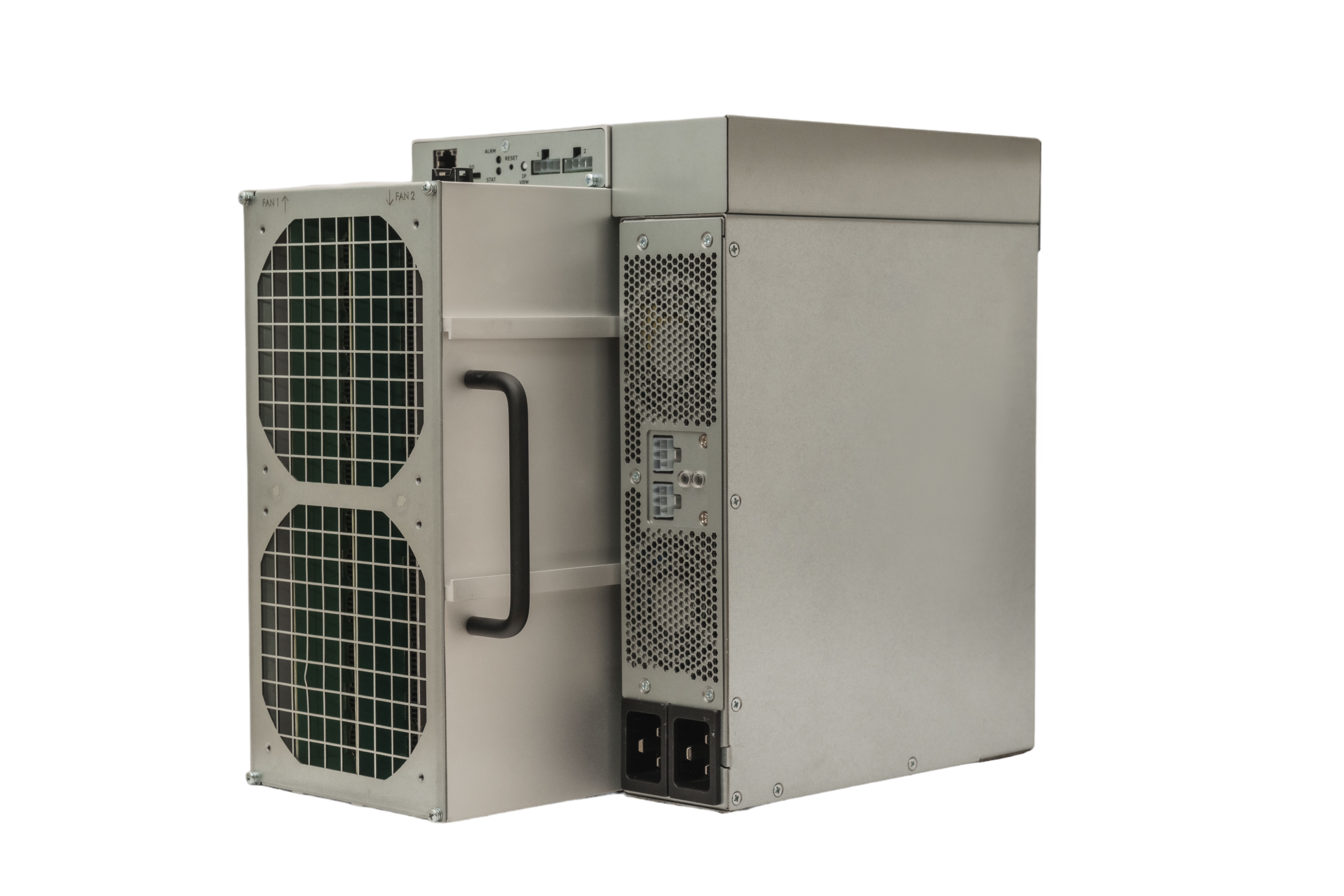
Auradine attacked the problem from several layers at once. It designed the ASIC. It supplied the complete miner. It wrote the firmware and management software. Its APIs worked with in-house systems and fleet tools such as Foreman and Awesome Miner. By 2025 it was also selling chips to other builders, supporting custom form factors and shipping one-megawatt containers created with Fog Hashing and FBox. A customer could buy the ingredient, the appliance or a metal box containing roughly 100 to 200 appliances.
One advantage, stacked six ways
That breadth was the distinction. Bitmain, MicroBT and Canaan already had scale, mature channels and familiar machines. Auradine offered US engineering, supply-chain diversification and a degree of openness that could appeal to customers tired of buying a sealed black box. FutureBit wanted chips for smaller consumer devices. MARA wanted custom control and domestic supply. Merkle Standard became the first user of the modular container. Genesis Digital Assets later ordered 1,000 air-cooled AT2880 machines for a Texas site.

The curious symmetry of eighty
Hardware companies consume money long before they produce reassuring photographs. A leading-edge chip tape-out, manufacturing commitments, boards, cooling, firmware and support all arrive before a customer pays in full. Auradine's funding history therefore reads less like indulgence than a map of the work: $81 million in its first announced round, more than $80 million in a 2024 Series B, then $153 million in 2025. The rounds mixed equity and debt. By the Series C, total capital raised was above $300 million.
The coincidence was irresistible: in April 2024, Auradine announced more than $80 million in new financing and $80 million in bookings, plus an order pipeline above $200 million. The machines had moved from promise to field equipment at more than 30 large mining operations. A year later the company said the count exceeded 40. This was the answer to the obvious early criticism. The pitch deck had not mined a single satoshi, but it had purchased enough time to build something customers ordered.
Who paid? Industrial miners and data-center operators - organizations for which a few percentage points of uptime or efficiency alter the economics of an entire site. This was not a consumer gadget business, though the decision to sell standalone ASICs invited other companies to build home miners and even heater-miners. Revenue came from chips, complete systems and deployment infrastructure, with software and fleet controls increasing the value of the hardware. Public list prices were beside the point; large installations were negotiated as capital equipment.
Then the larger power problem arrived
Auradine had always described itself more broadly than a mining company. The original language wandered through blockchain, security, privacy and AI. In 2025 it formed AuraLinks AI, an open-standards networking group aimed at the bandwidth and cooling demands of AI data centers. That work soon left home: it became Upscale AI, an independent company that emerged with $100 million in seed funding.
The more consequential split came in March 2026. Auradine became Velaura AI. The company stopped presenting Bitcoin hardware as its growth engine and began presenting ultra-low-power AI compute as its future. Existing Teraflux inventory would still be sold, warranties supported, and some remaining machines placed into hosted mining operations. But the center of gravity had moved.
Efficiency, harsh environments, cooling, fleet control and millions of deployed ASICs.
Power-limited data centers, edge devices and physical systems demanding more work per watt.
What failed first was not the engineering. It was the assumption that selling new mining machines would remain the best use of it. Mining profitability had weakened, hardware inventory had piled up across the industry, and the AI boom had made electrical capacity a strategic constraint. Auradine's experience could travel: low-power digital design, advanced process nodes, heat management and systems that adjust to a power envelope are useful whether the arithmetic secures Bitcoin or runs an AI model.
Under the Velaura name, the company introduced Titan Core, a silicon design and intellectual-property platform for AI accelerators. It says the technology can improve performance per watt for mathematical operations by two to four times and cut overall chip power by as much as half, while fitting into existing architectures. Those are company claims, not an independent bake-off. The more persuasive evidence is cumulative: the underlying design techniques had reached more than 30 million production ASICs by August 2026. That month, Velaura raised another $110 million at a valuation above $1 billion.
Auradine did not really abandon its first idea. It discovered which part of the idea was worth carrying forward.From hash rate to performance per watt
The bit worth copying
Most companies cannot copy Auradine's capital bill, founders' exit history or access to semiconductor talent. They can copy its architecture of options. The company chose a market where energy efficiency could be measured in cash every day. It owned enough of the stack to change the whole system rather than polish one component. It exposed interfaces so customers could connect existing tools. Then, when a larger market began suffering from the same constraint, Auradine could move without discarding its hardest work.
A portable version of the playbook
- Use a demanding first market as a proving ground, not as an identity.
- Own the layers that must change together to produce the promised result.
- Give customers APIs and form-factor choices instead of a sealed appliance.
- Measure the capability in the field before carrying it into a broader market.
- Follow the enduring bottleneck. In Auradine's case, that bottleneck was power.
There are limits. Vertical integration is a poor recipe when capital is scarce, manufacturing partners are unreliable or the team lacks deep systems experience. Grid-response economics depend on the local market and utility program. A premium US supply story works only when buyers value geopolitical resilience enough to pay for it. And a pivot into AI succeeds only if technical inheritance becomes customer advantage, not merely a new label on old circuitry.
One technical capability solves an expensive, measurable constraint across more than one market.
The new market shares the vocabulary of the old one, but not its customers, workflows or economics.
Auradine's short life contains several companies: a mysterious web-infrastructure startup, an American Bitcoin-miner challenger, a supplier of chips and megawatt boxes, an incubator for AI networking, and finally the previous name of Velaura AI. The corporate language changed frequently. The physics did not. Computation creates heat, consumes electricity and eventually meets a wall. Auradine's useful trick was to notice that the wall, rather than the workload placed in front of it, was the business.