Four days is not long enough to understand money. It may, however, be long enough for a gifted chip designer to spot an engineering problem disguised as money. In 2013, Jihan Wu brought Micree Zhan a proposal involving bitcoin, an obscure digital currency whose believers needed faster machines. Zhan went away to study it. He returned ready to build.
The partnership that followed was almost suspiciously complementary. Wu was the convert, a former investment analyst who understood bitcoin’s economic logic and spoke fluently to its community. Zhan was the microelectronics engineer. He understood how to make silicon perform one narrow calculation with ruthless economy. Together they founded Bitmain in Beijing, and before the year was out the company released its first Antminer.
Bitcoin likes to imagine itself as weightless. Its coins exist as entries on a distributed ledger; its mythology favors mathematics over institutions and networks over buildings. Yet the network depends on very earthly things: processors, fans, racks, cables, electricity and warehouses where the air hums. Zhan’s importance lies in that contradiction. He helped give digital scarcity an industrial body.
The provincial engineer
Zhan Ketuan was born in 1979 in Minhou County, Fujian, near Fuzhou on China’s southeast coast. He entered Shandong University’s electronic engineering program in 1997. The detail that survives from those student years is unexpectedly social for a man later known for avoiding publicity: he served as a departmental student-union president. He graduated in 2001 and earned a master’s degree in microelectronics engineering from the Chinese Academy of Sciences in 2004.
His early career stayed close to circuitry. He worked at Tsinghua University’s Research Institute of Information Technology, then ran a venture called DivaIP. The idea was to stream television to a computer through a set-top box. It was not the business that made his name, but it supplied the useful education that degree programs rarely advertise: hardware must leave the laboratory, work in the world and find buyers before the money runs out.
Wu encountered the venture before approaching Zhan about mining hardware. The pitch found the right engineer at a peculiar moment. Bitcoin miners had begun migrating from ordinary computers toward application-specific integrated circuits, or ASICs. A general-purpose processor is a clever generalist. An ASIC is a zealot. It does one family of tasks exceptionally well and has no dinner conversation outside it.
That narrowness was the opportunity. Zhan led Bitmain’s chip research and development, while the company iterated through Antminer models. The S1 arrived in 2013. The S5 followed. The S9, released in 2016, became a defining machine of the next mining boom. Every improvement in performance per watt could alter the economics of an operation running thousands of boxes around the clock.
“Deep learning is very intensive computationally and our experience in creating high-performing hardware for Bitcoin has absolutely prepared us for this exciting area of computing.”Micree Zhan, 2017
A factory for probability
By 2017, bitcoin’s rising price had turned those boxes into coveted industrial equipment. Bitmain reported $2.5 billion in revenue that year. Its draft Hong Kong listing documents later showed $742.7 million in profit for the first half of 2018. They also offered a rare view of the people behind the private company: Zhan held roughly 36.6 percent, against Wu’s roughly 20.5 percent, and led the technical team through each chip breakthrough.
The scale made Zhan fantastically wealthy on paper. China’s 2018 Hurun ranking estimated his fortune at 29.5 billion yuan. A Bloomberg ranking the next year put it at $5.2 billion. Rich lists lend a pleasing decimal point to assets that are anything but liquid, particularly shares in a private hardware company exposed to the price of bitcoin. Still, the rankings revealed the value investors placed on the machinery beneath the currency.
How concentrated the machine became
Top: estimated 2017 share of cryptocurrency-mining hardware. Bottom: share of first-half 2018 Bitmain revenue generated by mining-hardware sales. Figures from Bitmain’s draft listing materials and the market study cited there.
This dominance also concentrated risk. The same filing recorded swelling inventory and negative operating cash flow. Bitcoin’s price could rise faster than factories could supply miners, then fall before those miners reached customers. A chip takes months to design and manufacture. A market can change its mood before breakfast.
The second machine
Zhan did not want Bitmain to depend forever on cryptocurrency. Toward the end of 2015, his team began exploring chips for artificial intelligence. The connection made sense at the level he knew best. Both mining and machine learning reward large volumes of specialized computation; both punish wasted power. In 2017, Bitmain unveiled the Sophon BM1680, a processor for deep-learning tasks, along with an accelerator card and server.
The name supplied a glimpse of the reader behind the engineer. In Liu Cixin’s science-fiction novel The Three-Body Problem, a sophon is a supercomputer folded into a proton. Zhan also spoke admiringly of Sapiens, Yuval Noah Harari’s history of the shared stories that allow strangers to cooperate. “If we believe in the same story we can work together,” he said. Money, nations and companies, in his telling, were all virtual constructions. It was a philosophically elegant observation that his own company would soon test with brutal practicality.
The AI wager widened into Sophgo, a chip designer established in 2020. Zhan’s ambition was no longer merely faster hashing. He spoke of reducing the cost and power required for AI and making specialized computing available across industries. It was an engineer’s version of expansion: find another large problem that can be compressed into silicon.
The company becomes the puzzle
In October 2019, while Zhan was away from Bitmain’s Beijing office, Wu announced that his co-founder had been removed from all positions. Corporate records showed that Zhan also ceased to be a director of the Cayman Islands holding company. The largest shareholder had lost his seat at the table.
The explanation lay partly in Bitmain’s corporate machinery. Its governing documents assigned ten votes to the special class of founder shares held by Zhan and Wu, but director removal still moved through resolutions and board procedure. Ownership, voting power, directorship and legal representation were overlapping systems, not synonyms. In a company spanning Cayman, Beijing and other entities, the circuitry of control was more intricate than any Antminer board.
Zhan fought back through courts, administrative appeals and control of local operations. At one point in 2020, a confrontation over a business license at a Beijing government office drew police attention. Later, rival sides asserted authority over accounts, websites, supply and staff. The episode had the undignified comedy of a farce, except that billions of dollars, employees’ livelihoods and the direction of a major hardware company were caught inside it.
Zhan is removed from Bitmain roles and begins challenging the move.
Control fragments across entities, offices and legal proceedings.
The founders settle; Zhan keeps the core Bitmain hardware business.
The settlement came in January 2021. Wu stepped away from Bitmain and took control of spun-out interests including Bitdeer, while Zhan retained the core mining-machine operation. Public accounts placed the share purchase around $600 million, financed in part by borrowing. A partnership that had paired bitcoin fluency with chip design ended by separating assets, allegiances and ambitions.
A general-purpose processor is a clever generalist. An ASIC is a zealot. It does one family of tasks exceptionally well and has no dinner conversation outside it.
What the quiet founder funds
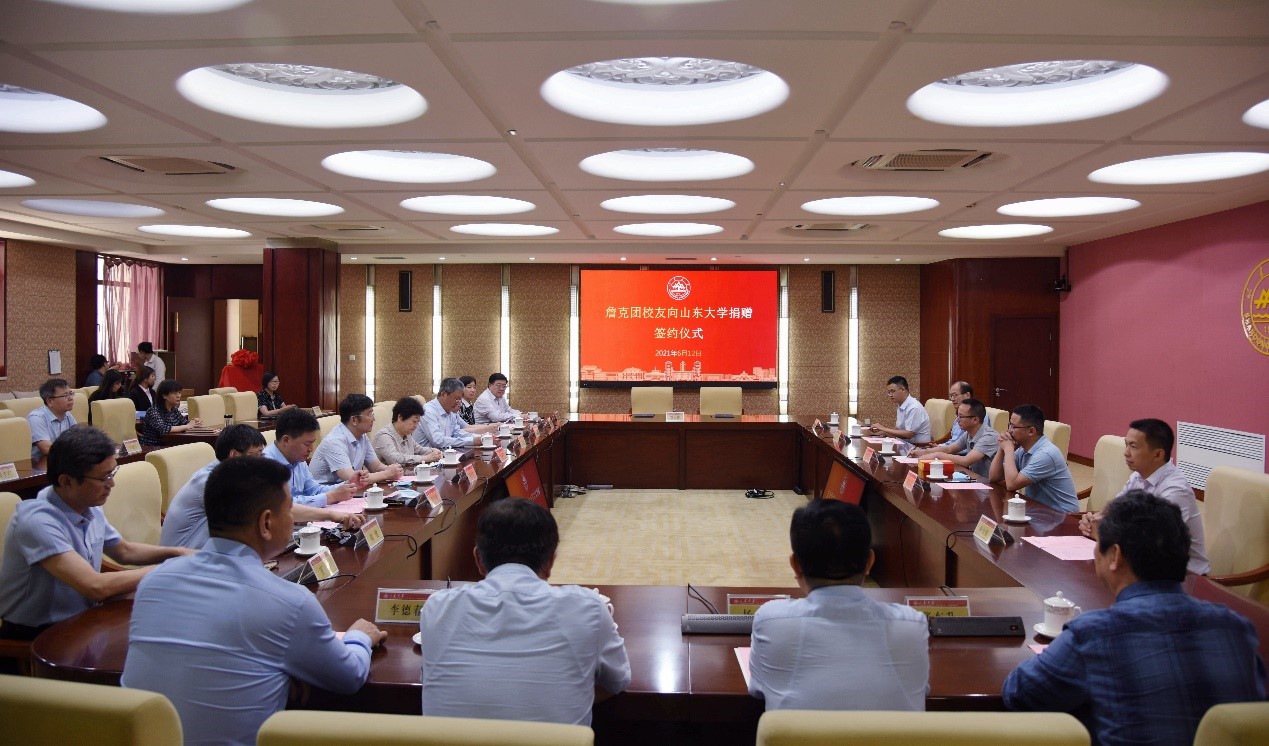
Five months after the settlement, Zhan appeared at Shandong University for a ceremony that said more about his aspirations than another product launch might have. He donated an intelligent-computing center whose equipment was publicly valued at 50 million yuan and committed at least 200 million yuan over five years to build a research institute with the university.
The plan was concrete: recruit hundreds of researchers, work on AI, industrial internet, TPU and CPU technologies, prepare experimental teaching materials, support student competitions and establish a 20 million yuan early-stage incubation fund. He thanked the university and teachers who had helped him, and described the gift as a starting point for connecting industry with education. It was an attempt to reproduce the conditions that produce engineers before companies produce fortunes.
The AI chapter has since become entangled in the international contest over advanced semiconductors. In late 2024, Sophgo faced scrutiny after TSMC-made components ordered by the company were linked by investigators to a Huawei processor. Sophgo denied any direct or indirect business relationship with Huawei and said it had provided TSMC with an investigation report. In January 2025, the U.S. Commerce Department added Sophgo entities to its Entity List, imposing licensing restrictions and citing work connected to China’s advanced-AI goals.
That latest turn places Zhan’s career inside a larger migration. Bitcoin mining began as a niche at the edge of finance. ASIC design made it industrial. AI then made specialized computing central to the strategic competition between nations. The engineer who once studied a strange currency for four days now works in a field where a chip’s route through the supply chain can become an affair of state.
Zhan remains an unusually indistinct public figure for someone attached to so much machinery, money and corporate theater. His verified social presence is sparse. Interviews are rare. The products and filings carry most of the biography. That reticence has a certain symmetry: his work has always happened below the visible interface, where electricity becomes calculation and control depends on architecture.
The Bitmain story is often framed as a crypto drama. It is better understood as a hardware story with a governance accident in the middle. Zhan saw that bitcoin’s ethereal promise required purpose-built matter. He turned that insight into chips, then into a global company. When the company became the problem, there was no ASIC for it. He had to solve that one at human speed.