The first machine in Jihan Wu's Bitcoin career was a translation. In 2011, two years after graduating from Peking University, Wu encountered the Bitcoin white paper while working in finance. He studied the idea for two days straight. Economics said it could work. His working knowledge of computer science said the machinery held together. Then he did the practical thing that grand technological movements often forget: he made the idea readable to somebody else.
Wu's Mandarin translation of Satoshi Nakamoto's paper brought Bitcoin's argument to a Chinese-speaking audience. He also helped create Babite, an early Chinese Bitcoin community. The acts look modest beside the warehouses, chips and billions of dollars that followed. Yet they contain the pattern of his career. Find a technical system with an economic consequence. Understand the bottleneck. Move directly toward it.
At first, the bottleneck was language. Soon it was money. Wu helped raise 100,000 yuan from family and friends and bought 900 bitcoins. Next came hardware. He invested in early specialist mining projects, including ASICMINER, learning both how spectacular the returns could be and how quickly a technical lead could evaporate. By 2013, he knew that conviction alone did not manufacture a chip. For that, he needed an engineer.
The economist finds his engineer
Micree Zhan was a chip designer Wu had met several years earlier. Wu approached him with the proposition that became Bitmain. The pairing was almost diagrammatic: Wu understood markets, money and Bitcoin's peculiar social energy; Zhan understood silicon. Together they built machines designed for one task, the rapid computation that secures Bitcoin's network and awards new coins to miners.
ASICs are purpose-built and unforgiving. A general computer is a decent dinner guest; it can discuss many things. A mining chip is the guest who talks about one subject with alarming fluency. Bitmain turned that narrow talent into a broad business. Its Antminer rigs became fixtures in an industry where efficiency, delivery time and access to electricity can decide who survives a price swing.
By 2017, according to Wu, Bitmain generated $2.5 billion in revenue. The private company sat at the center of mining-hardware production and operated influential pools. Wu, still barely into his thirties, had moved from explaining a decentralized currency to running one of its most consequential concentrations of industrial power.
His public manner did not resemble the standard founder's polished enthusiasm. In a 2018 interview in Manhattan, a reporter opened with “What's up?” Wu sat silent. Prompted again, he offered: “Um.” The conversation eventually found its footing, but the pause was memorable. Here was a person willing to place immense bets and fight public protocol battles, yet apparently disinclined to manufacture small talk on demand.
A civil war measured in megabytes
Bitcoin's block-size dispute transformed Wu from manufacturer into combatant. One camp wanted larger blocks so the network could process more transactions directly. Another argued that expansion would make the network harder for ordinary participants to verify, shifting power toward industrial operators. Wu became one of the most visible advocates for on-chain scaling and later a prominent supporter of Bitcoin Cash, the 2017 fork built around larger blocks.
The argument was ostensibly about capacity. It became a referendum on authority. Could miners, the people supplying computational security, steer the protocol? Should developers? Could a system designed to avoid central control tolerate companies whose machines and pools occupied so much of its physical layer? Wu's influence made him indispensable to the debate and an obvious target within it.
There was a philosophical irony. Wu believed Bitcoin could work because no permission was needed, yet success had given his company enough weight that every move was treated as politics. His sharp, occasionally profane social-media style did little to lower the temperature. Bitcoin Cash arrived, but it did not replace Bitcoin. The split proved that even formidable industrial power could not command consensus.
Then the founders' partnership itself fractured. Wu and Zhan fought for control of Bitmain in a dispute that became unusually public, complete with clashing corporate seals and competing claims to authority. A 2021 settlement ended with Wu leaving. The company that had made his reputation no longer had him inside it.
The second act gets a balance sheet
Wu did not retire into the agreeable occupation of predicting markets. He had already established Matrixport in 2019, a Singapore-based digital-asset financial-services business. Bitdeer, originally connected to Bitmain's mining operations, became independent and placed Wu in the chairman's seat. In 2023 it began trading on Nasdaq. In March 2024, Wu added the chief executive's job.
His explanation for returning was sober: separate roles would let executives concentrate on their areas of expertise, while he would focus on technology, leadership and culture. The lesson of Bitmain seemed to be present without being recited. A durable company needed more than a hot market and a good chip. It needed an organization capable of surviving both founders and cycles.
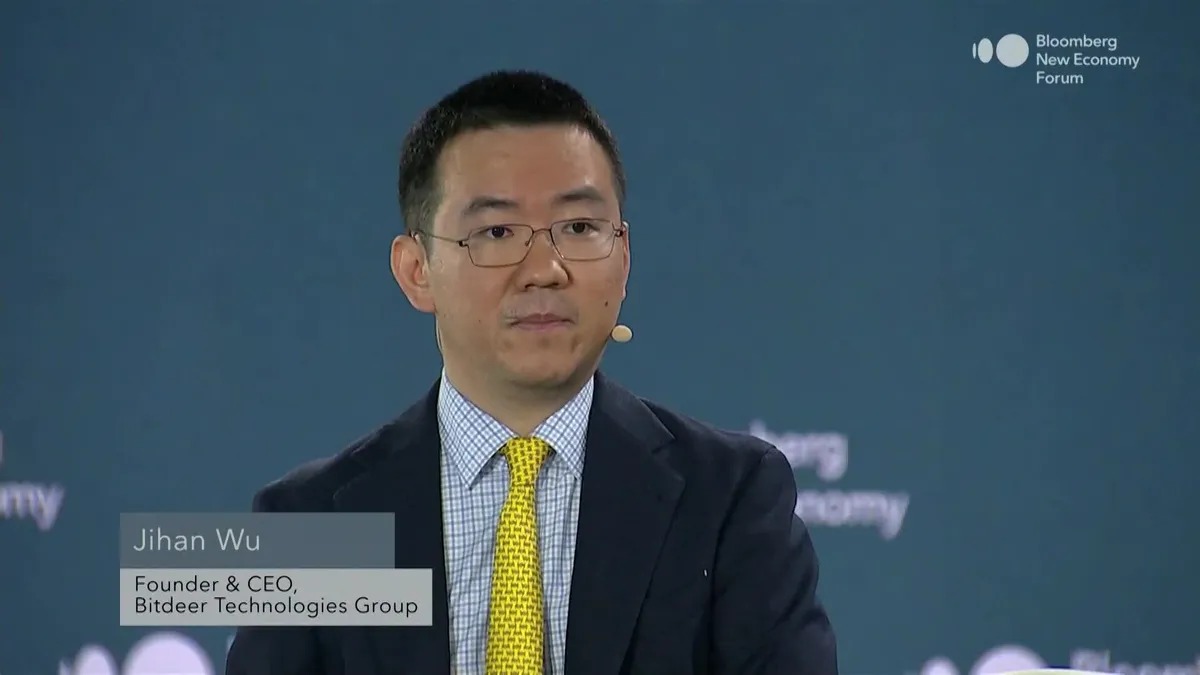
Bitdeer's strategy is a return to the old Wu instinct, expanded vertically. Design the chip. Manufacture the rig. Operate the data center. Secure electricity across several countries. Mine bitcoin. Sell machines when the economics favor customers and deploy them internally when they do not. In late 2025 the company accelerated installation of its own SEALMINER equipment. By December, it reported 55.2 exahashes per second of self-mining capacity and 636 bitcoins produced that month.
The advantage of vertical integration is control. The disadvantage is everything one must control. Chip design is expensive. Machines become obsolete. Data centers consume capital before earning revenue. Bitcoin prices refuse to consult a construction schedule. Electricity invites regulation, weather and geopolitics into the server hall. Wu has chosen a business in which each hedge introduces a fresh exposure.
One power socket, two revolutions
Artificial intelligence has given the data-center estate a second possible purpose. Mining rigs and AI accelerators are not interchangeable, and converting facilities is not a matter of changing a sign over the door. The workloads require different networking, cooling and reliability. But both begin with something scarce: large quantities of usable power in the right place.
Bitdeer has explored turning suitable capacity toward high-performance computing and AI. In early 2026, Wu told investors that owning U.S. data centers was an important advantage because American customers wanted capacity on American soil. Smaller sites could support GPU rental, he said, while larger developments were better suited to long-term colocation arrangements. He estimated certain GPU deployments could reach infrastructure in the third or fourth quarter of 2026, depending on construction.
It is tempting to call this a pivot. The word is too graceful. A pivot suggests one neat foot planted on the floor. Bitdeer is attempting to keep Bitcoin mining, proprietary machine production, cloud services and prospective AI campuses moving at once. Wu was equally plain that 98 or 99 percent of the company's coin-mining activity would remain Bitcoin. AI is an additional demand for infrastructure, not an apology for crypto.
This is the revealing continuity. Wu's career began with the conviction that a monetary network could exist because economics and computer science reinforced each other. Bitmain translated that belief into silicon. The block-size fight exposed the social limits of engineering. Bitdeer now joins those lessons in a more conventional corporate form, with quarterly calls, depreciation policies and shareholders impatient for returns.
He remains a curious fit for celebrity. Public glimpses suggest a reserved speaker until the subject becomes systems, incentives or machinery. His biggest achievements, meanwhile, are impossible to hide: a translation that expanded access, a hardware company that reshaped mining, and a second enterprise whose map runs through Singapore, the United States, Norway and Bhutan.
Wu once needed two days to decide Bitcoin worked. The proof has occupied the next fifteen years. It has included fortunes, feuds, forks and enough specialized computers to turn abstract consensus into an industrial hum. His present wager is that the same habit - moving beneath the argument to the infrastructure - still works when the fashionable calculation is no longer only a hash, but an AI model. The translator is still translating. The new language is megawatts.