bitcoin-mining
(18)
Emmanuel Montero and the machinery behind the money
A former US Navy diver built a Bitcoin mining business in the UAE. At Omnes, Emmanuel Montero is now working to turn that industrial activity into a financial instrument professional investors can hold.

Gideon Powell and the value of switching off
He grew up in a family that searched for oil. Now the Cholla CEO is exploring a different kind of resource: electricity demand that knows when to step aside.

Giga Energy found AI’s bottleneck in the electrical room
Two Texas students set out to mine Bitcoin with stranded gas. The equipment that kept them waiting became the business: transformers, switchboards, and now factory-built AI data centers.

Velaura AI Is Selling the Watts Its Chips Do Not Use
Once a maker of Bitcoin miners, the Santa Clara chip company now offers AI builders a different prize: more computing inside the same power budget. The arithmetic is promising; the hard part is making a lower-voltage chip behave.

Auradine Built a Better Bitcoin Machine - Then Followed the Electricity
It raised $81 million before it had a product, earned $80 million in bookings with machines built to mind the power grid, and then made its most revealing move: leaving the Bitcoin-miner business behind to chase AI's electricity problem.

Micree Zhan Built Bitcoin’s Engine - Then Had to Win Back the Keys
The quiet engineer behind Bitmain turned a peculiar internet currency into a silicon business. When the partnership fractured, the battle moved from chip architecture to company law.

Jihan Wu and the Long Road from a White Paper to Silicon
He began by translating an idea. Fifteen years later, Jihan Wu is building the chips, power networks and data centers meant to prove that computing infrastructure can outlast crypto's arguments.

Andrew Webber Found a Second Market for Electricity
A newspaper story about California paying Arizona to take surplus electricity sent a former Marine and Wall Street investor down an unlikely path. His answer was to bring computing to the power - and teach data centers when to get out of the grid's way.

The Bitcoin Miner That Learned to Rent Power to AI
Core Scientific spent years turning electricity into Bitcoin. Now it is converting the same hard-won sites, substations and operating know-how into something AI companies need even more: rooms where extremely dense computers can run on schedule.

The Bitcoin Miner That Decided It Was Really an Energy Company
MARA runs roughly 1.9 gigawatts of computing across four continents, holds more than 50,000 bitcoin, and now wants to sell you the cooling tanks and energy software behind it all.

The Company Betting the Future of Finance Runs on Bitcoin
Adam Back's hashcash sits inside the Bitcoin whitepaper. A decade later, the company he co-founded is trying to build the rails everyone else runs on - sidechains, Lightning nodes, hardware wallets, and a satellite that beams the blockchain to Earth.
Riot Platforms, Inc.
Riot spent years turning cheap electricity into Bitcoin. Now the same land, substations and cooling know-how are being repackaged for AI - a pivot that could make the power connection more valuable than the mine.

Bitfury
For over a decade Bitfury built the picks and shovels of the Bitcoin economy - the chips, the cooling, the code. Now it is spending its winnings on the next wave of computing.

Digital Power Optimization, Inc.
Digital Power Optimization (DPO) is a New York-based energy services company that builds and operates 'power-first' flexible data centers at renewable power plants. Its on-site data centers - running bitcoin mining and AI workloads - consume electricity only when it is curtailed, wasted, or undervalued, then curtail during peak demand so power can be sold back to the grid. The model lets hydro, wind, and other generators capture over $100/MWh from otherwise stranded power while helping stabilize the grid.

Unblock
Unblock builds and operates mobile, modular data centers that plug directly into wasted energy - gas that would otherwise be flared at oil wells, methane venting off landfills, and renewable power that gets curtailed for lack of grid capacity. By converting that stranded energy into computing power on-site, the company turns an environmental liability into revenue for energy producers while cutting emissions. Founded in 2021 and led by CEO Tomas Ocampo, Unblock has scaled to roughly 15 MW of deployed capacity across Latin America, claims the world's second-largest computing fleet at oil-field facilities, and eliminates an estimated 142,000 tons of CO2 equivalent annually.

Tomas Ocampo
Tomas Ocampo is the founder and CEO of Unblock, a company that drops modular data centers next to remote oil wells and renewable sites in Latin America, turning gas that would otherwise be flared off (and power that would otherwise be curtailed) into Bitcoin and AI computing. An Argentine lawyer turned investment banker turned Stanford-trained energy operator, he ran YPF Ventures before launching Unblock in 2021. The company now operates one of the largest computing fleets at oil field facilities in the world, says it eliminates roughly 142,000 tons of CO2 a year, and raised a $13.5M seed round in 2025 led by Goldcrest Capital and Collaborative Fund.
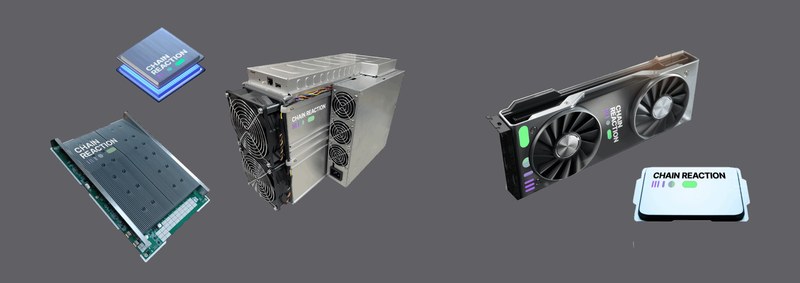
Chain Reaction Ltd.
Chain Reaction is an Israeli-American semiconductor company designing custom ASICs for encrypted computation and Bitcoin mining. Its EL3CTRUM line powers next-generation hashing hardware, while its 3PU (Privacy Processor) accelerates Fully Homomorphic Encryption so cloud workloads in finance, healthcare and defense can run on encrypted data.

Alon Webman
Alon Webman is the co-founder and CEO of Chain Reaction, an Israeli semiconductor company building purpose-built chips for encrypted computation, Bitcoin mining, and privacy-preserving AI. Before Chain Reaction, he co-founded Mellanox Technologies in 1999 and spent nearly two decades there, rising to VP-level roles before NVIDIA acquired Mellanox for $7 billion in 2020. A Technion graduate, Webman is now betting his second act on making fully homomorphic encryption practical at scale - a technology that would let clouds compute on data they can never see.