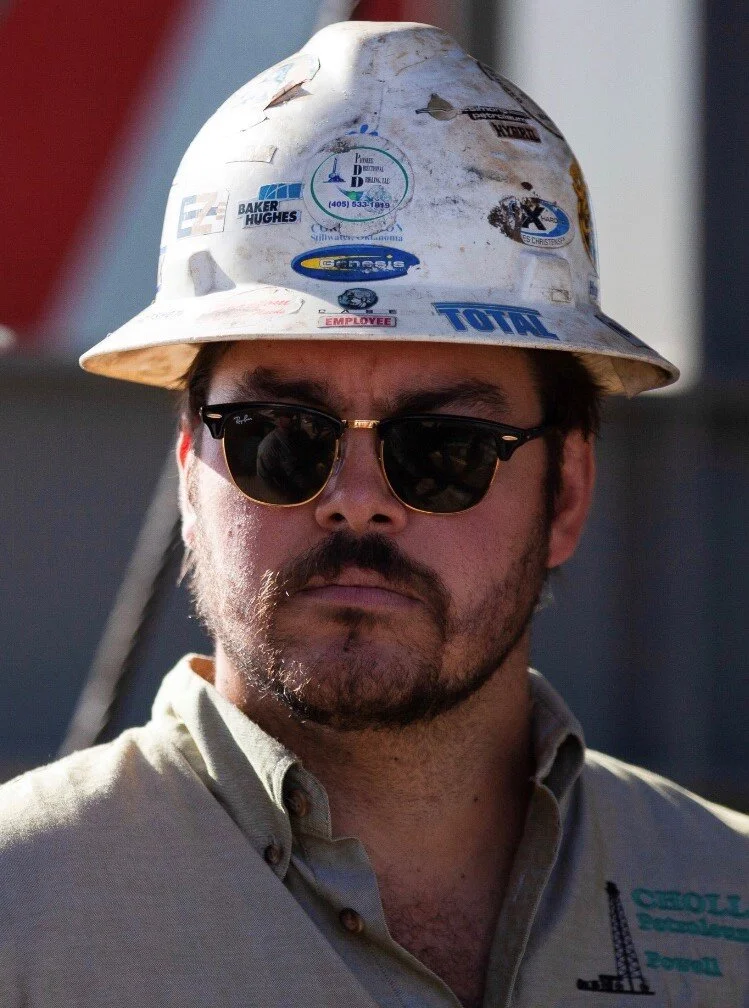
On his first drilling-rig job in southern Oklahoma, Gideon Powell received the customary welcome afforded to someone who did not yet understand the machinery: the crew gave him a hard time. They also looked after his safety. Then they discovered he was the boss’s son, and the teasing stopped. Powell remembers that change. The lesson he drew from the job was simple: he had a great deal to learn.
It is a useful place to begin with a CEO. A surname can explain how someone gets near a drilling rig. It does considerably less to explain what he does once he is there. Powell’s subsequent career has involved moving between things he knew and things he needed to understand, with a family energy business providing the setting.
Today he leads Cholla Inc. in Dallas. Its interests extend from petroleum exploration into electricity infrastructure, Bitcoin mining, data centers, and venture investing. These businesses make an unusual family portrait. To follow the resemblance, watch what Powell does with uncertainty.
A family business goes looking for a new map
Powell studied finance at Baylor University. His early personal biography also records lacrosse and membership in Kappa Sigma, along with the familiar extracurricular loyalties of a Texan who enjoys hunting, fishing, and the Dallas Cowboys. Football offers an education in patience that no business school has yet managed to put on a transcript.
He worked with Cholla while still in college. The acquisitions work that followed involved Dallas and West Texas, assessing prospects and looking for reserves in areas that had received too little attention. A finance degree gave him one vocabulary for evaluating opportunity. Oilfield experience supplied another, less inclined to assume that everything important would fit inside the spreadsheet.
In 2013, he took the lead in Cholla’s entrance into the Permian Basin. The corporate chronology records substantial divestitures of non-operated leasehold and production in Howard and Glasscock counties in 2016. Those exits helped establish the opening for his next line of inquiry.
The company invested in HODL Ranch in 2017. By 2019, that project had been acquired by a Silicon Valley startup, while Cholla was drilling its first operated horizontal well in Nolan County. Read together, those two events explain the business’s direction better than a claim about reinvention. The oil work continued as another field of exploration opened.
A ranch with a different kind of livestock
After exiting part of the Permian investments, Powell stepped away from daily operations to investigate global power markets and possible carbon-dioxide utilization projects. That search brought him and his team to Bitcoin mining and high-performance computing. He co-founded Autonomous LLC, which acquired raw land and worked with a data center developer to create HODL Ranch.
The sequence matters. The starting question concerned energy. Computing emerged as a possible answer. The attraction was a customer with a different relationship to electricity, one whose demand could be managed rather than treated as an immovable fact.
Following the initial project divestiture, Powell returned to Cholla as president and chief operating officer. His detour had supplied experience with an additional part of the energy system. Exploration now involved the usefulness of a location above ground as well as the resources below it.
He has described a shift from considering power generation to investing in the businesses that consume power. In West Texas, Cholla assembled land and pursued the slow prerequisites of computing campuses: power access and fiber connectivity. The romance of a frontier business turns out to contain a respectable quantity of waiting for infrastructure.
Powell’s phrase for this emerging group of operators is “compute cowboys.” It is an entertaining label for work whose success still depends on equipment, connections, and a site that makes economic sense. Digital money may travel freely. The machines producing it require somewhere to stand.
The customer who can leave
Cholla Energy’s proposition begins with timing. Bitcoin miners can reduce consumption when electricity is scarce. A conventional data center may need continuous uptime. The company wants to carry lessons from mining into suitable computing workloads, particularly those able to tolerate delay.
This is the distinction behind Powell’s interest in flexible load. A customer that can pause gives a power system another decision it can make. The customer may avoid expensive electricity; the grid has less demand to serve at a difficult moment. Whether the arrangement delivers wider benefits depends on the actual operating rules and economics.
Cholla’s practical work includes acquiring land, developing infrastructure, and investing in substations. It also describes seeking sites in the Dallas-Fort Worth market near large transmission switching stations. Geography remains central to a business whose eventual output appears on a screen.
A flexible computing customer consumes electricity.
The customer reduces its electricity demand.
Work can resume when the economics permit.
The diagram is simple; the bargain underneath it deserves attention. How much interruption can the customer accept? What does the system require in return for a connection? Who bears the cost of the necessary infrastructure? Powell’s thesis makes those questions part of the business opportunity.
A wildcatter’s terms of engagement
Powell has brought this interest in uncertain opportunities back to petroleum. In 2024 he described reservoirs developed through a mixture of conventional geology and newer drilling methods as hybrid reservoirs. He argued that independent and family-owned companies would have an important role in finding additional reserves.
Cholla’s petroleum strategy reflects that preference. It includes revisiting basins with known resources, applying horizontal drilling where vertical production already offers clues, and working with outside geologists and operators who possess local knowledge. An overlooked prospect becomes interesting because there is something specific to investigate.
The same preference appears in Cholla Ventures, which offers seed and early-stage capital to energy entrepreneurs. Its stated interests include flexible load technologies, computing development, and grid infrastructure. It emphasizes patient investment and operating experience. A new idea is invited to arrive with someone prepared to work on it.
“At Cholla, we don’t give a damn about pedigree.”
Gideon O. Powell
That is an unusually direct invitation from someone leading a family company. It puts the emphasis on what a prospective partner can contribute. Pedigree is convenient to print. Practical knowledge takes longer to demonstrate.
Powell acknowledges the advantage of his own starting position. He has said that his first Bitcoin project was hard to finance and that family-business resources allowed early risks. In his telling, Cholla uses cash flow from petroleum operations to support land development and experiments in power systems.
He is particularly interested in young technologies that established operators may be slow to adopt. The aspiration is to test ideas at a manageable scale and learn through use. That approach asks more of an investor than approving a presentation: the proposed experiment needs a place, equipment, and people capable of finding out what happens.
The argument leaves the oilfield
Powell’s views have carried him into public debate. At an Oxford-style event hosted by University of Texas at Austin organizations in 2022, he took the side arguing that policymakers should encourage cryptocurrency mining. Economist Cesare Fracassi was on the same side; James Galbraith and Adrian Shelley argued the opposing position.
The format asked the audience to reconsider its position after hearing both teams. That is a useful setting for an infrastructure argument. A project affects people who may have no interest in owning the currency it helps produce. Its case has to reach beyond the enthusiastic customer.
The legislative record shows Powell engaging with that question more directly. An April 2025 Texas House analysis lists him as a witness supporting HB 3970, a proposal for an expedited large-load interconnection program. The committee’s supporting witnesses also included representatives of American Bitcoin, Enchanted Rock, and the Sierra Club.
A separate May analysis lists him as a witness on SB 6, concerning planning and expedited processing for large electric loads. These appearances locate his interests in the unglamorous machinery of infrastructure policy: how customers connect, how growth is planned, and how flexibility might be recognized.
By May 2026, the conversation was also about AI. Marty Bent recounted discussing dedicated power generation and computing with Powell at the Texas Energy and Mining Summit. The idea under discussion was to build additional generation with computing as an anchor customer, rather than compete solely for existing grid capacity.
Powell was also listed for an August 2026 PubKey DC conversation with Bent about entrepreneurship, property rights, energy, AI, and public trust. The subjects show how far his field of inquiry has spread. A computing campus invites a conversation about its relationship with the people around it.
A trebuchet in the margins
Outside those projects, Powell’s interests remain conspicuously physical. His company biography lists reading, time with friends and family, and an affection for building trebuchets. Medieval siege engineering is an excellent reminder that an idea involving stored energy will eventually demand a working mechanism.
He lives in Dallas with his wife and four children. His civic commitments include advising Buried Alive, supporting criminal justice reform, and membership in Stand Together. He also serves on the MIT Energy Club’s advisory board. The interests connect his commercial ambition with a stated concern for individual liberty and stronger communities.

There is an appealing continuity in this career. Powell keeps returning to systems that have to work in the world: the rig, the well, the substation, the campus. Each introduces a different constraint. Each offers another opportunity to learn what a promising idea can survive.
The next chapter depends on whether flexible computing can earn its place alongside other electricity customers. Powell’s proposition gives that ambition a concrete test. The customer arrives ready to work, with the capacity to step aside when the system needs room. For a business accustomed to searching underground, knowing when to switch off is an unexpected thing to go looking for.
Continue the conversation
- Cholla: Powell’s biography
- X / Twitter
- Personal archive
- The 2023 career interview
- Compute cowboys: the interview
- The new wildcatters
- Watch: UT Austin mining debate
- Listen: Energizing Bitcoin, episode 1
- Power and AI: May 2026 discussion
- Cholla’s company timeline
- Cholla Energy
- Cholla Ventures
- Cholla Petroleum
- MIT Energy & Climate Club
- Exploration: Hart Energy, December 2024
- Texas House: HB 3970
- Texas House: SB 6
- The UT debate lineup
- PubKey DC conversation listing