There is a small irony in a company that began with Bitcoin miners selling restraint to the AI industry. Mining hardware is judged, more or less, by how much calculation it can squeeze from a watt. AI infrastructure is arriving at the same question from the opposite direction: how many more chips can a data center run before the electrical feed says no? Velaura AI, the Santa Clara company once called Auradine, has built its next business around that collision.
The short version
- Velaura licenses low-voltage design technology for the arithmetic circuits inside custom AI accelerators.
- It says Titan Core uses 2–4 times less power for those targeted operations at the same performance. Whole-chip gains depend on the design and workload.
- Its earlier Teraflux Bitcoin-mining hardware supplied the manufacturing experience behind the pitch.
- The AI business charges an upfront technology fee plus a royalty tied to customer power savings, according to its CEO.
First, build the machine that counts every watt
Auradine was founded in 2022 by Rajiv Khemani, Barun Kar and Patrick Xu. The original venture raised $81 million in an initial financing, including a $10 million credit line, before it had a commercial product. The first visible one was Teraflux, a family of Bitcoin-mining systems built around custom chips, cooling and software that could tune power use. It was an expensive opening move in an expensive business: chip development can demand tens of millions before the first useful piece of silicon appears.
The products did ship. In April 2024, Auradine announced more than $80 million in Series B financing and $80 million in Teraflux bookings. By April 2025 it said miners were deployed with more than 40 Bitcoin data-center operators. MARA was both an investor and a customer. The hardware portfolio still appears on Velaura's site, alongside FluxOS firmware and FluxVision fleet software. This is a company with a mining business in its history and on its product page, rather than a startup that invented a tidy origin story after discovering AI.
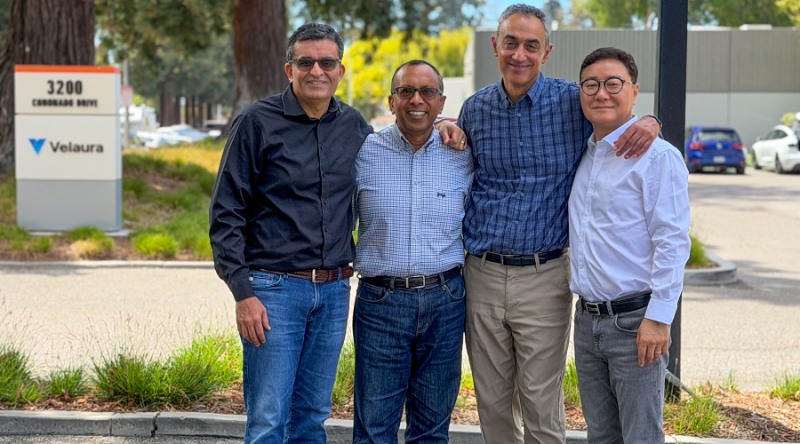
The transition did not happen in a single announcement. Auradine introduced AuraLinks, an AI data-center networking initiative, in late 2024. It formed an AI group while raising $153 million in 2025. In March 2026, the company adopted the Velaura name and showed Titan Core, a silicon design and intellectual-property platform aimed at AI accelerators. Manu Gulati, whose earlier work spans Apple, Google, Qualcomm and NUVIA, joined as co-founder and chief development officer. The company framed the change around a constraint it knew from mining: power.
The arithmetic hidden inside the accelerator
A custom AI chip spends power on several jobs. Velaura focuses on mathematical operations such as matrix multiplication, which its analysis says can account for roughly 40 to 70 percent of an accelerator's power, depending on the workload. The rest includes memory access and moving data around. Titan Core applies low-voltage libraries, circuit design and specialized tooling to those arithmetic blocks. In the company's reported results, they deliver 2–4 times better performance per watt without giving up speed.
The physics is unusually legible. Dynamic power in a chip rises roughly with the square of voltage. Lower the voltage and the energy saving can be large. But lowering it also makes the design less forgiving: clocks slow, manufacturing variation matters more, and stray particles can trigger errors. Velaura says its hardened logic, error correction and design flows address those problems at leading process nodes. That is the real product: a way to keep a fast chip reliable after removing some of the electrical margin that made it easy to run.
That distinction matters when a claim travels from an engineering slide to a boardroom. A 2–4x gain in the arithmetic blocks is not a 2–4x gain for the entire chip, much less for the building that houses it. Velaura models 250–500 watts saved on a continuously running 1,000-watt accelerator in an illustrative case. At ten cents per kilowatt-hour, its published three-year estimate is about $650–$1,300 per chip before cooling and other infrastructure effects. Actual savings would move with the workload, utilization, electricity price and chip architecture.
A royalty on electricity avoided
The customer is not a person buying an AI app. It is the company designing an accelerator. Velaura says the buyer supplies its RTL chip design and constraints for power and area. Velaura supplies IP, low-voltage libraries, tool flows and engineering work; the output can be an optimized physical design or a chiplet for a particular manufacturing node. That makes Titan Core part of a customer's chip program, a place occupied by in-house engineering teams and other semiconductor IP providers. It is a different sale from asking a data center to swap one finished GPU for another.
Khemani told Reuters that Velaura charges an upfront fee, followed by a royalty tied to a share of the customer's power savings. It is a neat commercial wager: if saved electricity is the point of the product, make it the meter for payment. The arrangement also makes proof unusually important. The customer and supplier must agree on a baseline and measure the saving inside a chip whose behavior changes with software and workload.
“Every advance in AI, from reasoning models to embodied intelligence, creates demand for more compute, and ultimately more power.”Rajiv Khemani, co-founder and CEO
In August 2026, Velaura announced a $110 million financing led by Seligman Ventures that put its valuation above $1 billion. Combined with Auradine's previously announced rounds, the headline figures add to roughly $424 million, some of it debt. The new round was styled a Series A under the Velaura name, despite the predecessor's Series A, B and C. The chronology is mildly comic; the money is substantial. Velaura says it will use the new funds to develop the AI portfolio and expand engineering and customer teams.
The customer at the end of the power cord
There are two markets in Velaura's telling. A hyperscale data center may be limited by a power allocation and by the cost of cooling dense racks. A robot, drone or autonomous machine may be limited by a battery and heat it cannot easily shed. Both need more computation from each watt. Yet the commercial evidence is at different stages. The company reports more than 30 million ASICs using its underlying low-power technology, a manufacturing record built before Titan Core's AI push. Its named Teraflux mining customers and operators belong to that earlier business. Khemani told Reuters that Velaura was engaged with three of the four largest cloud providers as prospective AI customers, but did not name them.
The distinction between a conversation, a design win and a deployed chip is where this story will be decided. Low-voltage IP must survive a customer's complete design, fabrication, validation and real workloads. In a data center, the value is clearest when power, cooling or rack capacity genuinely limits expansion. Where memory movement dominates arithmetic, where utilization is low, or where electricity is cheap and plentiful, the same arithmetic offers a smaller prize. Physical AI adds its own test: an efficient calculation has to fit the size, latency and reliability demands of a machine moving through the world.
For other builders, the useful lesson is almost embarrassingly plain. Identify the resource your customer cannot buy quickly, then work on the part of the system that spends most of it. Velaura chose the math circuits and the watt. It has shipped enough earlier silicon to make its engineering claims worth examining. The next chapter requires a customer to turn those claims into a production AI chip, and then to count the watts that are no longer there.