The useful version
- Celestial AI uses light to move data among AI processors, memory and switches. It does not make an AI processor.
- Its Photonic Fabric portfolio includes PFLink chiplets and IP, PFSwitch systems, OMIB packaging and management software.
- Its buyers are hyperscalers, custom-chip teams and data-center equipment makers. Publicly discussed hyperscaler design engagements remain unnamed.
- Marvell paid about $3.25 billion upfront in 2026, with up to $2.25 billion more tied to revenue milestones.
The least glamorous part of an artificial-intelligence machine is often the part that brings the machine to a halt. Picture a ballroom full of brilliant mathematicians, each capable of a trillion calculations, passing their notes through a letterbox. Buying more mathematicians will not help. The letterbox is the system. Celestial AI began with the semiconductor version of this social embarrassment: processors were becoming astonishingly fast, while the paths between processors and memory were becoming crowded, hot and short.
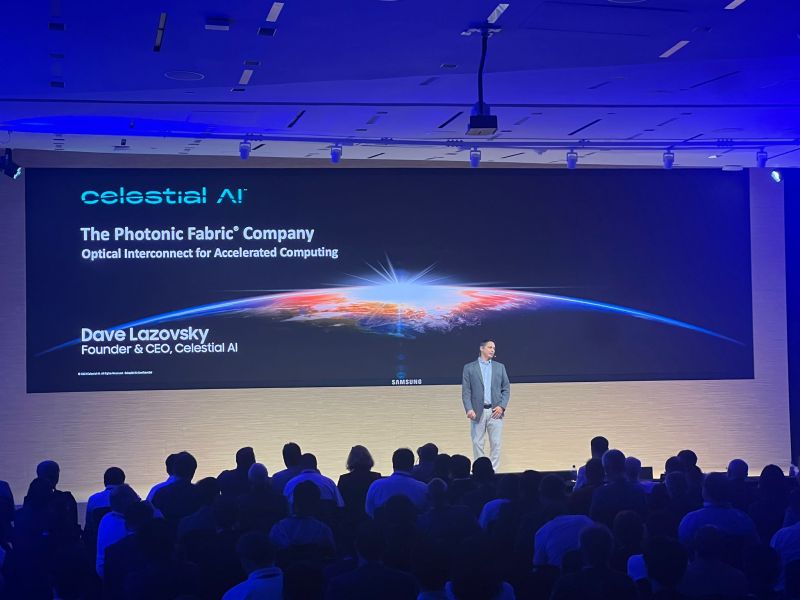
David Lazovsky and Preet Virk, semiconductor veterans who founded the company with software executive Michelle Tomasko in 2020, made a contrarian choice. They would not build another accelerator. They would build its roads. Their premise was that AI would become a data-movement problem before it ran out of arithmetic. That sounds obvious now, which is the fate of any good industrial thesis after several hundred billion dollars of data-center construction has made it visible.
The first thing to fail is the wire
Copper is excellent at being cheap, understood and already installed. At very high data rates, however, an electrical signal loses integrity over distance. Restoring it costs power. The faster the cluster and the farther the signal must travel, the less charming the bargain becomes. A rack full of accelerators is already a furnace with an electricity account. Making every bit pay an additional toll to cross the rack is poor manners and worse economics.
There is also the chip's so-called beachfront: the limited perimeter where electrical connections can enter and leave the die. Conventional co-packaged optics brings light close to the chip but generally lands data at its edge. Celestial AI's distinctive claim is that its thermally stable photonics can be integrated more deeply in a 3D package, delivering bandwidth nearer the point of compute. More coastline, in effect, without purchasing a larger island.
“The key problem going forward is memory capacity, bandwidth and data movement.”David Lazovsky, co-founder and former CEO
Those figures are company estimates presented by Marvell for Gen2 PFLink, not measurements from a public fleet. They nevertheless explain the ambition: hundreds of terabits per package, enough reach to cross racks, and latency low enough for processors to behave as members of one large computer rather than pen pals.
A fabric, not a single miraculous chip
Photonic Fabric is a platform name, and this matters. PFLink is the connection itself, available as a chiplet or as licensable intellectual property. PFSwitch coordinates high-bandwidth, low-latency scale-up traffic among accelerators. OMIB - Optical Multi-chip Interface Bridge - is packaging technology for bringing electronics and photonics together. Software watches links and systems for telemetry and reliability. A proposed Photonic Fabric Appliance adds pooled memory: a 2025 paper described a system with as much as 32 terabytes of shared memory and 115 terabits per second of all-to-all switching.
The customer is not someone buying a shiny box from a shop. It is a hyperscaler designing a future cluster, a semiconductor company placing optical I/O beside a custom XPU, or an original design manufacturer assembling the result. Celestial AI said multiple lead hyperscalers and semiconductor customers were designing in the technology. It did not name them. AWS publicly praised the logic of the Marvell combination, but praise is not a disclosed purchase order, and anonymity should not be converted into a logo parade.
The business was an ecosystem with invoices
Celestial AI's business model ranged across chiplet sales, rack-scale systems, IP licensing, packaging and software. That breadth was not decorative. Semiconductor products are group projects with expensive equipment. Broadcom collaborated on custom silicon and prototype development. Samsung's orbit included high-bandwidth memory, foundry and packaging work, as well as investment through its Catalyst Fund. Marvell's materials identify TSMC 4/5-nanometer processes for PFLink electronics.
This is one lesson worth copying, even by founders who never intend to touch a wafer. Celestial AI chose standards and partners early. Its links were presented as adaptable to familiar protocols rather than as a demand that the data center forget everything it knew. It sold into the surrounding supply chain while retaining a proprietary center. A new industrial platform is easier to adopt when it arrives as a useful neighbor, not a religious conversion.
The company financed this diplomacy lavishly: $56 million in Series A funding in 2022, $100 million in Series B in 2023, $175 million in Series C in 2024, and a final $255 million Series C1 close in 2025. Total disclosed capital exceeded $520 million. This was not a clever weekend prototype. Photonics, packaging, validation and customer qualification consume years before they produce respectable revenue.
The price of being early
In December 2025, Marvell agreed to buy Celestial AI. The acquisition closed in February 2026. The upfront consideration was approximately $3.25 billion: $1 billion in cash and $2.25 billion in shares. A further $2.25 billion in stock depends on cumulative revenue. One-third of the earnout becomes payable if the business reaches at least $500 million by the end of Marvell's fiscal 2029; the whole sum requires more than $2 billion.
That structure is more honest than most technology slogans. Marvell paid handsomely for the platform, the team and access to an emerging market. It also made a large part of the total price wait for the customers. Marvell expects initial revenue contribution in the second half of fiscal 2028, an annualized run rate of $500 million in the fourth quarter, and $1 billion a year later. These are forecasts, not receipts.
What changed Celestial AI's mind about remaining independent was scale. Lazovsky described Marvell as the home with the customer relationships, connectivity portfolio and manufacturing reach needed for high-volume production. The startup had proved a complete electrical-optical-electrical silicon link in 2023 and announced customer design work in 2024. The next problem was not invention. It was repetition - fabricating, packaging and qualifying the same delicate result in commercial quantities.
A beautiful idea still has to leave the laboratory
Photonic Fabric will not improve every machine. A modest cluster with short traces may be happier with copper, especially while optical packaging carries a cost premium. Workloads that do not strain memory bandwidth will not pay much for relieving it. Deep co-packaging must meet yield, reliability and thermal targets. Standards must settle. Lasers, fibers and assembly must arrive in volume. The elegant diagram is the beginning of manufacturing, not its conclusion.
Optics wins when distance, bandwidth and energy costs outweigh its packaging complexity. Below that line, copper remains annoyingly competent.
Competitors know the same physics. Ayar Labs, Lightmatter, Ranovus and established semiconductor companies are pursuing silicon photonics or co-packaged optics; Nvidia, Broadcom, Intel and others influence the switching and interconnect standards around them. Celestial AI's defense is not that nobody else has discovered light. It is the combination of thermal stability, deeper package integration, protocol adaptability and a portfolio that stretches from a link to a memory appliance.
The broad lesson is pleasingly portable. When a market rushes toward one scarce component, inspect what that component will overburden next. Faster automobiles create traffic. Larger cities create elevators. More AI compute creates a demand to feed, cool and connect it. Celestial AI noticed the traffic before the motorway appeared on every investor's map.
Now its wager belongs to Marvell. The company must turn anonymous design engagements into shipped systems and estimated picojoules into operating economics. If it succeeds, the cleverest part of tomorrow's AI machine may not be where the model thinks. It may be where the light gets through.