A cyberattack and a bad night at home once shared a familiar ritual: switch something off, switch it on again, then stare accusingly at the router. Gopi Sirineni spent a large part of his career making that little box less deserving of blame. At Qualcomm, he led whole-home Wi-Fi strategy and the development of Wi-Fi SON, software that let several access points coordinate rather than quarrel. Mesh Wi-Fi turned coverage from a household séance into infrastructure.
Now Sirineni is applying the same systems instinct to machines the size of rooms. AI data centers are packed with accelerators, fans, networking gear, firmware and remote-management components. They are valuable, hot and complicated. Software security watches the obvious doors, but highly privileged machinery lives below the operating system. His company, Axiado, wants to put a resident observer down there.
The object at the center of the plan is the Trusted Control/Compute Unit, or TCU. It combines jobs that have traditionally been scattered across separate components: platform management, a hardware root of trust, cryptography, firewall functions and an AI engine trained to notice abnormal behavior. The premise is simple enough to explain over lunch. If malware gets past the front desk, something sober should still be watching the building.
The first category
Sirineni arrived at this argument through wires, radios and a succession of companies. He studied electronics and communications engineering at Osmania University in Hyderabad, then earned a master's degree in electrical engineering at the University of Arkansas. His career ran through Integrated Device Technology, Marvell, Cavium and AppliedMicro, placing him near the unglamorous plumbing of the internet: Ethernet, embedded processors and the devices that push packets along.
He also learned how markets acquire names. At Ubicom, where he became vice president and chief operating officer, the team worked on processors for networked devices. Qualcomm acquired Ubicom in 2012, and Sirineni spent the next eight years inside the larger company. He oversaw product management and business development in wired and wireless infrastructure, commercialized 802.11ac products for the connected home, and drove the launch of Wi-Fi SON.
The important part was not merely better reception. A collection of routers could be treated as one adaptive system. It could measure conditions, coordinate decisions and improve the experience without asking the person upstairs to become an amateur network engineer. Distributed Wi-Fi became a product category. Sirineni had seen an architectural idea turn into something customers could request by name.
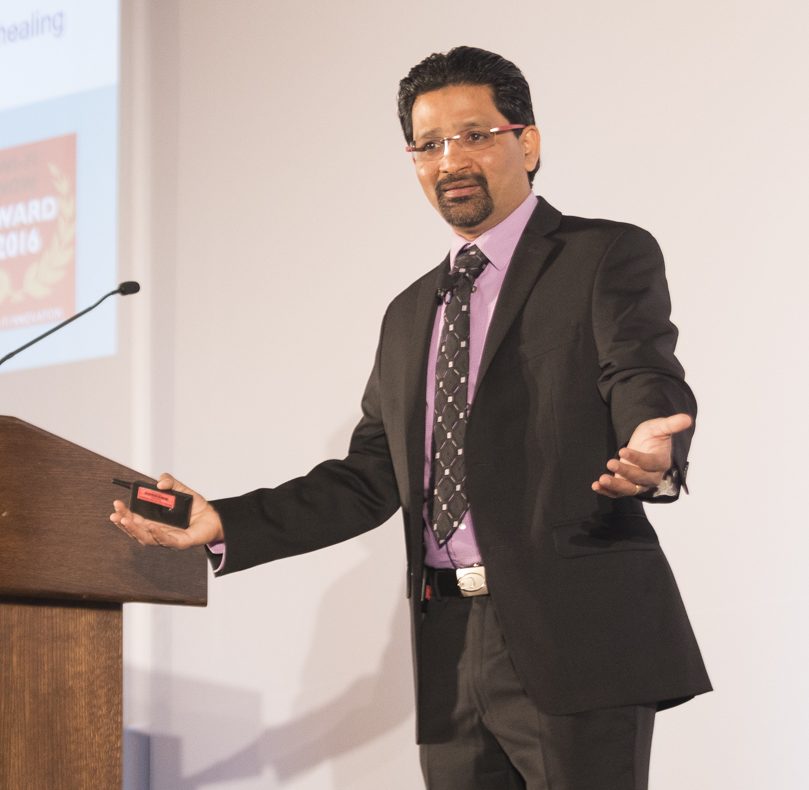
There was a founder interlude, too. Sirineni started Cloud Grapes, a cloud-transcoding company, before returning to the networking world through Ubicom and Qualcomm. He has served on the board of Codelucida, a company working on error-correction technology, since 2013. He later advised Cognitive Systems, whose Wi-Fi sensing technology uses disturbances in wireless signals to understand motion. The recurring theme is hard to miss: invisible systems become useful when they learn to read their surroundings.
A chip company meets a pandemic
Sirineni joined Axiado as president and CEO in April 2020. The timing had the comic precision of a trapdoor. Semiconductor startups already consume patience and capital: architecture, verification, tape-out, fabrication, firmware, customer qualification. Now meetings had disappeared into laptop screens, supply chains were wobbling and the company needed money quickly.
He learned the product in detail, sharpened the pitch and kept fundraising. Axiado closed a $25 million Series B in 2021, with demand exceeding the amount the company had initially sought. Sirineni has called that one of his defining career moments. It did not prove the chip would work or the market would form. It bought the team the chance to answer those questions.
The financing story continued as the product widened. Axiado announced a $60 million Series C in December 2024, then more than $100 million in Series C+ funding a year later. The later round was led by Maverick Silicon, with participation from Prosperity7 Ventures, Orbit Venture Partners, Crosslink Capital, Nosterra Ventures and others. Axiado said the money would support sales, customer operations, supply chains and next-generation platforms. By then, the company had expanded its team by 40 percent, doubled headcount in Taiwan and India, and planned a larger global push.
Capital is only one scoreboard in silicon, and often the noisiest one. The quieter score is whether a component earns a place in systems designed by other companies. Axiado has demonstrated its modules in server architectures and worked within the Open Compute Project's data-center secure control module standard. Its approach is meant to complement existing security software, not ask customers to toss every tool they already own into the sea.
The control room under the floor
The TCU sits in an unusually consequential neighborhood. The management plane can boot a server, update firmware, read sensors and operate the machine even when the main processor is unavailable. That convenience also makes it a tempting target. A compromised control layer can remain privileged and difficult to see. Axiado's response is to place detection beside control and anchor trust in hardware.
Its Secure AI engine learns patterns of normal system behavior and looks for deviations that may indicate ransomware, a firmware compromise, a supply-chain problem or a side-channel attack. The hardware can preserve forensic signals and act while an attack is unfolding. Sirineni describes it as a last line of defense, positioned after the port-of-entry products have done their work.
In 2025, Axiado introduced the AX3080 TCU, a single-chip platform aimed at control and management in cloud and AI systems. Its newer language is broader still: an AI-powered management plane. Security agents share silicon with dynamic thermal management and dynamic voltage and frequency scaling. One set of agents watches for hostile behavior; another adjusts cooling or power in response to workload.
There is an elegant economy to the combination. The same privileged layer that knows whether a server is behaving strangely can also know whether it is running too hot or wasting electricity. AI accelerators have made power and cooling board-level concerns. Moving some decisions off CPUs and GPUs may leave more expensive compute available for the work customers are paying it to do.
The appetite for altitude
Sirineni's extracurricular list reads like a waiver form: motorsports, dirt biking, paragliding, diving and bungee jumping. He plays basketball and cricket. He paints. The thrill-seeking label has followed him through interviews, partly because he encourages it. “Anything where I can feel more alive, I do,” he once said.
Yet the more revealing pastime may be coaching. For more than seven years, he coached children in the National Junior Basketball League. His teams reached national competition and won two regional championships. Coaching puts ambition on a weekly schedule. The idea must become a drill; the drill must become trust; the trust has to survive a bad quarter.
His view of leadership owes something to Sehat Sutardja, the late Marvell co-founder who advised him to treat people genuinely and make them feel part of a family. Sirineni's version is concise: “You take care of your team, and they will work with you toward achieving your vision.” For a hardware startup, where a product cycle can outlast fashions, care is less decoration than retention strategy.
There is also an older sense of duty. Sirineni has spoken about growing up as the oldest son, expected to step forward, anticipate problems and show younger family members how to handle them. It is a personal explanation for his bias toward responsibility. The chief executive, in his telling, should not merely announce the destination. He should understand the awkward machinery along the way.
The University of Arkansas has recognized that journey with alumni honors. Its College of Engineering gave him a Distinguished Alumni Award in 2021; his public profile also lists induction into its electrical-engineering and engineering halls of fame. These are neat bookends for someone whose work keeps returning to foundational layers. He began by studying how electronic systems communicate. He now runs a company asking how those systems can earn trust.
Watch: Sirineni discusses Axiado's 2025 funding and the build-out toward 2026 with theCUBE.
The second category
Axiado still faces the long work that follows a category claim: qualification, deployment and evidence at scale. The company has accumulated awards, partnerships and financing, but data-center buyers are conservative for sensible reasons. The component guarding privileged infrastructure must itself become an object of trust. A clever architecture earns attention. Reliability earns the socket.
Sirineni's advantage is that he has watched an unfamiliar architecture become ordinary before. Mesh Wi-Fi succeeded when customers stopped thinking about its orchestration and simply expected coverage. Hardware-anchored AI security may follow a similar path if it works: initially technical, eventually assumed. The desired outcome would be almost boring. Servers would boot, threats would be contained, cooling would adjust and nobody would need to perform the old ritual of switching the machine off and on again.
That is the peculiar reward of infrastructure. When it fails, everyone knows its name. When it works, it disappears. Gopi Sirineni has spent a career making complicated systems better at disappearing.