The first Ayar Labs design office was an apartment in Berkeley. Mark Wade installed the CAD servers there, gave the company's first chip the plain name AL1, and taped it out as a one-person design team. The chip was simple by the standards of what followed. The bet behind it was not. Wade and his co-founders believed that the copper connections carrying data in and out of processors would eventually become a hard limit on computing. Their proposed escape route was light, tucked close enough to the silicon that optical communication could happen inside the package.
This was 2015 and 2016, years before ChatGPT made racks of accelerators a familiar object of economic desire. Silicon photonics did not make investors lean forward. Wade remembers the phrase functioning as an anti-buzzword. One investor told the team that opening a grocery store sounded more attractive. The founders responded with a maneuver both funny and practical: they struck “silicon photonics” from the pitch deck, but continued building silicon photonics.
The vocabulary could bend. The physics could not. Compute density was rising faster than the ability to move information between compute, memory, and switches. If the trend continued, more arithmetic would sit idle while bits waited in traffic. Wade's career has grown inside that mismatch, from physicist to photonics researcher, chip designer, chief scientist, CTO, and finally CEO. His story is less a sudden flash than a patient argument with the wiring.
01 / A useful collisionPhysics meets a bottleneck
Wade arrived at Louisiana Tech University with an appetite for both abstraction and machinery. He completed bachelor's degrees in physics and electrical engineering in 2010, graduating summa cum laude as the university's top graduate. He edited the engineering and science magazine, joined the Eta Kappa Nu honor society, and played drums. The combination is revealing without requiring mythology: equations, circuits, deadlines, rhythm.
Graduate school at the University of Colorado Boulder gave him the applied problem he wanted. Around 2010, research groups at Colorado, MIT, and later UC Berkeley were plotting the trajectory of computing systems. Transistors could keep multiplying, but chip-to-chip I/O and memory bandwidth were not keeping pace. Wade joined a collaboration shaped by professor Milos Popovic, his doctoral adviser, along with Rajeev Ram and Vladimir Stojanovic. Fellow graduate researcher Chen Sun became a central collaborator and later an Ayar Labs co-founder.
The bottleneck they chose to attack
The team started from the system problem and worked backward. They wanted photonic devices made in ordinary advanced CMOS rather than a special research process. That constraint was commercially sensible and technically impolite. Wade spent long hours reverse-engineering process-design files and mask logic so the group could form optical components in a manufacturing flow never intended to support them.
In 2015 the collaboration produced a processor containing more than 70 million transistors and 850 photonic components. It communicated directly with a separate memory chip using light. The result appeared in Nature, helped Wade complete his Ph.D., and offered a pleasing historical fork: several co-authors went on to build the RISC-V company SiFive, while Wade, Sun, Stojanovic, Popovic, Ram, and their collaborators turned the optical work toward Ayar Labs.
A breakthrough still needs a factory
Academic proof did not remove the industrial chores. Optical I/O needed foundries, packaging, lasers, design tools, reliability testing, standards, and customers willing to place a new component beside expensive processors. Wade has emphasized that Ayar Labs never fabricated its chips in a research foundry. From the beginning, the company sought processes and partners that could plausibly scale.
GlobalFoundries became an early strategic foundry partner in 2017. Intel Capital arrived in 2018, bringing knowledge of advanced multi-chip packages. Over time, Ayar Labs developed two companion products: the TeraPHY optical engine, which converts data between electrical and optical form, and the SuperNova external multi-wavelength light source. The package is where the idea becomes useful. Bring the optical connection close to the compute die, and a signal can travel from millimeters to much longer distances without the severe reach and power tradeoffs of high-speed electrical links.
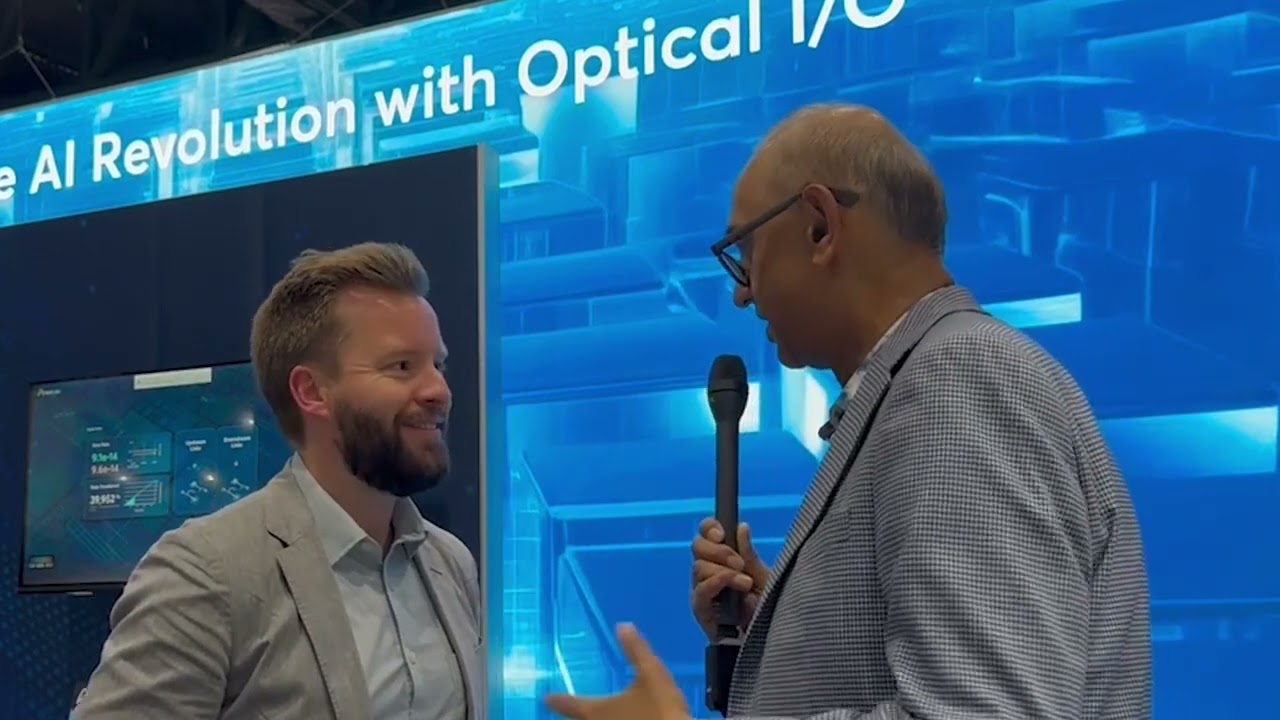
The market story wandered more than the technology. High-performance computing offered the first obvious application. Telecommunications, aerospace, and defense provided other demanding environments. Around 2018, Ayar Labs began leaning into AI, not because the future had been revealed but because large models fit the profile: enormous compute, enormous traffic, and an interconnect valuable enough to justify a new stack. Transformer models were young. ChatGPT was years away. The company had found a workload whose ambition matched its bandwidth charts.
From proof to production readiness
The engineer follows the urgent problem
Wade's title changed more dramatically than his operating principle. He served as president and chief scientist, then CTO and senior vice president of engineering. In December 2023, Ayar Labs named him CEO. He replaced Charles Wuischpard, who had led the company for five years and remained briefly as an adviser. Wade publicly thanked Wuischpard as both leader and mentor, a small but useful detail in an industry fond of portraying transitions as coronations.
The CEO version of Wade no longer spends every day at the chip-design console. He works with major customers, supply-chain partners, investors, and the teams responsible for execution. Yet he describes the transition with an engineer's test: identify the most important problem at Ayar Labs at a given moment, then put his time there. In the apartment era, that meant seven-day weeks and eighteen-hour tape-outs. At other points, it meant getting on the road because the company needed capital. Now it means making the product manufacturable, integrable, and dependable at volumes no academic demonstration has to contemplate.
There is a founder lesson hiding here, but it is not the decorative sort. A stable mission can demand a changing identity. Wade did not leave engineering behind when he became CEO; he enlarged the system boundary. The object to debug now includes partnerships, capital, schedules, standards, and confidence.
04 / Timing catches upAI turns traffic into strategy
By 2024, the commercial context had changed sharply. Ayar Labs raised a $155 million Series D from investors including AMD Ventures, Intel Capital, and NVIDIA. In March 2025 it unveiled an 8 Tbps TeraPHY optical chiplet using the open UCIe interface and a 16-wavelength SuperNova light source. Open standards matter because an optical engine becomes more attractive when designers can place it into multi-vendor chiplet systems without adopting a private electrical interface.
Recognition followed. Goldman Sachs named Wade among its Most Exceptional Entrepreneurs of 2025. Louisiana Tech honored him as a College of Engineering and Science Alumni of the Year. Ayar Labs expanded its San Jose headquarters, opened an office in Taiwan, and deepened partnerships across the semiconductor supply chain.
Then came the capital intended to turn preparation into output. On March 3, 2026, Ayar Labs announced a $500 million Series E led by Neuberger Berman, with participation from institutional investors and strategic backers including AMD, Alchip, MediaTek, and NVIDIA. The round brought total funding to $870 million and valued the company at $3.75 billion. Its stated purpose was concrete: expand high-volume production and test capacity.
That use of money says more than the round's size. A photonic engine has to survive temperature changes, package tolerances, continuous operation, and the awkward geography of a real rack. It has to arrive in quantities a customer can plan around. The light source must be replaceable, the electrical interface familiar, and the test process economical. Each requirement narrows the distance between an impressive device and a dependable part. Wade's present task is to close that distance without losing the performance that made the device interesting. The work is cumulative, unromantic, and decisive: a hundred small agreements between physics and production.
Wade expects the decisive transition during 2027 through 2029, as large customers build optical connectivity into new accelerator roadmaps. Beyond that, he sees optically connected systems spreading from leading AI installations into telecommunications, aerospace, satellites, and defense. Consumer devices can wait. He is not pitching a glowing phone. He is trying to make thousands of accelerators act less like neighboring machines and more like one computer.
The grocery-store investor has become a durable joke because the reversal is neat. Reality is messier and more interesting. Ayar Labs did not win by waiting for everyone else to admit the founders were right. It spent a decade turning a research result into a supply chain while the application caught up. Light was always fast. The company had to learn patience.