At first glance, an optical transceiver does not look like the hinge of history. It is a small metal package, the sort of thing that might disappear into the neglected drawer where adapters go to wait for a future that never comes. Rafik Ward has built a career on understanding why this particular future did come. The module takes electrical data, turns it into light, sends it through fiber and reverses the trick at the other end. Multiply that exchange across a data center, then across the world, and the modest component becomes part of the nervous system of modern computing.
Ward now serves as senior vice president, chief strategy officer and chief marketing officer at Lumentum, the San Jose photonics company. It is a pairing of titles that suits him. Strategy asks where technology and capital should go. Marketing asks how to make that journey intelligible. Ward has spent more than twenty years crossing that bridge, close enough to the engineering to hold three optical-communications patents and fluent enough in the market to explain what a lane, a laser or a link means for a business.
His timing looks enviable in 2026. AI systems are consuming compute and moving data at a rate that makes their connections a first-order problem. Yet Ward's career began long before phrases such as “AI infrastructure” could rescue a dinner conversation. He joined Finisar in 2003, when the optical industry was still recovering from the telecom crash and 10 gigabits per second sounded brisk. He stayed through several cycles, a useful apprenticeship in a field where the laws of physics remain calm while forecasts become excitable.
An engineer learns the market
Ward studied mechanical engineering at the University of British Columbia, then earned an MBA from MIT Sloan in 2001. Even his school record shows the two halves of the later executive. At MIT he was co-president of the Middle East Club and helped organize a Middle East trip, a cultural function, a California technology trek and a Whistler ski trip. MIT awarded him a Martin Trust Community Fellowship for leadership and contributions to student life. The list has the appealing untidiness of actual community building: international dialogue, company visits and snow.
Two years earlier, Ward had spent four months volunteering with Crossroads International in rural Botswana, improving groundwater pumping stations. The work belongs to a different scale than optical networking, but both begin with physical systems that matter most when they fail. Later, in 2019, he became a founder and board member of WEST Scholars, an organization that supports full scholarships for science and engineering undergraduates in Africa.
At Finisar, Ward moved through marketing, product management, business-unit leadership and corporate strategy. His public trail reads like a compressed history of bandwidth. In 2008, as senior director of marketing, he discussed how a chirp-managed laser developed for long-haul transport might find a life in data communications. In 2009, as vice president of marketing, he presented a working 120 Gb/s parallel active optical cable as progress toward 100G links. By 2014 he was explaining a 50 Gb/s silicon-photonics demonstration and the possible Ethernet standards it could serve.
The numbers grew, and so did Finisar. During Ward's tenure, the company's annual revenue rose from roughly $120 million to $1.4 billion. Lumentum's biography of Ward credits him with a pivotal role in Finisar reaching the top global market-share position in optical modules. That achievement had less glamour than a consumer launch. Optical components earn their reputation one reliable shipment at a time.
“The optical landscape is changing rapidly, and we're watching this happen in front of our very eyes.”
The useful intermission
Finisar was acquired by II-VI in 2019. Ward's next act was more distributed. He founded Early Light Consulting in 2020 and advised technology startups and private-equity firms on strategic and operational questions. His orbit included photonics companies such as DustPhotonics, Enosemi, Enlightra, Dream Photonics, Nexus Photonics and AttoTude, along with a board role at COTSWORKS. The work placed him across a young silicon-photonics ecosystem rather than inside one corporate chart.
That intermission matters because the optics market was changing its address. Telecom had long provided the demanding use cases. Cloud data centers brought immense volumes. AI clusters then began compressing vast amounts of compute into tight spaces, where every electrical connection carried a bill in heat, power and reach. The component conversation became an architecture conversation, and Ward had spent years learning both dialects.
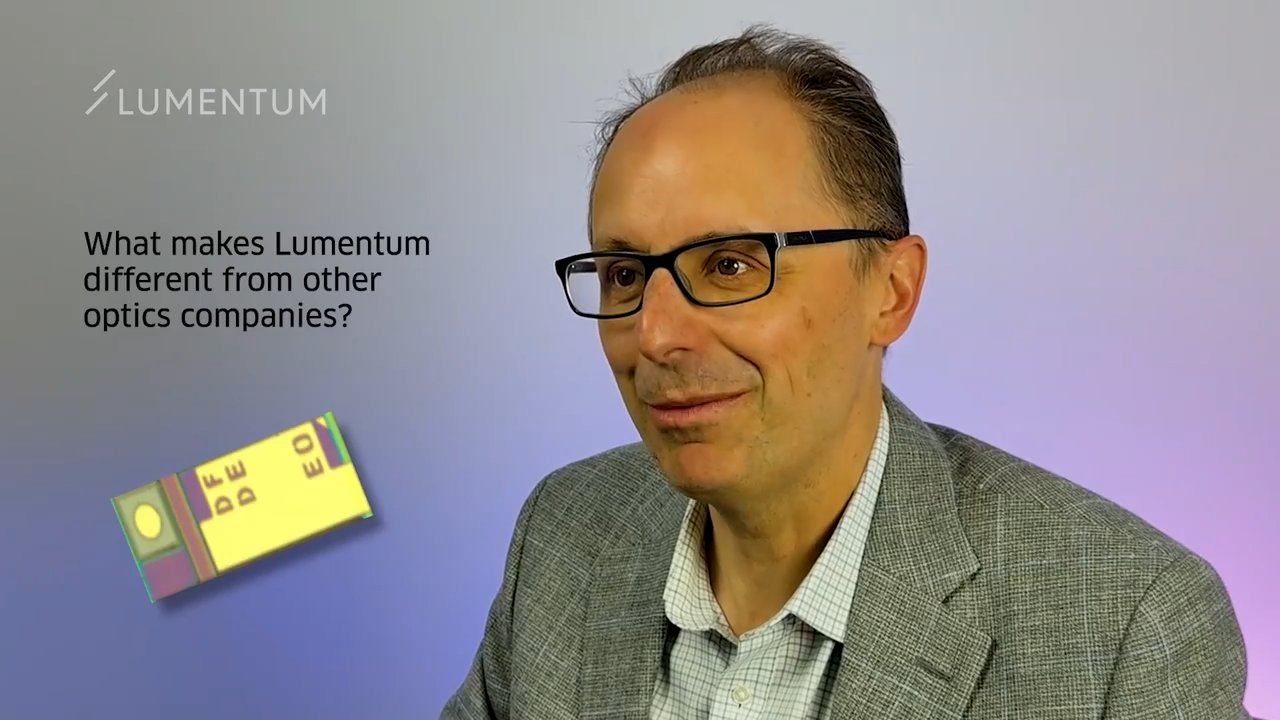
In April 2025, Ward joined Lumentum to lead global marketing strategy and corporate growth initiatives, including mergers and acquisitions, strategic partnerships and market development. Within a year, his title had expanded to chief strategy officer and chief marketing officer. The remit places him where manufacturing capacity, product choices and a rapidly forming AI market meet.
Four verbs, many photons
Ward's first Lumentum blog post gave the portfolio four pleasingly blunt verbs: transmit, receive, amplify and switch. Lasers and modulators transmit. Photodiodes receive. Pumps and optical amplifiers strengthen signals. Wavelength-selective and optical circuit switches direct them. The framework does what good product strategy should do. It leaves the complexity intact while giving readers a handle sturdy enough to pick it up.
The four verbs also reveal Lumentum's strategic advantage under Ward's telling: it participates throughout the network without trying to sell everything. He points to high-speed electro-absorption modulated lasers, continuous-wave lasers, high-power sources for co-packaged optics, tunable lasers, optical circuit switches and high-speed transceivers. Breadth matters because the next network may use several optical approaches at once.
At OFC 2026, Ward discussed this plural future in concrete terms. Demand for indium-phosphide lasers is rising. Lumentum is adding fabrication capacity. It is also developing VCSEL-based approaches for co-packaged optics and demonstrating optical circuit switching for large AI clusters. Strategy here resembles a well-arranged workbench: several tools, each honest about the job it can do.
When copper gives way
Ward expects one of the next changes to happen inside the AI cluster. The “scale-up” network, connecting processors into a larger computing system, has historically used copper. As clusters expand, he expects optics to take a growing share of those links. He also expects greater adoption of co-packaged optics, which moves optical functions closer to switching silicon, and a steep increase in lane counts.
The lane count keeps climbing
Conceptual progression based on Ward's five-year industry outlook. Bar height illustrates lane count direction, not physical size or market share.
For the first decades of optical transceivers, ports were generally single-lane devices. Around 2015, the industry began moving to four lanes; eight-lane designs followed. Ward now talks about future transceivers with 64 lanes or more, in both pluggable and co-packaged forms. The progression sounds like a spec-sheet contest until one remembers what each lane carries: model parameters, training data, requests and results, all trying to cross the same narrow shoreline of a chip.
His argument for co-packaged optics is similarly operational. The technology has been discussed for roughly a decade, but AI workloads have sharpened the reasons to deploy it. Bringing optics close to the switch can improve link reliability, increase bandwidth density at the chip edge and simplify the work of bringing new racks online. In the race to build compute, installation time becomes part of product performance.
“Future transceivers will have many more lanes than this. We're talking about transceivers that have 64 lanes, some even greater than 64 lanes.”
The person in the system
Ward's recent public posts add a human counterweight to the architecture diagrams. After his first year at Lumentum, he wrote that working at the frontier of optics and AI felt like a blessing, then quickly moved the credit to the people around him. “In my experience, it's truly the people who make a place what it is,” he wrote. In another post, he tried to thank Sean Ogarrio, a colleague retiring after forty years, and admitted he was still struggling to find adequate words.
This instinct fits the earlier clues: the student clubs, the volunteer engineering, the scholarship organization, the years spent translating specialist work for wider audiences. It also serves a practical executive purpose. Photonics does not scale through diagrams alone. It scales through fabs, packaging lines, reliability testing, standards meetings and teams willing to make the same component correctly a very large number of times.
The small metal module from the neglected drawer has become an object of strategic attention. AI needs compute, compute needs connections and those connections increasingly need light. Ward arrives at this moment with a rare continuity: he spoke about 100G before it was ordinary, showed silicon photonics before it was fashionable, advised the startups pushing integration forward and returned to a large manufacturer when capacity became urgent.
His story offers a tidy lesson from an untidy industry. Careers compound when a person stays near a durable constraint. For Ward, the constraint has always been moving more information, farther and faster, without losing the signal. The components have changed. The lane counts have multiplied. The strategy remains wonderfully physical: make the light, guide the light and be ready when the rest of the world finally notices it.