Company File · Photonic Computing
Lightelligence
The MIT spinout teaching data centers to think in photons.
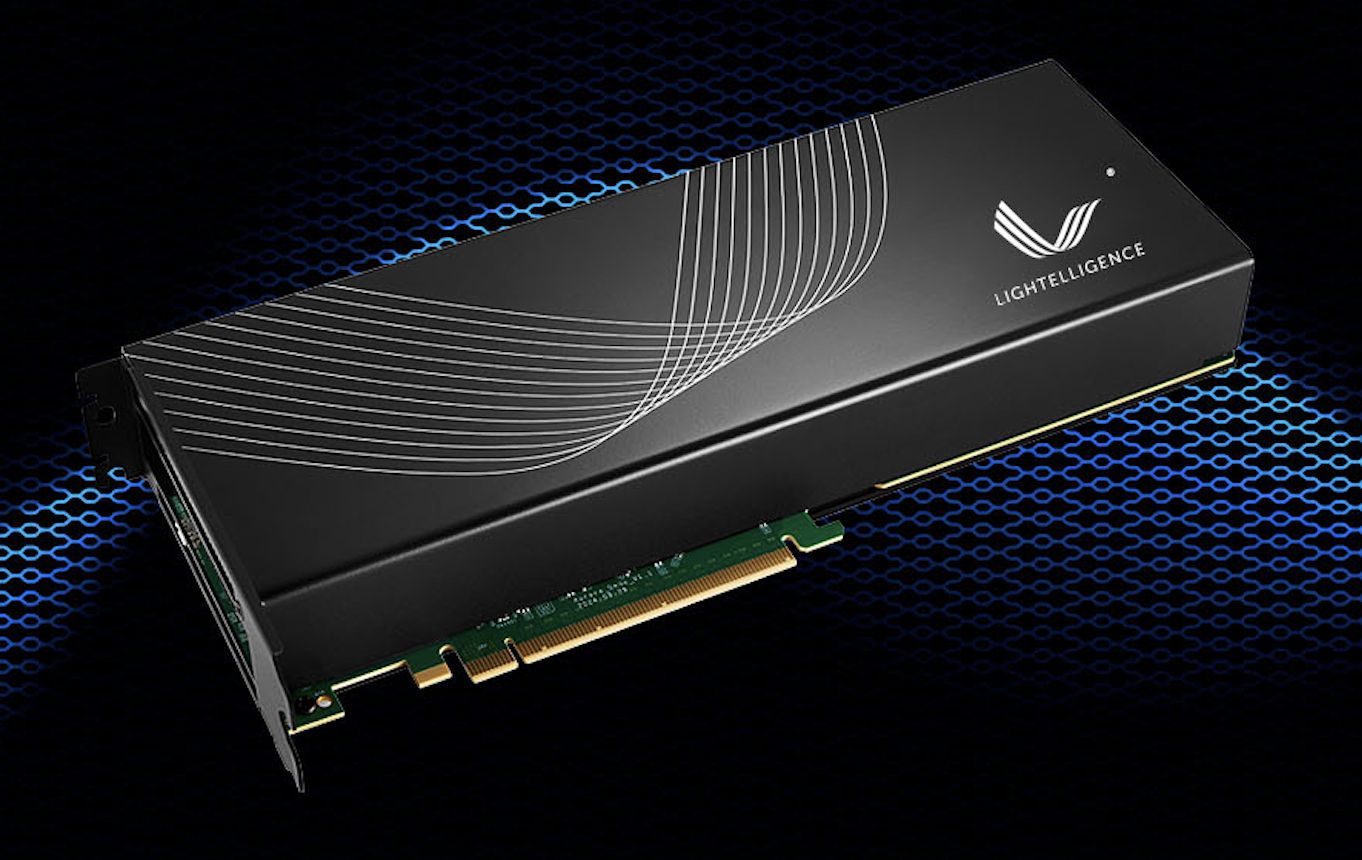
PACE2: the part of the data center that runs on sunlight's day job - light.
The MIT spinout teaching data centers to think in photons.
On a trading floor in Hong Kong this spring, a chip company nobody outside of physics labs had heard of opened at a price four times its listing. The product inside the box does something deceptively simple: it computes with light.
Lightelligence does not sell faster electronics. It sells an exit from them. For half a century the industry made transistors smaller and called it progress. Lightelligence looked at the copper wires connecting those transistors - the unglamorous plumbing of every AI data center - and decided the bottleneck had moved. Their bet: the next leap in computing is not a smaller switch, but a different messenger. Photons instead of electrons.
It is, admittedly, the kind of idea that sounds like a science-fair poster until someone raises $319 million and rings an opening bell. They did both.
Here is the uncomfortable secret of the AI boom: the expensive part of a data center is increasingly not the math, but the moving. Shuttling data between processors, memory, and accelerators eats bandwidth and burns power. Electrons in copper get hot, get slow over distance, and refuse to scale politely. The more chips you bolt together, the worse the traffic jam.
Everyone in the industry can see this. The interesting question is what you do about it. Most answers involve doing the same thing harder - thicker wires, fancier packaging, more power. Lightelligence proposed something less obedient: stop sending electrons through metal and start sending light through glass.
In 2017, a graduate student named Yichen Shen was lead author on a Nature Photonics paper with the unassuming title "Deep learning with coherent nanophotonic circuits." It showed that a neural network could run on a chip that did its arithmetic with beams of light. Most papers end on a citation. This one spun out of MIT and became a balance sheet.
Shen brought along company worth keeping: Marin Soljacic, the MIT physics professor (and wireless-power pioneer) whose lab the work grew out of; Huaiyu Meng, an MIT engineering PhD who took the CTO seat; and Spencer Powers from the Sloan School, who runs the business side as president. Four people, one idea that the rest of the field had filed under "interesting, someday."
The founding technology wasn't a pitch deck - it was peer-reviewed physics. Lightelligence is one of the rare hardware companies whose origin story you can find in a journal index.
Lightelligence's product names - Hummingbird, Photowave, Moonstone - sound like a birdwatching catalog and behave like a data-center upgrade. The naming is whimsical. The engineering is not.
The Photonic Arithmetic Computing Engine pairs a 64×64 optical matrix multiplier with a CMOS chip - a working photonic computer, not a slide. PACE2 is the 2026 second generation.
A "system in a package" wiring a 64-core AI inference accelerator together with a programmable optical layer, so cores talk at the speed of light.
The first optical communications hardware built for PCIe and Compute Express Link - the connective tissue of composable, disaggregated data centers.
A multi-wavelength comb laser that supplies the actual light powering the interconnect products. Every optical system needs a sun; this is theirs.
"Deep learning with coherent nanophotonic circuits" publishes in Nature Photonics. Lightelligence spins out of MIT in Boston.
An early optical AI accelerator demonstration - proof the physics survives contact with a real chip.
A fully integrated photonic computing platform with a 64×64 optical matrix multiplier on a CMOS chip.
Optical interconnect for PCIe/CXL and the optical network-on-chip arrive, aimed at composable data centers.
One of the year's larger deep-tech rounds, led by China Mobile, Shanghai State-owned Investment and others.
Lists on the SEHK as the world's first AI silicon-photonics chip stock; shares jump roughly 400% on day one.
Skepticism is healthy here - deep-tech hardware has a long graveyard. So look at the money, which is harder to argue with than a pitch. Lightelligence raised across four rounds and capped it with a public debut that priced the company in the tens of billions of Hong Kong dollars.
On its 2026 Hong Kong debut, Lightelligence stock surged about 400%, closing with a market cap near HK$81.5 billion. Investors weren't buying revenue - 2025 sales were modest - they were buying the bet that AI's next bottleneck is optical.
The stated goal is unfussy: break the bandwidth and energy ceilings of AI computing by moving and processing data with photons. The unstated ambition is larger - to make optical the default layer of computing rather than the exotic one. If they're right, "co-packaged optics" stops being a conference panel and becomes the boring, necessary plumbing nobody thinks about. That, for a hardware company, is the dream: to become invisible because you're everywhere.
There's irony in it. A company built on light wants its biggest success to be that you never notice it - the same way you never notice the fiber under the ocean until it goes quiet.
An IPO is a starting gun, not a finish line. Lightelligence has competitors with similar convictions - Ayar Labs, Lightmatter, Celestial AI - and incumbents like Nvidia and Broadcom circling co-packaged optics from above. Modest 2025 revenue against a multi-billion valuation is a gap that physics alone won't close; manufacturing, yield, and customers will. Skeptics have a point. They usually do, right up until they don't.
Back to that Hong Kong trading floor. The number on the screen jumped fourfold because a room full of careful people decided the unglamorous plumbing of AI is about to change hands - from copper to glass, from electrons to light. Lightelligence didn't invent that idea on debut day. It published it in 2017 and spent nine years making it shippable. The opening price was just the moment the rest of the world finished reading the paper.