Imagine buying a second kitchen because the first chef cannot reach the pantry quickly enough. The chef is excellent. The ingredients exist. Yet dinner arrives late, and the electricity bill keeps rising. This is the odd predicament Majestic Labs sees in AI infrastructure: organizations adding processing power to work around a shortage of accessible memory. Its founders have spent years building chips. Now they are asking what happens when the pantry becomes the starting point.
- The problem: large AI workloads can leave processors waiting for data.
- The proposal: Prometheus gives processors one large, shared memory pool.
- The people: three founders who previously worked together at Google and Meta.
- The test: broad availability is planned for 2027; efficiency figures remain company claims.
01 / THE EXPENSIVE WAITWhen faster chips arrive hungry
The memory wall describes a mismatch: processors can calculate faster than the memory system can supply what they need. Capacity matters, too. A model may need more fast memory than one accelerator provides. Splitting it across more hardware adds connections, movement and coordination. Majestic’s objection is that customers can end up purchasing additional compute partly to obtain additional memory. A procurement decision becomes an architectural workaround.
That distinction matters most in inference, when a trained model answers users. Longer conversations and larger models make memory harder to ignore. In the founders’ account, watching those demands grow changed the question they wanted to answer. Racing NVIDIA on its established terms looked unappealing. They would instead separate memory from compute so that one could grow without obliging the customer to buy more of the other.
02 / THE MACHINEPrometheus rearranges the furniture
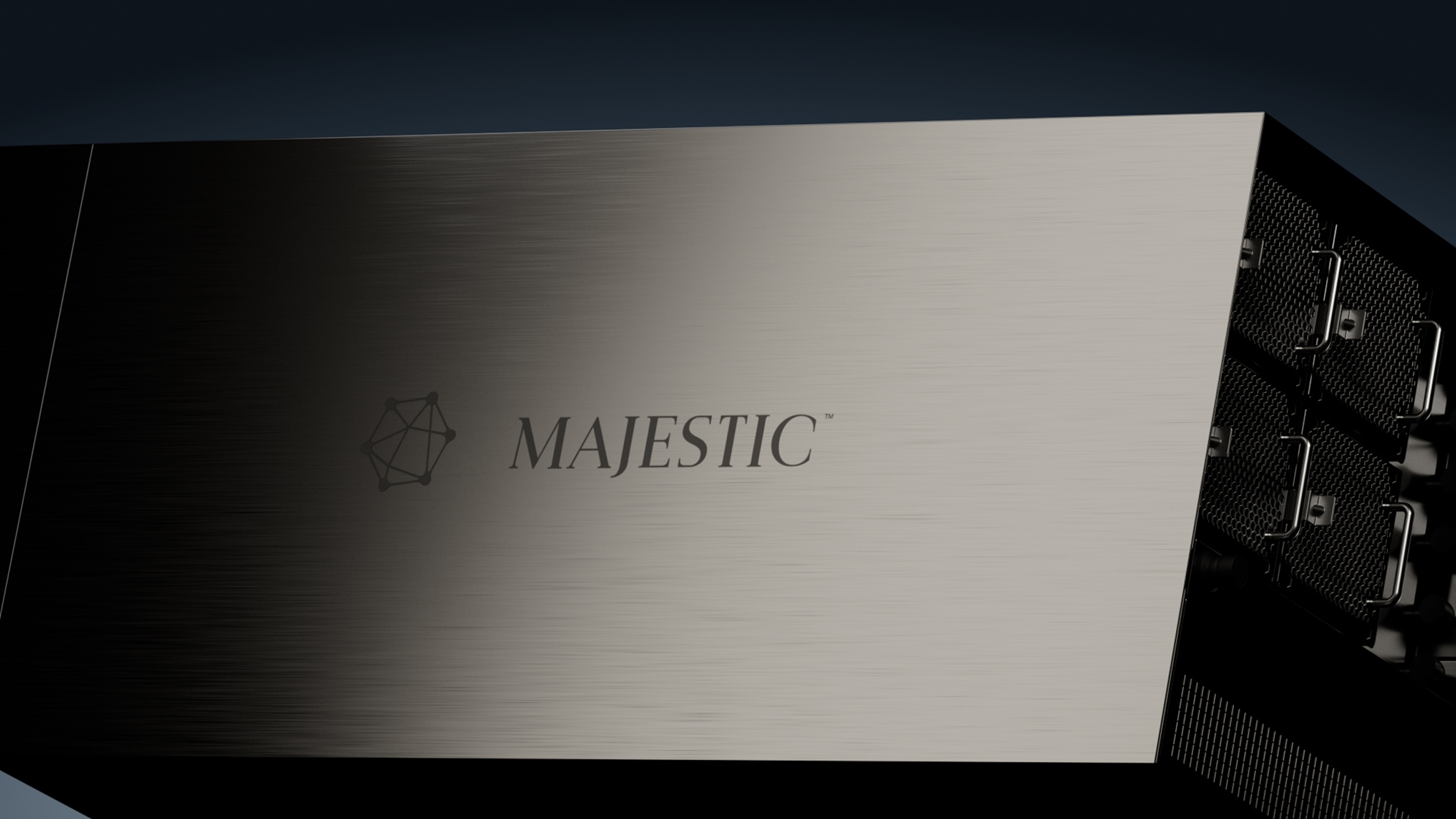
Announced in April 2026, Prometheus is a server built around a uniform, shared memory space, configurable up to 128 terabytes. Ignite, its proprietary AI Processing Unit, brings Arm application cores together with RISC-V vector and tensor cores. These elements operate in the same memory space. The proposition is a whole system: processors, memory connections and software arranged to make very large workloads less awkward to run.
Prometheus’ announced maximum shared-memory capacity per server.Design specification. Not a speed multiplier.
The intended uses include large language models, long contexts, mixture-of-experts systems and agentic AI. Majestic also points to graph and tabular models. These are workloads for which keeping substantial amounts of information readily accessible can matter. The appeal is particularly clear when an organization’s ambition exceeds the memory available in its existing machines. A smaller model that already fits comfortably presents a different buying calculation.
03 / THE REUNIONThey have built together before
Ofer Shacham is CEO, Sha Rabii is president, and Masumi Reynders is COO. Their partnership predates the company’s late-2023 founding. They helped establish silicon organizations at Google and Meta, giving them experience with the unpleasant distance between an attractive chip design and hardware that ships. Rabii’s Google teams delivered components including the Pixel Visual Core and YouTube’s Argos video transcoder. Shacham’s work included specialized computing and silicon for Meta’s glasses.
Reynders brings a legal and business background, with responsibilities spanning operations, strategy and ecosystem relationships. That is useful company in a room full of engineers. In a September 2026 interview, she described admitting what she does not know as a way to make colleagues explain the benefit to the end user. The habit supplies a quiet discipline: an impressive engineering answer still needs to answer somebody’s actual question.

04 / THE SOFTWARE BARGAINThe programmer gets a vote
A new processor asks developers to trust unfamiliar machinery. Majestic is trying to make that request smaller. It announces support for PyTorch, vLLM and Triton, familiar tools in AI development, with the intention of running existing code without changes. This is a product promise as consequential as the memory capacity. Software teams have deadlines; they cannot spend every quarter acquiring a new professional identity to accommodate another accelerator.
“The system just has to work, with no switching cost.”MASUMI REYNDERS / PROMETHEUS ANNOUNCEMENT, APRIL 2026
The company calls this priority Day 1 productivity. Its announced AWS relationship concerns help developing the infrastructure; it should not be mistaken for a fleet of Prometheus servers already running inside AWS. The larger lesson is practical: replacing hardware means negotiating with the software already in place. Buyers should test the actual models, libraries and operational routines they intend to use, rather than treating framework support as a universal compatibility certificate.
05 / THE BILLA hundred million buys a chance
Majestic emerged publicly in November 2025 with more than $100 million in financing. Lux Capital led the earlier seed round; Bow Wave Capital led Series A. The capital supports hiring, the software stack and customer pilots as the product approaches general availability. It is funding for development, rather than evidence that an equivalent amount has already been spent. The business is aimed at selling AI infrastructure to organizations, not subscriptions to a consumer chatbot.
Its prospective buyers include hyperscalers, AI cloud operators and enterprises. September coverage describes orders and evaluation work with cloud, finance and AI organizations. Majestic’s commercial argument is fewer machines, less power and more useful work from the available infrastructure. Its claimed performance improvements are projections to assess against specific workloads. For a power-constrained data center, useful output within the electricity budget can matter more than the glamour of an individual chip.
06 / THE BORROWABLE IDEAMeasure the queue before buying another chef
A sensible pilot would hold model quality and the user experience constant, then compare completed work, response time and energy use. Include the time engineers spend bringing the system into service. That makes the purchasing question more honest: does the proposed architecture improve the entire job at an acceptable cost? A large memory specification is a reason to investigate, not a substitute for the answer.
What can an infrastructure team copy today? Start by asking why the processor waits. Measure memory demand, data movement, latency and useful output per watt on the workload that pays the bills. Additional memory will not cure every limit: a compute-bound job, an unsupported software dependency or a demanding migration could change the result. Prometheus will have to earn its place through those ordinary tests. The name comes from the Greek figure who brought fire to humanity. Customers will judge the delivery.