The first objection was that Sid Sheth was too late. In 2019, more than a hundred companies were already trying to make chips for artificial intelligence. Venture capital had heard a great many silicon pitches and developed the weary expression of a maître d’ at closing time. Then Sheth and his co-founder, Sudeep Bhoja, offered a fresh complication: they wanted to build for inference in the data center. Some investors answered with a question. What, exactly, was inference?
Training an AI model is the expensive education. Inference is everything that follows: every prompt answered, image made, sentence translated and line of code suggested. Sheth liked to explain the distinction through a human life. We spend our early years learning, then several more decades applying what we learned. Efficiency matters in the long second act. In 2019, however, the semiconductor crowd was watching the classroom.
Sheth had reason to watch what happened afterward. He had spent more than two decades following information as it moved through machines. After a master’s degree in electrical and computer engineering from Purdue, he joined Intel in 1997 and worked around Pentium microprocessors and network processors. He then became a founding team member at Aeluros, moved through NetLogic and Broadcom, and eventually ran Inphi’s networking business. As cloud companies connected larger fields of processors, he saw AI traffic beginning to reshape the data center. Training was conspicuous. Use, he believed, would be enormous.
His earlier work had already joined engineering to commerce. At Aeluros, he helped market mixed-signal chips for high-speed networks and co-authored a paper presented at the 2006 International Solid-State Circuits Conference on a 10-gigabit Ethernet laser driver. NetLogic acquired Aeluros the following year. At Inphi, Sheth helped build a networking operation around the pipes inside cloud data centers, growing it past $1 billion. The sequence taught a durable lesson: a chip is never merely a chip. It sits inside a standard, a supply chain, a customer budget and a system that must be persuaded to change.
A leap with something to lose
This was not the standard fable about a prodigy abandoning a dorm room. Sheth and Bhoja were well into their forties. Their children were teenagers. Both men held senior positions at Inphi, a company that Marvell would later buy in a deal valued around $10 billion. Starting over looked, in Sheth’s own telling, “foolhardy.” It also looked familiar. Sheth came from generations of Gujarati entrepreneurs in India. His grandfathers, father and uncles had built businesses; working for someone else was, as he put it, generally frowned upon.
The inherited instinct did not make the timing kind. Six months after d-Matrix began, the pandemic scattered its people. California’s 2020 fire season added evacuations and unease. The company was experimenting with analog in-memory computing, an approach that promised efficiency but presented ugly practical tradeoffs. Converters were difficult to fit along the bitlines. Accuracy, predictability and programmability could suffer. The hardware did not care how sincere the founding thesis was.
“Sometimes it’s easier to get $40 million than to get $2 million when you are serving a large market opportunity.”Sid Sheth on d-Matrix’s near-death year
So the team changed the architecture. It moved toward an all-digital system that combined SRAM memory cells with computation in a custom circuit fabric. Software and hardware were developed together, a priority Bhoja insisted on from the beginning. The target changed too. Early attention to computer vision and recommendation systems gave way to transformer models such as BERT and GPT-3. d-Matrix kept the problem and replaced the assumptions.
The memory problem, simplified
stores model data
cuts the round trips
Inference repeatedly retrieves model information. Moving less of it over distance can reduce delay and energy use.
The $2 million ask was the dangerous one
By late 2020, the young company had built and packaged a proof-of-concept chip with working software in twelve months. It needed another $2 million to manufacture silicon for a customer demonstration. Investors would not provide it. With roughly two weeks of cash remaining, the founders asked an impolite strategic question: what sort of chip company were they proposing to build with only $2 million?
They rewrote the plan and asked for $40 million. The larger number described a larger destination, and the signal changed. A Series A followed, backed by Playground Global and Microsoft’s M12 among others. Nighthawk, the first proof-of-concept chip, was not the final architecture. It was evidence that the team could turn an idea into silicon while the floor moved beneath it.
Each year seemed to provide a market reply. GPT-3 showed surprising ability. ChatGPT turned generative AI into a public habit. Open-source models broadened access. Reasoning systems demanded more computation at the moment of use. d-Matrix adjusted repeatedly, but not randomly. Its compass continued to point toward inference, transformers and the growing cost of moving model data between memory and compute.
Then the world learned the word
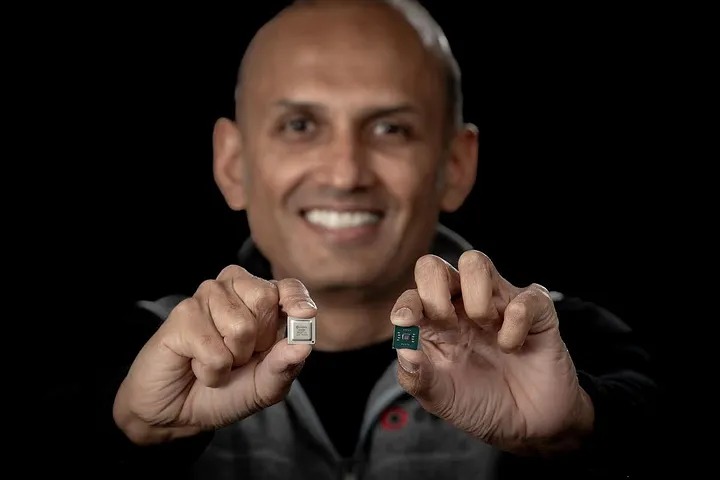
When ChatGPT arrived in November 2022, Sheth called it a “holy smokes” moment, politely. The company had already redesigned its product around generative transformers. What became Corsair would use eight chiplets on a PCIe card, high-density SRAM as performance memory and a software stack called Aviator. The objective was not a prettier benchmark. It was to generate tokens quickly enough for many people to interact with AI at once.
The timing still demanded patience. A chip must be designed, taped out, fabricated, packaged, tested, programmed and supported. It cannot be patched into physical existence on a Friday afternoon. In 2023, during a bleak funding market, d-Matrix raised $110 million. In November 2025 it closed a $275 million Series C at a $2 billion valuation. The company said the round brought its total capital raised to $450 million.
The investors now spanned the same geography as the ambition. Temasek, Microsoft’s M12, the Qatar Investment Authority, EDBI, Industry Ventures, Mirae Asset and others participated in the Series C. d-Matrix had also grown beyond its Santa Clara base, with teams in Toronto, Sydney, Bangalore and Belgrade. More than 250 people were working on a thesis that had begun with two semiconductor veterans leaving secure posts. Capital did not make the original hunch correct, but it bought the fabrication runs, compiler work and patient debugging needed to test it in public.
Money was not the finish line; production was. Corsair entered full production in June 2026, manufactured with TSMC and Alchip on an established N6 process. d-Matrix emphasized ordinary data-center virtues: PCIe cards, air cooling and components selected with supply in mind. The clever chip would still have to arrive, fit and run. Infrastructure prefers revolutions that respect the loading dock.
Sheth’s strategy also became less gladiatorial than the usual chip contest. GPUs remain excellent at the compute-heavy opening phase of a response. Corsair is designed for the memory-sensitive decode phase, when a model produces tokens one after another. In this view, CPUs, GPUs and specialized XPUs divide the labor. Parasail announced a deployment combining Corsair with NVIDIA Hopper and Blackwell systems. d-Matrix later said its next-generation Raptor accelerators would fit NVIDIA’s NVLink Fusion rack infrastructure.
“Stay humble, stay paranoid, and execute.” Sheth says d-Matrix looks for people who learn from feedback, bring full effort to their craft and persist through setbacks.
The personality of a long bet
Sheth’s public language is full of movement: leaps, pivots, inflection points, catching wind. Yet the temperament underneath appears less breathless. He looks for fast learners and persistence in colleagues. His company’s maxim borrows the productive anxiety long associated with Intel. Humility keeps a team listening; paranoia keeps it checking; execution makes both traits useful.
He does not claim a tidy division between work and life. Instead, he changes the context in which he sees the work. He hikes near large bodies of water, meditates, listens to Indian classical music and goes to the gym with his sons. The habits suit a person who has spent his career around invisible traffic. Step away, clear the clutter, return to the flow.
By 2026, d-Matrix was expanding beyond a card. It acquired GigaIO’s data-center business for rack-scale systems expertise, then Wallaroo.ai for deployment and orchestration software. Its portfolio stretched from Corsair accelerators to JetStream networking, Aviator software and complete rack designs. The chip startup was becoming an inference platform company because, as Sheth put it, inference had become a systems problem.
His ambition is correspondingly broad: make generative AI inference commercially viable for everyone. In India, he has spoken of affordable compute as a condition for wider participation. He has said he wants half of the world’s AI decisions to run through d-Matrix technology, a destination grand enough to make the old $2 million request seem almost quaint.
The outcome remains unwritten. Semiconductor markets are littered with correct predictions that arrived before customers, after budgets or beside a dominant ecosystem. Sheth understands this from experience. His notable achievement so far is not that every hunch proved right. It is that he and his team changed the design, the workload, the financing plan and the product while preserving the central idea: the world would spend far more time using AI than teaching it.
“Everybody doesn’t want to train AI. Everybody wants to use AI.”Sid Sheth
In 2019, that distinction required an explanation. Now it describes the bill. Every answer carries a cost in time, electricity and hardware, multiplied by millions of people and machines. Sid Sheth bet that the unglamorous second act would become the main event. The audience has arrived; d-Matrix is finally carrying its equipment onto the stage.
Follow the work