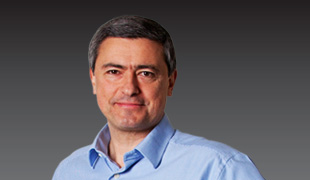
In January 2026, Khaled Nasr published a book called Rule Arbitrage - about evading regulatory, tax, accounting, and credit rating rules. The title alone tells you something about the man: he spent two decades in venture capital and still finds the rules worth studying, even the ones worth bending.
Nasr is the General Partner and Chief Operating Officer at InterWest Partners, the Menlo Park firm that has been writing checks into healthcare and information technology for more than 40 years. He joined in 2005 as an IT investor, then took on the COO role in 2016 - a move that put him in charge of everything from financial operations to fundraising to investor relations. Running the back-office of a VC firm while also sitting on portfolio company boards is the kind of workload that demands either unusual organizational discipline or very little sleep.
Foreign investment is elusive for MENA startups - entrepreneurs need to develop products and markets that can attract international VCs.
- Khaled Nasr, via Wamda (2014)The Operator's Advantage
Before Nasr started writing checks, he spent 16 years inside networking and telecommunications companies at a time when the internet was still figuring out what it wanted to be. He ran sales and marketing operations, managed international expansion, and eventually climbed to the C-suite. At Advanced Computer Communications (ACC), he was COO, responsible for the company's international operations. At FlowWise Networks, he sat in the CEO chair.
That's not a resume detail. It's a filter. When a founder walks into an InterWest pitch and starts explaining why their sales motion won't work until year three, Nasr has seen that playbook from the inside. When a portfolio company CEO is deciding whether to take an acquisition offer or hold for an IPO, Nasr has made that call. The gap between investor and operator is narrower than most VCs like to admit, but Nasr is on the short list of people who have actually lived on both sides of the table.
Education: B.A. Mathematics + M.A. Social & Political Sciences, Cambridge University - an unusual pairing that may explain how Nasr navigates both technical diligence and human judgment calls with equal facility.
Alta Partners: The Learning Decade
Nasr made his first move into venture capital in 2000 as a General Partner at Alta Partners, where he invested exclusively in IT companies. The five years at Alta were his education in deal-making, and the exits tell a clean story. Synad was acquired by ST Microelectronics. Netli was acquired by Akamai. Celetronix landed at Jabil. Occam Networks went to Calix. Four portfolio companies, four acquirers that knew what they were buying. That's not luck.
By 2005, InterWest Partners came calling. The firm had the portfolio breadth Nasr was looking for - healthcare and information technology side by side, early-stage bets on companies that needed both capital and adult supervision. He joined the IT team and has been there for nearly two decades since.
The InterWest Portfolio
Nasr's board seats at InterWest portfolio companies cut a wide swath across enterprise technology. He joined the board of InVisage Technologies in 2008, a company working on quantum dot image sensors for cameras, and stayed until 2017. NexPlanar, which made polishing pads for semiconductor manufacturing, was another board seat from 2009 until its acquisition by Cabot Microelectronics. Xirrus, an enterprise Wi-Fi networking company, was on the list from 2009 to 2017.
The through-line across Nasr's portfolio isn't a single vertical - it's infrastructure. The plumbing that makes other technology work: networking, semiconductors, data storage, enterprise software. Companies that B2B buyers evaluate on spec sheets, not Super Bowl ads. When Virsto Software was acquired by VMware in 2013, it was because VMware needed what Virsto had built: storage virtualization for virtual desktop infrastructure. When DataRPM was acquired by Progress Software, it was because DataRPM's predictive maintenance AI fit neatly into an enterprise software platform. These are not consumer exits. They are the quiet, durable kind.
His active board seats as of 2025 include Aria Systems, a subscription billing and monetization platform that he joined in 2021, and Aryaka Networks, an SD-WAN and SASE company where he has been on the board since 2012. Thirteen years on an Aryaka board seat says something about patience - and about what the company has been building.
The COO Role: Running the Firm
In 2016, Nasr added a second title to his business card. As COO of InterWest Partners, he became responsible for the firm's financial management, fundraising cycles, investor relations, and administrative operations. For a firm managing hundreds of millions of dollars across multiple funds, that's a serious operational load. InterWest's most recent disclosed fundraising activity dates to 2008, when the firm raised its tenth fund - but the ongoing LP relationships, reporting cycles, and fund accounting don't stop between raises.
The dual GP/COO role is structurally unusual. Most VC firms separate investment and operations; partners focus on deals, and a separate COO handles the firm's internal plumbing. Nasr's version collapses both into one person. It's an efficient structure that requires - and rewards - the kind of operator who doesn't need to choose between thinking about companies and thinking about the firm itself.