Put common SoC infrastructure in a reusable hub chiplet. Let customers attach the specialized die.
Falcon silicon, Kameleon FPGA chiplets, CXL cards, switchless pools and JBOM racks.
CXL 3.0 samples, Achronix IP, Micron validation and a planned PNNL deployment.
Modularity wins only if compatibility, packaging, software and volume economics hold together.
A custom chip contains two kinds of engineering. There is the reason to build it: the novel accelerator, the peculiar algorithm, the trick that competitors do not have. Then there is everything required to make that clever thing behave like a product. It needs CPUs, memory controllers, security, I/O, software, testing and a way to speak to the rest of a computer. The first kind wins the pitch meeting. The second kind eats the calendar.
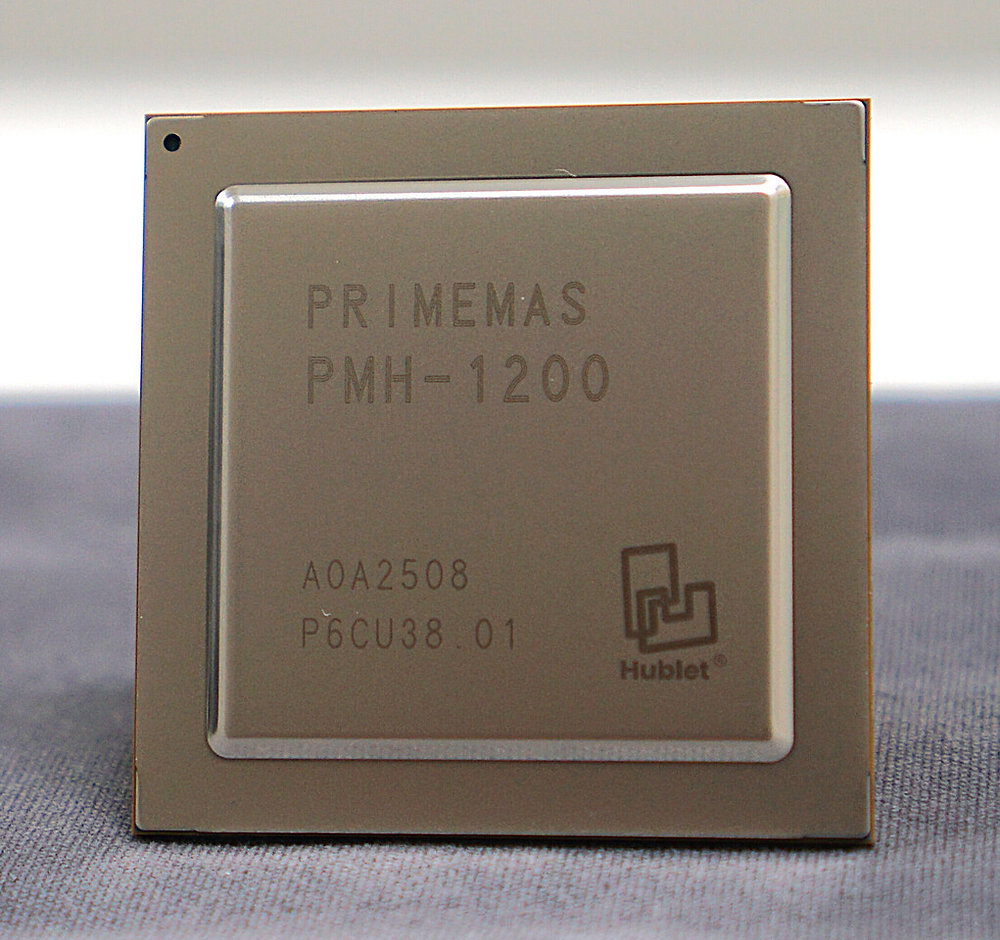
Primemas was founded in 2023 around a blunt question: why should every chip team rebuild the second kind? Founder and CEO Il Park had spent more than 25 years around server CPUs, mobile systems-on-chip and DRAM at IBM, Samsung and SK hynix. His answer is the Hublet, a pre-built hub SoC that collects the expensive common pieces and exposes high-speed die-to-die links for a partner's custom silicon.
Think of an ambitious restaurant. The chef should invent the dish, not pour the foundation, wire the building and certify the gas line. Primemas wants to deliver the semiconductor equivalent of the inspected kitchen. Its customer arrives with the recipe - an AI accelerator, perhaps - and plugs it into infrastructure that already knows how to boot, move data and address memory.
The division of labor
- Accelerator IP
- Domain knowledge
- The differentiating idea
- CPU + memory control
- CXL + I/O + security
- SDK + system fabric
The pitch is not “we make your accelerator.” It is “we make everything around your accelerator reusable.”
The first thing that fails is the schedule
A conventional advanced SoC can take two or three years. In a fast AI market, the product can be late before its first wafer returns. The bill is equally awkward: verification, physical design, software and packaging all scale with complexity, while a leading-edge mask set leaves little room for a casual second attempt. The company says Hublet can reduce both development cost and time to less than 10 percent of the conventional approach, and its corporate page puts time-to-market below one year. Those are Primemas's targets, not an industry audit, but they explain the architecture.
The cost of this wager is visible in Primemas's financing. The company raised a $72 million Series B in January 2026, after an earlier Korean pre-Series A reported at KRW 9.3 billion. It is not a software startup pretending fabrication is a detail. Primemas is fabless, but turning a block diagram into working controller silicon, boards and rack systems still consumes serious capital.
Then memory became the main character
Hublet began as a broad answer to custom SoC development. The market supplied a sharper problem. AI processors got faster, datasets got larger, and memory capacity became the part of the system everyone kept walking into. A GPU can perform arithmetic at astonishing speed and still spend expensive moments waiting for data. CXL, the cache-coherent link built on PCIe, lets servers attach and share memory beyond the DIMMs sitting beside a single CPU.
This changed the practical center of Primemas's story. Falcon-1, its first platform SoC, became a CXL controller and the base for a ladder of memory products. At the low end are direct-attached modules from 256GB to 4TB. Above them is SLiM, a switchless pool advertised from 1TB to 20TB. At rack scale there is JBOM - Just a Bunch of Memory - designed to range from tens of terabytes toward petabyte configurations. Near-memory computing puts selected work beside the data instead of hauling all of it back to a central processor.
The memory ladder
Capacity bands are Primemas product ranges. Bar lengths are illustrative, not linear.
“You bring your unique accelerator IP, and we provide the rest.”Primemas product proposition
That range also reveals the business model. Primemas is not merely licensing a diagram. It sells or co-develops silicon, add-in cards, custom boards, appliances and development systems. Product pages end in a conversation with sales, which is appropriate for equipment whose natural unit is a design win rather than a download. Customers include accelerator companies, memory manufacturers, cloud and data-center operators, database teams and builders of industrial or edge-AI machines.
The partners are part of the product
Chiplet marketing loves the Lego metaphor. Real chiplets are less forgiving. Electrical interfaces, package design, firmware, memory qualification and thermal behavior have to agree. A bright plastic brick clicks into place because an ecosystem has already absorbed the difficult standards work. Semiconductor modularity needs the same social machinery.
Primemas has assembled useful evidence of that machinery. Achronix supplies Speedcore embedded-FPGA IP for programmable Hublet configurations; the companies presented the combination at Chiplet Summit. Micron worked with Primemas through its CXL ASIC Validation Lab, and Primemas says its CXL cards are headed into Abaco, a rack-scale system for the US Department of Energy's Pacific Northwest National Laboratory. The planned system has more than 100TB of shared and pooled CXL memory, with Liqid contributing to pooling. Samsung and ETRI are pursuing a separate ultra-high-capacity CXL system that combines Samsung DRAM, Primemas controllers and ETRI integration.
These relationships matter more than a grand adjective. Customer samples appeared in 2025. In 2026 the company showed PMA14 and PMA16 add-in cards, SLiM and JBOM at the Future of Memory and Storage conference. Its September display described PMA16 as a 16-DIMM card with up to 8TB using 512GB RDIMMs and dual CXL 3.2 links. The story has moved from “a hub would be useful” to “here are the cards and the rack they are meant to enter.”
What another builder can copy
The portable lesson is not to name everything after small reptiles and household storage acronyms, charming as that may be. It is to identify the layer customers repeatedly pay for but do not use to differentiate themselves. Standardize that layer. Leave a clean boundary around the customer's special knowledge. Then make the reusable component valuable at several scales: chip, card, chassis and rack.
Primemas also chose a first market where modularity has a visible economic purpose. Extra memory capacity is easy to explain. Pooling can reduce stranded DRAM, while a switchless design can avoid the latency, cost and power of a separate switch in the configurations it supports. The benefit is legible before the grander dream of mix-and-match AI chiplets arrives.
The sharp edges
This approach is less persuasive when a product ships at enormous volume, where a tightly optimized monolithic SoC can repay its larger upfront cost through lower unit cost, power and package complexity. It also depends on reliable die-to-die standards, foundry and packaging access, mature software, workload support for CXL memory, and enough customers to amortize the common platform. A modular kitchen helps only when the connectors fit and the dinner service actually starts.
That is the honest tension inside Primemas. Its platform tries to remove bespoke work from an industry whose best products are often defined by obsessive optimization. Falcon does not have to beat every purpose-built SoC at every metric. It has to make enough products arrive sooner, at a tolerable cost and with performance customers can use. Abaco and the first production memory systems will be more revealing than any “world's first” label.
For now, the company occupies an interesting place between IP vendor, chip designer and systems maker. It sells the center that lets other companies own the edge. If that sounds less glamorous than inventing the next accelerator, that is precisely the point. The expensive plumbing becomes a good business when everyone else is relieved not to build it.