A modern AI server is a small kingdom with a celebrity problem. The GPU gets the portraits, the conference applause and the breathless comparisons. Around it, less photogenic machinery moves tensors across a network, fetches model weights from storage and coordinates work among machines. When that supporting cast falls behind, the glamorous chip waits. It is rather like booking a virtuoso pianist and forgetting the piano.
Eriko Nurvitadhi has spent much of his career in that supporting machinery. He is a computer architect, a former Intel researcher and principal engineer, and a co-founder of MangoBoost, the Bellevue company building hardware and software for AI infrastructure. MangoBoost now lists him as its chief AI officer, responsible for the product organization. His concern is not merely how fast a chip can calculate. It is how well an entire system turns expensive silicon into useful work.
This distinction has become costly. AI models are distributed across GPUs because one accelerator is often not enough. Those GPUs need to exchange data. They need to pull large datasets from storage. They need software that decides where work should go. A faster accelerator can make the surrounding delays more conspicuous, like a sports car forced into a grocery-store car park.
01 / The old questionCould the FPGA beat the GPU?
Nurvitadhi's path to this problem began before the AI infrastructure boom had a name. At Oregon State University, his education crossed electrical engineering, computer engineering, computer science, international studies and business. By 2004 he had completed both a master's degree in electrical and computer engineering and an MBA. That combination looks unusually broad for someone whose later work would become intensely technical, but it fits a career spent carrying ideas between research and products.
At Carnegie Mellon, where he completed a PhD in electrical and computer engineering in 2010, he worked with the ProtoFlex project. The project used field-programmable gate arrays - chips that can be reconfigured after manufacturing - to accelerate full-system multiprocessor simulation. Its aim was not simply to build faster hardware. It was to create a practical instrument for studying complicated computers.
The FPGA would remain a recurring character. Unlike a CPU or GPU, whose architecture arrives largely fixed, an FPGA can be arranged for a particular task. The flexibility costs something: programming is harder, and the surrounding software can be awkward. But it lets researchers ask deliciously impolite questions about what a computer ought to look like.
“Can FPGAs Beat GPUs in Accelerating Next-Generation Deep Neural Networks?”The title of a 2017 paper co-authored by Nurvitadhi
At Intel Labs and later in the Programmable Solutions Group CTO Office, Nurvitadhi explored those questions across AI and data analytics. He worked on accelerator architectures, systems and software flows, and on transferring research into technology that product teams could use. His publication record grew past 60 peer-reviewed papers. MangoBoost says he has roughly 30 granted patents and around 50 more pending. In 2020, Intel's patent group recognized him among its top 30 inventors.
The same year, the Semiconductor Research Corporation gave him a Mahboob Khan Outstanding Liaison Award. The award recognized his support for a Carnegie Mellon project on programming reconfigurable hardware. It is a small biographical clue with a large implication. The work of making novel chips useful is social as well as technical. Researchers, students, tool builders and product teams must agree on enough of the problem to move together.
02 / The useful pivotStop fighting the star
The title of that 2017 paper framed FPGAs and GPUs as rivals. The more interesting answer to the question arrived later: the FPGA did not have to beat the GPU everywhere. It could help the GPU where adaptability mattered, especially in networking, storage and communication.
A 2022 paper co-authored by Nurvitadhi studied FPGA-based AI SmartNICs for distributed training. At six nodes, the proposed system improved training performance by 1.6 times against a conventional-network baseline; the paper estimated a 2.5-times improvement at 32 nodes. The accelerator still performed the model's heavy computation. The FPGA-based network device made the conversation among accelerators less wasteful.
The expensive handoff
model weights + data
move + shape traffic
train + infer
The product thesis: handle infrastructure work close to the data path so accelerators spend more time computing.
That is the conceptual bridge to MangoBoost. Founded in 2022, the company emerged from years of systems research and gathered engineers from university labs and large technology companies. Nurvitadhi joined co-founders including systems researcher Jangwoo Kim, architect Dongup Kwon and operations executive Junki Park. The company's first public identity centered on the data processing unit, or DPU: a programmable card that offloads networking, storage, virtualization and related infrastructure work from the host CPU.
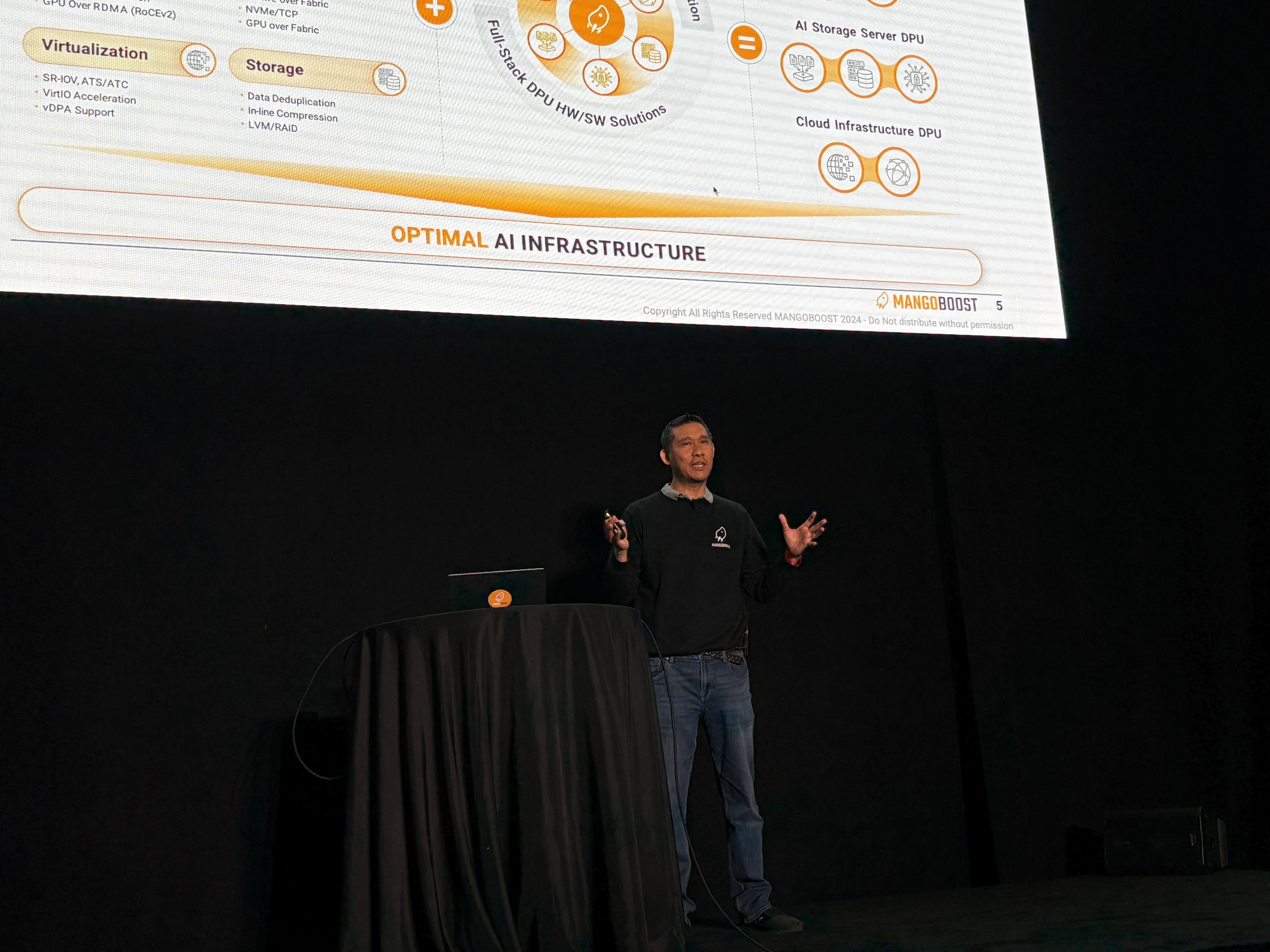
The DPU is not an easy object to love. It lives between familiar categories. It is a network card with opinions, a small computer devoted to chores the main computer would rather avoid. That ambiguity is precisely its attraction. Storage and networking have become part of AI performance, not plumbing to consider after the model works. In an older data center diagram, those functions might sit politely at the edges. In an AI cluster, they can decide whether the most expensive component delivers its promised output.
03 / The company-sized systemA card becomes a stack
MangoBoost's public product range has widened beyond a single card. It includes LLMBoost software for inference, GPU networking products, DPU-based storage systems and orchestration across the stack. This shift follows the customer's actual problem. A buyer does not want a clever peripheral in isolation. The buyer wants a model served within a latency target, a training job that scales across machines, or storage that can keep accelerators supplied.
Nurvitadhi's title has widened too. Earlier conference biographies called him chief product officer and co-founder; MangoBoost's current leadership page uses CAIO and says he remains in charge of the product organization. The acronym matters less than the span. His remit sits across the boundary where architecture choices become workloads, benchmarks and boxes a customer can operate.
Completes his Carnegie Mellon PhD after work on FPGA-accelerated computer architecture research.
Moves through research scientist and principal engineer roles at Intel.
Co-founds MangoBoost and chairs the IEEE FCCM technical program.
Presents the company's DPU and full-stack AI infrastructure work at industry and research conferences.
Public benchmarks are central to that translation. MangoBoost systems appear in MLPerf result tables, including inference submissions using AMD Instinct GPUs and its LLMBoost software. Benchmark results are never the whole truth about a system, but they are more useful than a cloud of adjectives. They force a claim into a workload, a configuration and a number that others can inspect.
“These are not just marketing claims, but real, quantified performance results that show how far our technology has come.”Eriko Nurvitadhi, speaking about MLPerf results
The sentence captures his public persona: precise, evidence-minded and happier with a measured result than a grand declaration. His conference service tells a similar story. He has sat on program committees across IEEE and ACM events, chaired the 2022 FCCM program and returned to panels debating how FPGAs, GPUs and ASICs should divide the work of large language models. These rooms reward specificity. A sweeping claim is an invitation for the next speaker to ask about memory bandwidth.
04 / The durable questionWhere should the work happen?
Across Nurvitadhi's career, one question keeps changing clothes: where should computation happen? In a reconfigured FPGA rather than software? In a specialized ASIC rather than a general processor? On a SmartNIC instead of the host CPU? Near storage instead of after data has crossed the system?
There is no permanent answer. Workloads grow, chips change and one generation's optimization becomes the next generation's bottleneck. The durable advantage is the habit of looking at the whole machine. It prevents loyalty to a component from becoming indifference to an outcome.
That habit also explains MangoBoost's aspiration to make FPGA-accelerated infrastructure usable without requiring every customer to become an FPGA expert. Hyperscalers have long built specialized hardware and software around their fleets. Nurvitadhi's 2026 FPGA symposium keynote framed MangoBoost's task as democratizing that kind of infrastructure for the AI era: composable hardware, co-designed with software, working with standard servers and established protocols.
The bet is both technical and commercial. If AI systems remain a collection of expensive parts, value will accrue to the companies that make those parts behave like one machine. The work is found in the handoffs: GPU to GPU, GPU to storage, model server to orchestrator. It is patient work, full of protocols and edge cases, and much less photogenic than a wafer held under stage lights.
Nurvitadhi has been preparing for it since processor simulation was his laboratory and deep learning was not yet the organizing obsession of the chip industry. The tools have changed. The question has survived. Somewhere in a data center, a GPU is waiting. He would like to give it something useful to do.