The costly employee in an AI data center is not a person. It is the GPU sitting around while a CPU negotiates network traffic, storage coughs up the next batch of data, or a neighboring accelerator waits for everyone else to catch up. MangoBoost has built a company around this deeply unglamorous pause.
The Bellevue-headquartered, Seoul-rooted startup makes data processing units, or DPUs - programmable cards that take infrastructure chores away from CPUs and GPUs. But calling MangoBoost a chip company now feels like calling a restaurant a stove company. Its 2026 catalog includes networking cards, all-flash storage, AMD GPU servers, LLM inference and training software, and a control panel for running the lot.
The thread through all of it is utilization. An enterprise can buy costly accelerators and still get mediocre economics if data arrives late, GPUs communicate poorly, generations cannot mix, or operators spend days tuning software. MangoBoost's job is to remove those waits. The company sells into cloud providers, enterprise AI teams, data-center builders, storage vendors and high-performance computing shops - people for whom a few lost percentage points become a budget line.
A chip for the chores
MangoBoost grew from more than a decade of systems work led by Seoul National University professor Jangwoo Kim. He founded the company with Eriko Nurvitadhi, Dongup Kwon and Junki Park. The executive division of labor still looks like a systems diagram: Kim is CEO, Nurvitadhi is chief AI officer, Kwon is CTO, and Park runs operations and finance.
Their first wedge was the DPU. A conventional server asks its central processor to do both the valuable application work and the housekeeping: move packets, manage remote storage, enforce security, emulate devices. A DPU handles much of the second list on dedicated hardware. In one 2023 Samsung petabyte-storage configuration, MangoBoost said its card cut CPU use by as much as 95 percent and delivered roughly three times the performance of existing alternatives. Those are vendor claims tied to a particular setup, but they explain the pitch neatly. Free the generalist from janitorial work.
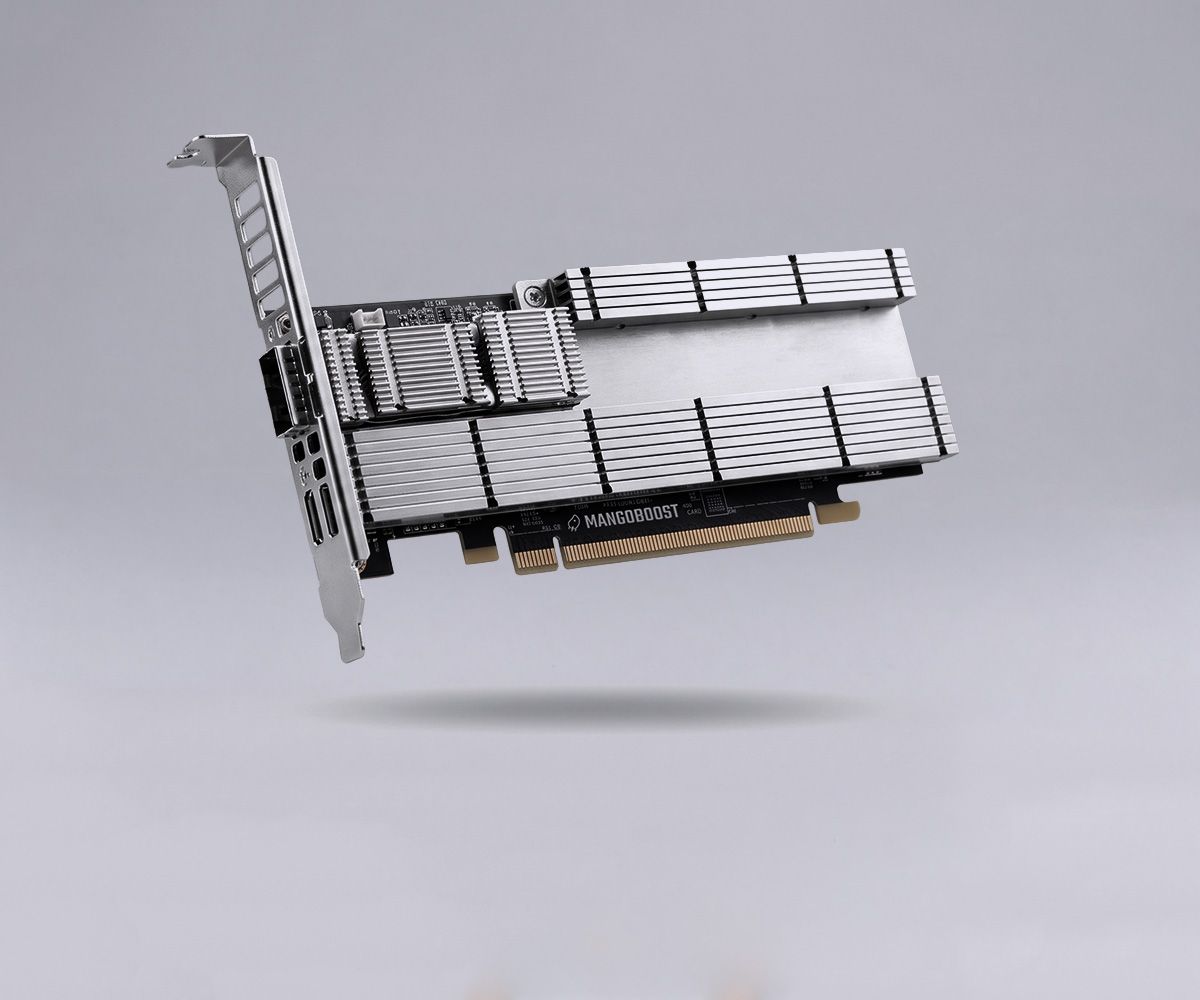
BoostX RoCE AI is the networking version, built around standard Ethernet and RDMA so GPUs can exchange data directly across nodes. BoostX NRT turns attached flash drives into NVMe-over-Fabrics storage. BoostX Base is the programmable foundation, exposed through MangoBoost's SDK and a Linux Foundation OPI bridge. The architecture matters because it lets the company customize a card for AI, storage or cloud infrastructure instead of prescribing one fixed appliance.
“Our goal is to provide full-stack DPU hardware and software solutions to satisfy the various needs of customers.”Jangwoo Kim, co-founder and CEO, in 2023
The card became the wedge
In October 2023, MangoBoost raised a $55 million Series A led by IMM Investment and Shinhan Venture Investment. It had 58 employees, 71 percent in R&D, and plans for FPGA cards, custom ASICs, software and DPU-enhanced systems. The round followed a $10 million seed and placed an estimated $300 million valuation on a company barely two years old. A later Series B was recorded in December 2025; MangoBoost now says it has raised more than $100 million.
What changed after the Series A is visible in the product shelf. The DPU did not fail. The point-product description did. Customers do not wake up wanting an infrastructure processing unit. They want a model served at acceptable latency, a training cluster that scales, or storage that does not starve accelerators. MangoBoost began wrapping the chip in those outcomes.
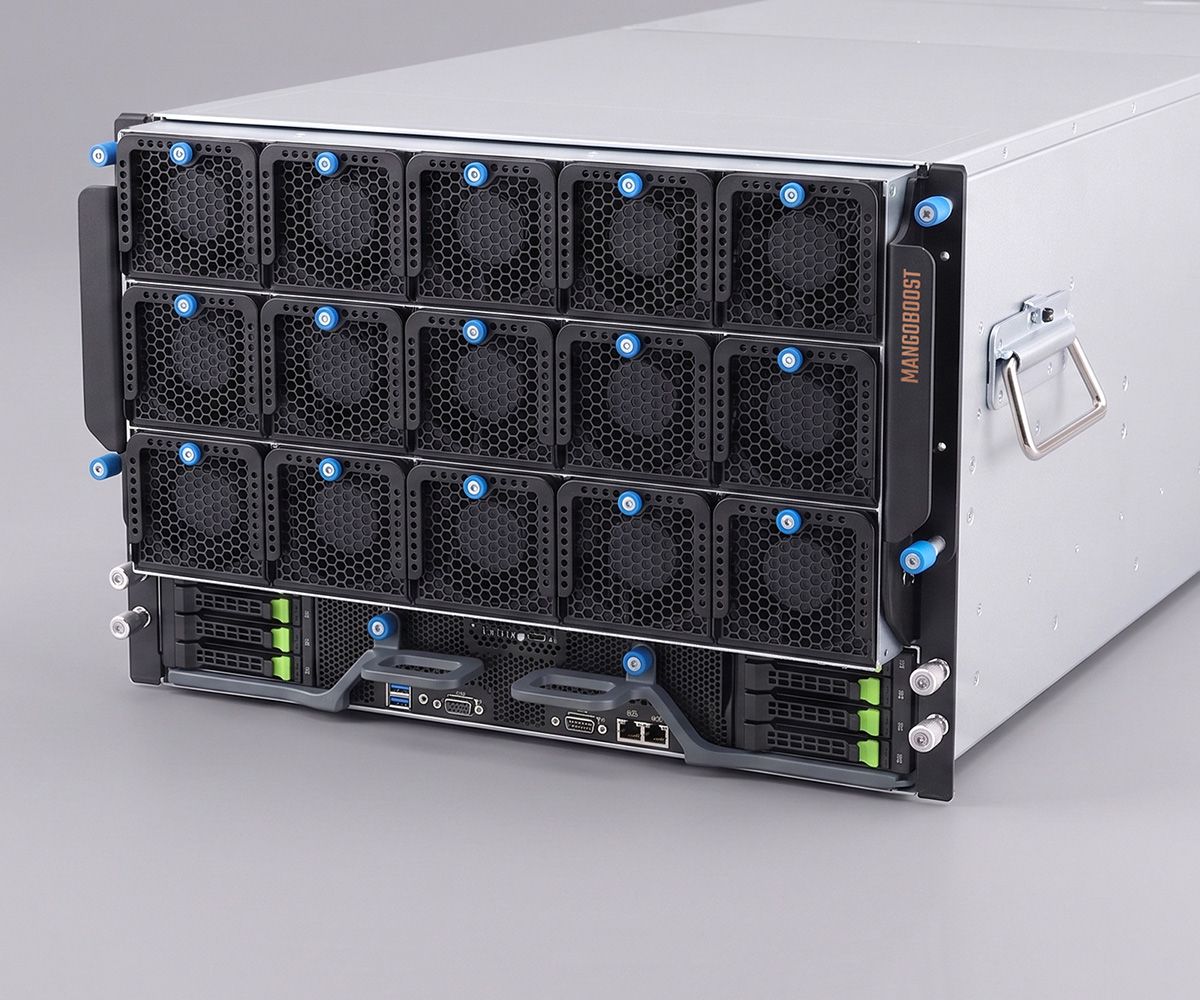
Mango Alphonso makes the change tangible: a turnkey AMD GPU server that bundles LLMBoost software, BoostX networking and Mango AI Center management. Kesar applies the same logic to storage. Its controller runs DAOS and exposes block, file, Python and HPC interfaces. Its enclosure removes the usual x86 CPU and DRAM from the target, putting NVMe-over-Fabrics service on BoostX NRT instead. That design is especially pointed when server memory is costly or supply-constrained.
Benchmarks as a sales department
Deep-tech startups have a trust problem. A glossy throughput claim is easy to make and unpleasant to verify. MangoBoost's answer has been to submit systems to MLPerf, the industry benchmark suite, often alongside AMD, Dell and Supermicro. This gives the company a repeatable artifact, respected collaborators and numbers that survive longer than a conference demo.
In MLPerf Storage v1.0, MangoBoost published a DPU-accelerated system submission and reported that its Ethernet-based single-host result led that round. In Storage v2.0, its NVMe/TCP initiator and target ran over a 400G connection and approached local-SSD performance. The first thing to fail in these workloads is rarely the GPU itself. It is the feeding system around it.
The flashier proof arrived in MLPerf Inference v6.0. MangoBoost joined newer AMD MI355X GPUs in the United States with MI325X and MI300X machines in South Korea, then served Llama 2 70B across the Pacific. The company reported 95.5 percent of theoretical scaling across the mixed fleet. That is a benchmark, not a promise that every wide-area deployment will behave so neatly. But it turns a dry software feature into a useful financial question: must yesterday's accelerators become stranded when tomorrow's arrive?
Read the small type. MangoBoost models roughly $4.6 million in three-year savings for a 256-GPU Alphonso build against a B200 cluster. The calculation includes power and maintenance, assumes matched scale and topology, and depends on vendor pricing. It is a sales model worth testing with your own contracts, not a universal invoice.
Where the money comes from
MangoBoost is a business-to-business infrastructure vendor. The likely revenue mix is hardware, enterprise software licenses or subscriptions, support, proof-of-concept work and custom integration. LLMBoost offers a free trial and an OpenAI-compatible interface; the broader portfolio uses product inquiries rather than public list prices. That is normal for data-center equipment, where the final bill depends on GPUs, optics, switches, capacity, support and volume.
The competitive field is not normal. Nvidia has BlueField and a formidable full-stack ecosystem. AMD owns Pensando. Amazon has Nitro. Microsoft bought Fungible. Intel and Broadcom sell adjacent infrastructure processors and network silicon. At the system level, every established server and storage vendor can assemble an alternative. MangoBoost's defense is neutrality plus integration: standard RoCEv2 Ethernet, support for heterogeneous accelerators, and one engineering team responsible from card to control plane.
That positioning also contains its risk. “Full stack” can mean fewer seams for the buyer, but many more surfaces for a 120-plus-person company to support. A DPU adds another programmable layer. RoCE networks reward careful congestion design. New firmware, drivers and model architectures keep arriving. MangoBoost must prove that the operational simplicity it sells outweighs the new vendor dependency it introduces.
The part a smaller company can copy
Nobody reading this should copy a DPU unless they have a semiconductor lab lying around. The go-to-market sequence, however, travels well.
Measure the expensive resource that is idle, then build around the bottleneck that causes the pause.
Use a neutral benchmark and publish enough detail for a technical buyer to challenge the result.
Validate beside vendors customers already trust. AMD, Dell, Samsung and Supermicro make a young logo feel less lonely.
Turn the clever component into an easier purchase: a server, a storage appliance, a deployment command, a dashboard.
MangoBoost's useful move is semantic as much as technical. A customer does not need to understand every packet-scheduling trick to understand “keep the GPU fed.” That sentence connects the DPU, the storage box and the inference engine. It also gives the company permission to expand without looking random.
When the mango is not worth the squeeze
Offload technology is useful under conditions, not by default. If a model fits on one machine, the data lives locally and utilization is already high, another card and control plane may add expense without returning it. Teams standardized on Nvidia's complete fabric may value native integration over vendor neutrality. Small operators may not have the network expertise to tune RoCE or evaluate failure modes. And benchmark gains can shrink when the production workload, model shape or traffic pattern changes.
| Good fit | Weak fit |
|---|---|
| Multi-node AI | Small single-node workloads with little network traffic |
| Mixed GPU fleets | Teams committed to one incumbent's end-to-end stack |
| Remote all-flash storage | Workloads already satisfied by local NVMe |
| Power or TCO constraints | Organizations unable to support another hardware layer |
The honest buying test is simple. Profile the idle time first. Run your models and data, not the vendor's favorite trace. Include staff time, optics, switches, support and migration in the cost. Then unplug a link, kill a node and watch what breaks. MangoBoost wins if the GPUs spend more time working and the humans spend less time nursing the stack.
Four years in, the company has made a credible journey from lab research to products that can be photographed, benchmarked and ordered. The next proof is less theatrical than a trans-Pacific cluster. It is whether ordinary enterprise deployments keep running after the demo team leaves. In infrastructure, useful acceleration can be the moment nobody notices - because nothing expensive is waiting.