Mike Henry has spent most of his adult life asking computers to waste less. At first, the waste lived inside the machine. Data moved back and forth between memory and processors, burning time and power with every trip. Later, the waste became geographic and contractual: GPUs sat idle in one data center while an AI company somewhere else waited, paid too much, or signed a commitment it did not want. His career has followed that inefficiency up the stack, from a transistor to a chip to a cloud stretched across continents.
The latest answer is Parasail, the San Francisco Bay Area company Henry co-founded with Tim Harris in 2023. Parasail aggregates computing capacity from a far-flung market of GPU providers, then gives developers one place to deploy open and custom AI models. In April 2026, Henry said it was producing 500 billion tokens a day through 40 data centers in 15 countries. The company also announced a $32 million Series A. Those numbers sound like scale. The more interesting part is what Parasail wants its customers to forget.
Servers. Procurement. Which GPU cloud has which machine in which region. Whether its flavor of Kubernetes is civilized or feral. Henry wants the infrastructure to recede until the request becomes almost childishly direct: give me tokens, fast and cheap, now.
The education of an inference obsessive
Henry trained as an electrical and computer engineer at Virginia Tech, collecting bachelor's, master's, and doctoral degrees between 2004 and 2011. There is something almost suspiciously tidy about the path that followed. He co-founded Mythic in 2012, when modern AI was still young enough that the term did not yet appear on every conference badge and earnings call.
Mythic began as Isocline, a research-minded semiconductor company. Its consequential turn came from a small experiment. Henry and his collaborators wanted software to tell an arrow from three random lines. Conventional programming looked like a month's work. New machine-learning tools produced an answer in about 90 minutes. The result was less a clever demo than a door swinging open. If general-purpose learning systems were going to absorb that many problems, they would need a great deal more compute.
The team's wager was analog compute-in-memory. Rather than ferrying every neural-network weight between separate storage and calculation units, Mythic used flash transistors to hold values and help perform the math where the data lived. It was an attack on movement itself. Silicon is fast; hauling information around it is expensive.
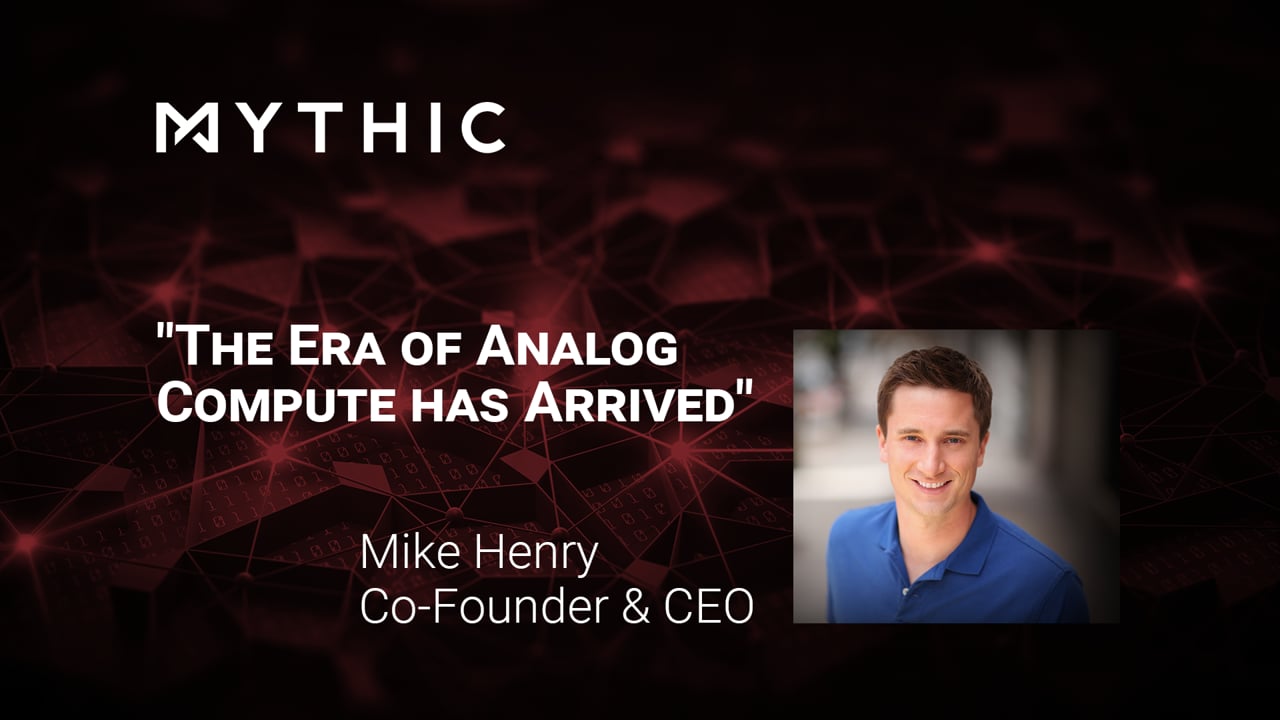
The idea did not enjoy a polite reception. Henry has recalled four years without venture funding, supported mainly by government contracts. He skipped his own paycheck for three months. At least 100 investors said no. The semiconductor industry supplied a Greek chorus of impossibility. Naivety, he later joked, helped because the goal always seemed just close enough to touch.
“I will never see myself as fully baked.”Mike Henry on remaining a lifelong learner
Eventually, Mythic demonstrated the technology, raised substantial capital and shipped an inference processor. Henry learned the bruising arithmetic of hardware: a bold architecture may be correct and still require much more time and money than its inventors expect. He also developed a firm dislike of brochure benchmarks. Peak operations per second can flatter a product. What matters is latency under an actual workload, power at partial utilization, cost, and whether performance survives contact with the rest of the system.
That instinct is visible in his recent comments about “benchmaxxing.” An endpoint under unpredictable heavy load is a less glamorous test than an isolated record, but enterprise software lives in the unpredictable part. Henry's engineer brain keeps asking the impolite operational question: what happens on an ordinary bad Tuesday?
A cloud made of other clouds
After leaving Mythic, Henry spent six months in 2023 as Groq's interim chief product officer. The job brought him close to data-center operators just as specialized GPU clouds multiplied. For most of the internet era, the gravitational pull had gone the other way. Three giant providers seemed destined to absorb everything. AI infrastructure was developing more like an archipelago.
Henry saw a market full of new islands, each with hardware, power and ambition, but no simple ferry system. Providers could simultaneously complain of GPU scarcity and carry unused capacity. Customers could know that cheaper machines existed without wanting to integrate, secure, monitor and bill across dozens of unfamiliar environments. The shortage was partly a shortage of coordination.
Many providers in. One endpoint out. The orchestration layer chooses capacity while the developer keeps thinking about the model.
Parasail's metaphor is the content delivery network. A web developer does not wish to spend the afternoon choosing routers on three continents. The website goes into a box; the network handles delivery. Henry talks about an AI model in similarly physical language: put it in a box and let it run. Underneath that pleasant sentence is ugly work. Compute, storage and networking vary by provider. Provisioning may be automatic, semi-automatic, or stubbornly manual. Kubernetes exists in several local dialects. The interface has to hide the differences without hiding the controls that matter.
This is why the most valuable Parasail feature may be the absence of a feature from the user's view. Complexity remains, but it moves to the vendor's side of the table. The customer sees a model, an API and a bill attached to useful work rather than idle hardware.
Keep the question, change the altitude
Founders are often encouraged to love the problem, not the solution. Henry's path is the unusually literal version. At Mythic, he attacked the cost of moving data inside silicon. At Parasail, he attacks the cost of matching work to silicon across the world. One company designed the machine. The other designs the market's connective tissue.
There is continuity in Henry's leadership language, too. He borrows Jim Collins's pairing of personal humility and professional will, then translates the latter into grit. He has spoken about a CEO circle that told him to stay in the game and an executive coach who helped him navigate Mythic's growth. His third ingredient for success is less canonical: a good smile.
The combination fits a founder who can discuss floating-gate transistors in one breath and tease his own unfinished education in the next. Henry says he is never fully baked. Skills and playbooks can always spend longer in the oven. LinkedIn followers, he has promised, may also receive occasional sarcastic comments.
“The customers want to deploy AI models at scale, and they want to keep it very simple.”Mike Henry on the infrastructure bargain
Simplicity is an expensive product to manufacture. Parasail's Series A gives the company more room to do it, but the contest is crowded. Hyperscalers own deep customer relationships. Specialist inference companies own their own optimizations. Hardware vendors are moving quickly, and every new model rearranges the cost curve. Parasail's wager is that neutrality can be an advantage: if no single chip, cloud, or contract is sacred, workloads can move toward the best available price and performance.
That bet depends on an open-model economy large enough to matter. Closed systems are convenient, but agentic software can generate extravagant volumes of requests. At scale, the price of abstraction becomes visible. Open models let companies tune, control and route more of the stack. They also hand the company a fresh infrastructure problem, which is where Henry appears most comfortable.
The lunch he would enjoy making awkward
For all the talk of GPUs and network topology, one detail offers a cleaner glimpse of Henry. Asked who he would choose for a private lunch if the guest had to answer every question truthfully, he picked Bill Belichick. Henry wanted access to the football coach's tightly locked genius. He also stressed that he was not a Patriots fan and would enjoy the discomfort of the encounter.
It is a revealing fantasy: sit with a famously guarded operator, remove the public relations layer, and inspect the system underneath. The same impulse has animated Henry's professional life. What is actually consuming the power? Where does performance disappear? Which capacity is sitting unused? What could work if the interfaces stopped getting in the way?
Parasail now has to prove that a network assembled from many suppliers can feel more dependable than one giant cloud. The business will be judged in the unromantic moments: a traffic spike, a model release, a failed machine, a customer whose latency budget does not care about the elegance of the architecture. Henry has spent long enough around silicon to know that reality is where claims meet the stress test.
He is still working on inference. The unit of attention has simply expanded. Once, it was a flash transistor holding a neural-network weight. Now it is a globe full of machines, each waiting for the right job to land.