A GPU is usually sold as a finished object: a card, a chip, a rack, a cloud hour. Oxmiq Labs would like to sell some of what comes before that object exists. Its customer is a company with an idea for an AI machine, a memory supplier, perhaps a foundry relationship, and a problem: designing the compute core and its software ecosystem from zero is ruinously difficult.
Founder Raja Koduri knows the difficulty personally. He led graphics and computing work at AMD, Apple and Intel. At Oxmiq, founded in 2023 and publicly launched in 2025, he is asking a counterintuitive question for a chip veteran: what if the best way to put more GPUs into the world is to let other companies build them?
- Oxmiq licenses GPU and chiplet designs to semiconductor and AI infrastructure builders.
- Its software aims to make existing AI workloads run across different kinds of accelerators.
- OxCapsule is in public beta; OxPython has run models on Tenstorrent hardware; OxCore has been shown on FPGA.
- A $35 million Series A in July 2026 brought reported total funding to $60 million.
The missing shelf in the chip shop
The analogy Koduri uses is Arm. Chip designers can license a CPU core, surround it with their own components and make a product. GPU design has no equally familiar shopping aisle. Large vendors mostly build and sell finished processors. A prospective AI-chip maker must therefore pay for a long architecture program, persuade software to run on it and survive the wait for silicon. Oxmiq wants to shorten that road by licensing the architecture itself.
Its centerpiece is OxCore, a configurable compute design combining a scheduler, a tensor engine and a parallel engine intended to run PTX, the intermediate language associated with CUDA. OxQuilt is the modular packaging scheme around it: choose a mix of compute, memory and interconnect, then fit the pieces to a workload and supply chain. The design logic is pleasingly ordinary. A company building a small device and one planning a data center need different amounts of memory, power and compute; they should not have to accept the same proportions.
The distinction matters. Oxmiq is offering a route into custom silicon, not a finished consumer graphics card. The company has reported an OxCore FPGA running a language model and says the architecture can be licensed. An FPGA demonstration shows that a design can execute code in a programmable hardware prototype. It does not settle manufacturing cost, yields, power use or performance in a production chip. Those are the expensive chapters in any semiconductor story.

Software goes first
There is a reason the company did not wait for a custom chip to start shipping. AI developers have already written enormous amounts of software around NVIDIA’s CUDA conventions. A new processor with no practical route for that code is a clever island. Koduri has said that hands-on work with Python, PyTorch and AI agents at his earlier venture, Mihira Visual Labs, sharpened this realization. Oxmiq’s answer was to build software alongside the hardware blueprint.
OxPython is its portability layer. In a company demonstration, familiar PyTorch and CUDA-oriented workflows ran language, image and video models on Tenstorrent’s Wormhole and Blackhole accelerators. Oxmiq says the four demonstrated models were delivered in a paying customer engagement. That is a useful proof point because the hardware was somebody else’s. A compatibility claim demonstrated only on one’s own prototype would have been less revealing.
“There is ARM for CPUs. But there is not ARM for GPUs. Anyone can license our IP and build a chip.”Raja Koduri, on Oxmiq’s business thesis
The other software product, OxCapsule, takes aim at the untidy equipment room. Many teams have a mixture of NVIDIA, AMD, Intel and other machines. OxCapsule offers a command-line interface for finding hardware, placing a workload, opening a remote development session and managing a fleet. In May 2026, the company reported 9,704 beta sessions and 14,563 hours of compute. Its current beta page lists more than 150 users and 300 GPUs. Those numbers establish real use, though they do not disclose paying-customer volume or revenue.
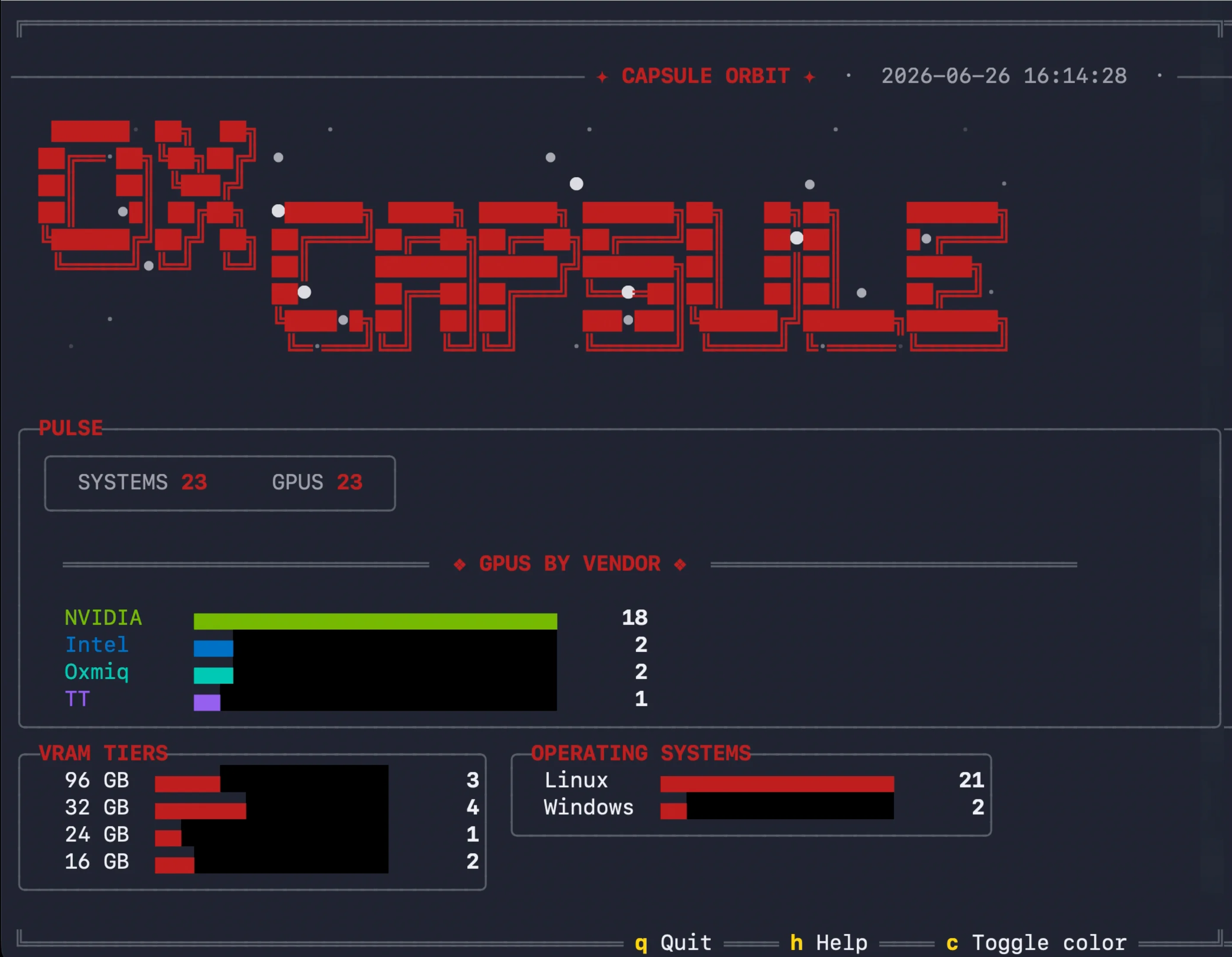
For a developer, the practical promise is modest and valuable: try a model on hardware already owned before buying more or rewriting everything. For a chip company, the software is a bridge to customers who cannot afford to abandon familiar tools. OxCapsule is currently a free beta; OxPython is proprietary and licensed through commercial arrangements. Oxmiq has not published standard commercial prices.
The quilt gets larger
Oxmiq’s original pitch was a licensing company for chip designers. Then AM Intelligence Labs came with a much bigger piece of graph paper. The companies announced a partnership to architect a renewable-powered AI compute platform in India, planned to reach two gigawatts over time. Oxmiq’s role spans hardware choices, interconnects, cooling and software orchestration. Its own account says this was a customer type outside the initial roadmap.
The expansion is revealing. At data center scale, choosing a processor is inseparable from choosing power delivery, networking and heat removal. A wrong decision is multiplied across racks. Oxmiq now talks about the entire path from electricity to generated tokens. That is a sound systems question, but the gigawatt targets are plans, not operating capacity. The near-term evidence remains its software releases, partner demonstrations and architecture work.
The July 2026 Series A brought $35 million, co-led by Fundomo and Samsung Catalyst Fund. Other named participants included MediaTek, AM Intelligence Labs, Pegatron Venture Capital, CDIB-TEN, Darwin Ventures and Morgan Creek Digital. The total capital raised, Oxmiq says, is $60 million. That finances development and customer integration; it is not the price of an OxCore license, an OxCapsule deployment or the proposed Indian facility. Those figures have not been published.
The price of a shortcut
Oxmiq competes with a powerful default: buy finished NVIDIA, AMD or Intel hardware and use its established tools. It also overlaps with suppliers of licensable graphics IP and specialist AI accelerators. Its difference is the bundle - a configurable core, chiplet architecture, CUDA-oriented software path and engineering help across the system. The bundle is persuasive where a customer genuinely needs a custom machine and has the organization to build one. It is less useful where a standard GPU already runs the workload at a sensible price.
There is a lesson here that smaller teams can borrow without hiring a chip architect. Start with the developer’s existing code. Prove a new tool on hardware you did not design. Measure the use of the machines already sitting in the fleet. Only then decide whether the next purchase needs to be another box, a different accelerator or a custom chip. Compatibility is a product feature; utilization is an economic one.
Oxmiq’s own test is still unfolding. It has shown software, prototypes and a widening customer brief. The harder demonstration will be a customer-built processor that justifies its design and manufacturing bill while running ordinary AI work with little fuss. If that happens, the recipe may prove more valuable than any single GPU made from it.