At an office complex north of Ann Arbor, a quantum computing lab has an unlikely neighbor: a herd of bison. Inside, Sygaldry is working on a less picturesque problem. AI data centers need enormous amounts of electricity, and the familiar answer - buy more GPUs - gets expensive very quickly. The company's proposal is to put a quantum machine alongside those GPUs and ask it to take on the parts of the work that suit it.
That last phrase matters. Sygaldry is not selling a magic replacement for every server in the building. It is designing quantum-accelerated AI servers and the software that would let researchers use them from existing workflows. Its target is better performance per watt for training and inference. Its evidence, for now, is an architecture, an experienced founding team, and $139 million of financing. Public customer results and an end-to-end speed benchmark remain ahead of it.
- One proposed server combines several complementary qubit types inside a fault-tolerant design.
- It is meant to augment classical AI hardware in data centers, with tools for researchers to call quantum routines.
- A $34 million seed round and $105 million Series A fund the effort; no public commercial deployment has been announced.
The second machine in the room
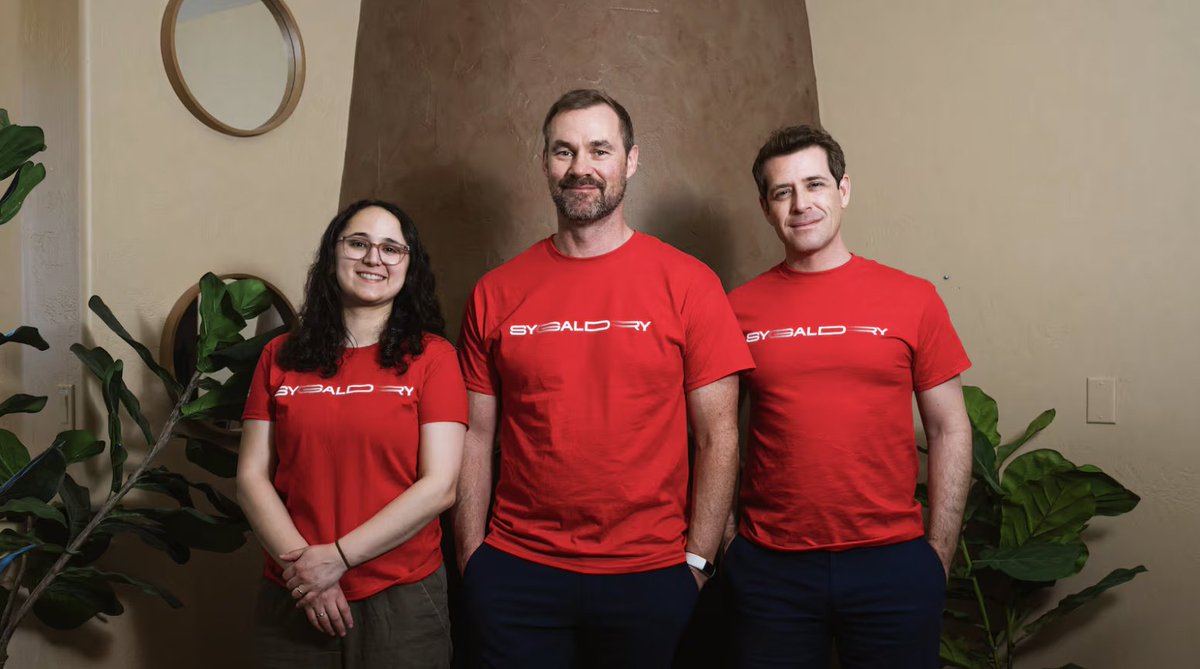
Chad Rigetti has already built one quantum company. Rigetti Computing emerged from Y Combinator in 2014 and eventually went public. At Sygaldry, founded in 2024, he has a more specific customer in mind: teams building large AI models. Co-founder Idalia Friedson brings a background in quantum strategy, product work, and policy; co-founder Michael Keiser brings AI research. The combination suggests a company trying to solve three problems together - physical hardware, useful algorithms, and adoption by people who already have their own tools.
The customers Sygaldry hopes to reach are AI companies, model researchers, and eventually data-center operators. What could they do with the system? The company's launch materials name shorter model-development cycles, faster fine-tuning, token generation, and diffusion-model inference as possible uses. Those are intentions, not measured product claims. There is no published price list, named paying customer, or announced production server.
“We're building quantum computers that meet the specific requirements for AI processing.”Chad Rigetti, co-founder and CEO
Why one kind of qubit is not enough
A conventional computer already uses a small menagerie of components: processor logic, memory, storage, and connections between them. Sygaldry's central idea is to take that division of labor into quantum computing. Instead of choosing a single qubit type for every job, its proposed fault-tolerant architecture combines modalities with different strengths. An investor's technical account describes matter qubits for logic or storage and photons for carrying information between components. This is a design thesis, not a photograph of a finished commercial machine.
Why bother? Quantum devices are delicate. Some qubit types favor long-lived states; others favor fast operations or communication. Mixing them may help engineers build a larger, more reliable machine. The first engineering obstacle is error: fragile quantum states can lose information before a computation is useful. A fault-tolerant architecture aims to correct that problem, but describing such an architecture is very different from operating one at a cost an AI buyer will accept.
The second obstacle is software. A quantum coprocessor earns its place only if an AI team can hand it a task, get an answer back, and beat the classical route after accounting for movement of data, error correction, cooling, and every other expense. That is why Sygaldry is developing integration tools and quantum algorithms alongside the server. In Keiser's description, one track would accelerate classical algorithms AI teams already use; another would explore quantum-native approaches. The neatness of the idea is no substitute for that full accounting.
The money bought time to build
Sygaldry closed a $34 million seed round led by Initialized Capital in August 2025. A $105 million Series A led by Breakthrough Energy Ventures followed in March 2026; the combined $139 million was announced in April. The investor choice is revealing. Breakthrough Energy's interest is in an AI system that can do more computation for each watt of electricity, a thesis that makes quantum hardware look like a possible climate investment.
Led by Initialized Capital
Led by Breakthrough Energy Ventures
Funding is capital raised, not the price of a server or proof of energy savings.
The company has not disclosed what its servers cost to build, what it would charge, or any revenue. It appears to be pursuing a business-to-business infrastructure model, but public terms are absent. Even the climate case will need care. If cheaper computation makes AI use expand sharply, total electricity demand may still rise. The useful metric for a buyer is not a slogan about exponential speed; it is the measured cost, time, and energy to complete one real workload.
The bison and the benchmark
Sygaldry's headquarters at Domino's Farms in Ann Arbor puts the hardware work near Michigan's engineering talent. A second office in San Francisco keeps the company close to AI researchers and potential customers. Ann Arbor SPARK has helped with recruiting and relocation connections. The location is more than a charming backdrop: a quantum server program needs physicists, systems engineers, AI scientists, and people who can turn a laboratory setup into a repeatable product. Sygaldry is hiring across those disciplines.
Its difference from both GPU-only infrastructure and many quantum rivals is therefore quite precise. It is designing around AI data-center use from the outset, and it wants multiple qubit modalities under one roof. Other quantum companies have made progress with individual hardware approaches; Sygaldry is betting that the final useful system will behave more like a carefully assembled computer than a single exquisite qubit technology scaled forever.
There is a limit to what anyone can copy today: the server is still in development. But the method is portable. Start with a customer's stubborn constraint - here, AI's power bill. Choose the workload before choosing the machine. Build the interface as seriously as the hardware. Then publish the comparison that counts: the entire job, on the entire system, against the best available alternative. In quantum computing, that last step is where elegant diagrams meet arithmetic.
Rigetti told Fortune he hopes to have machines in commercial production around the end of the decade. Until then, the most interesting thing about Sygaldry is also the simplest to misunderstand. It has raised a great deal of money to ask whether a quantum computer can become an ordinary, useful part of an AI data center. The bison outside the lab can afford to wait. The power meter cannot.