The most useful thing about an atom, if you are trying to build a computer, is not that it is tiny. Tiny is merely fashionable. The useful thing is that one atom of ytterbium is exactly like another atom of ytterbium. Nature is a fanatical manufacturer. It ships no Monday-morning units, no slightly crooked pins, no premium edition. This is the modest miracle behind Atom Computing, a Berkeley company whose machines arrange neutral atoms with beams of light and ask their nuclear spins to remember information.
The short version
- Atom sells on-premises, gate-based quantum systems to research, government, and enterprise programs.
- Its AC1000 has more than 1,200 physical qubits, all-to-all connectivity, and tools for measuring, resetting, and reusing qubits mid-circuit.
- Microsoft supplies error-correction expertise; QuNorth is the first publicly named commercial buyer.
- The wager works only if improved fidelity and error correction turn a large atomic array into useful logical computation.
Ben Bloom arrived at this wager by way of atomic clocks. As a doctoral physicist at the University of Colorado Boulder, he helped build one of the most accurate clocks then made. Atomic clocks are exercises in listening to atoms with absurd care. In 2018, Bloom and chemical engineer Jonathan King founded Atom Computing after Bloom concluded that neutral atoms offered the cleanest route to a large quantum machine. The same quiet nuclear states that keep exquisite time might keep quantum information, too.
A tweezer, an atom, and an unreasonable amount of patience
A neutral-atom computer begins with optical tweezers - tightly focused laser beams that hold single atoms in place. More lasers cool them, move them into an array, manipulate their quantum states, and encourage neighboring atoms into interactions that perform logic. Atom uses Ytterbium-171 and stores its qubits in the atom's nuclear spin. The arrangement needs no private electrical wire running to every qubit. Light travels through free space, and the array can be rearranged.
That matters because the usual scaling problem is architectural. A handsome 20-qubit experiment can become a bramble of control lines when multiplied by a thousand. Atom's second-generation array has 1,225 sites and advertises all-to-all connectivity - qubits can be moved so that distant members of the array become neighbors. Its published AC1000 specifications include single-qubit gate fidelity above 99.9 percent, two-qubit fidelity above 99.6 percent, and state preparation and measurement above 99.8 percent. Those decimals are not decoration. The missing fraction is where computations go to die.
What fails first
The physical qubit fails first. It forgets, it is measured badly, a gate nudges it the wrong way, or the atom simply escapes its trap. Every quantum architecture owns a particular anthology of disappointment. Atom's answer is not to pretend the physical qubit will become perfect. It groups many physical qubits into logical ones, detects errors, and corrects them before the useful information is lost.
qubit
Illustrative only: the number of physical qubits per logical qubit varies by code and experiment. More hardware can mean less error.
Here the replaceable atom becomes more than a parlor trick. Atom has demonstrated mid-circuit measurement, reset, and reuse. If an atom is lost, a fresh one can be loaded and placed into service. In work with Microsoft published in 2024, the companies reported an entangled state across 24 logical qubits and error detection, correction, and computation using 28 logical qubits. In 2026, Atom reported a toric-code experiment - a fuller test of whether error correction improves as the protected system grows.
Qubit count got the company noticed. Error correction is what it wants to be judged on.
What changed the argument
Atom's first machine, Phoenix, was unveiled in 2021 with 100 qubits and coherence times later reported above 40 seconds. It proved that nuclear-spin qubits could be held steady at a useful scale. Two years later, Atom announced the first universal gate-based system to cross 1,000 physical qubits. This was an excellent headline and an incomplete product.
The industry had spent years worshipping the raw qubit, a number as easy to compare as horsepower and about as prone to mischief. A thousand noisy qubits do not necessarily outperform a smaller, cleaner system. Atom's collaboration with Microsoft changed the unit of conversation. Microsoft brought error-correction codes and a framework for judging reliable machines; Atom brought abundant physical qubits, flexible movement, long coherence, and mid-circuit operations. The combined pitch is no longer simply “we have many.” It is “we have enough to protect a few.”
The customer buys a room, not a miracle
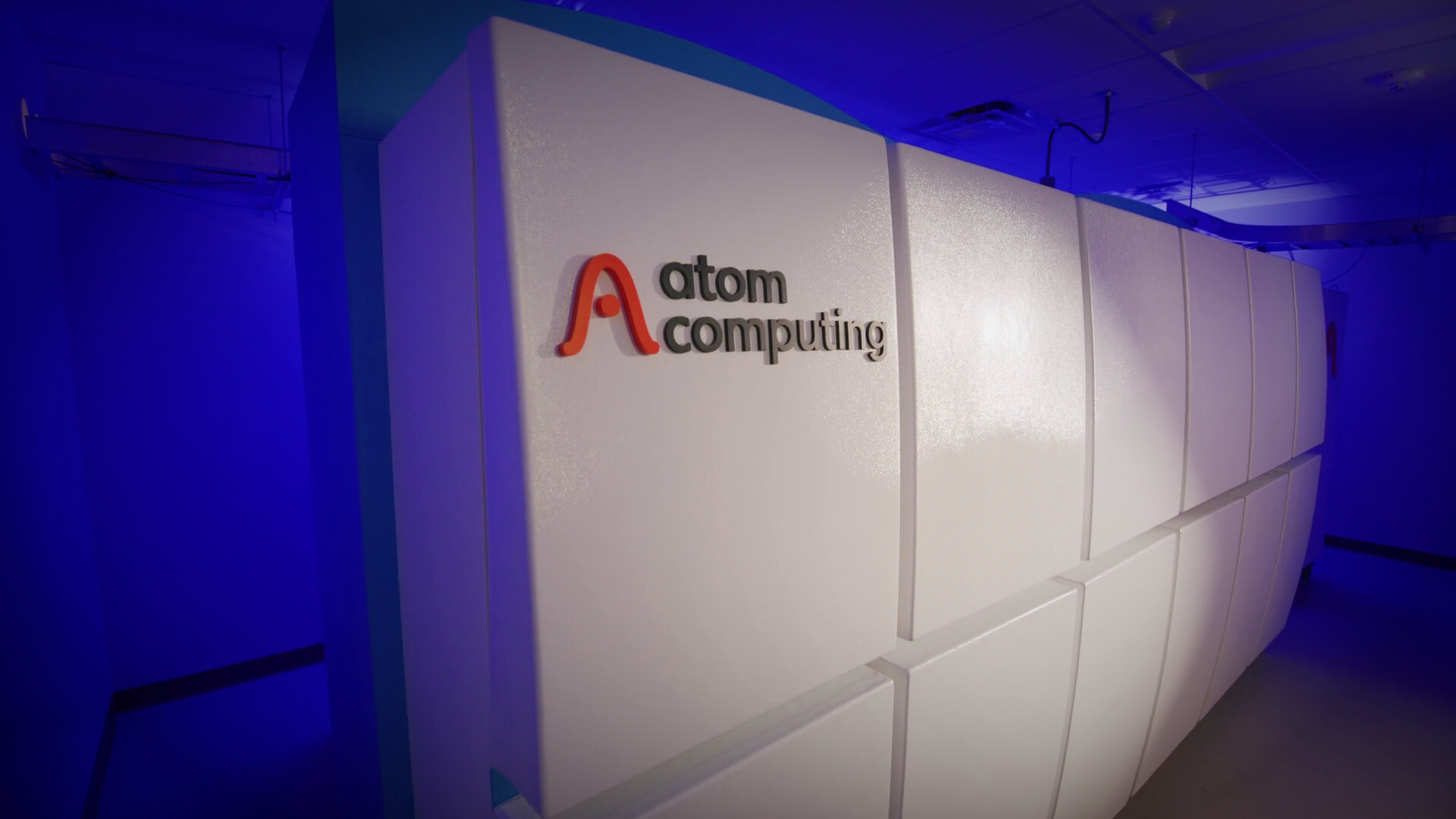
The AC1000 is sold as an on-premises platform. It occupies approximately 600 square feet, uses what Atom calls moderate power, speaks OpenQASM and Microsoft's QIR, and includes a 20-qubit emulator. Customers can arrange technical support nearby or in person. This is an enterprise hardware business in the old, reassuring sense: a large machine, specialist integration, service, and a relationship with the people who built it.
Its first publicly named commercial buyer makes the logic plain. QuNorth, a Nordic initiative funded by Denmark's EIFO and the Novo Nordisk Foundation, agreed in 2025 to acquire an Atom-Microsoft machine. The wider QuNorth program carries an €80 million commitment, but that is not a sticker price for the computer. It buys an ecosystem - hardware, access, skills, research partnerships, and the sovereign convenience of having the machine nearby. Atom has not published an à-la-carte price.
Other relationships test other parts of the proposition. DARPA is examining whether Atom has a credible near-term path to utility scale. NREL connected Atom's technology to a power-grid test bed for hybrid optimization. Phasecraft is adapting algorithms for batteries, photovoltaics, and materials. NVIDIA is linking quantum control to accelerated classical computing. Cisco and Nu Quantum are investigating networks that could join processors when one machine is no longer enough.
The price of making exotic machinery ordinary
Money has followed the machine in conspicuous steps: $15 million in Series A funding in 2021, $60 million in Series B funding in 2022, and a $100 million Series C led by Third Point Ventures in June 2026. Atom says total funding and planned government support now exceeds $300 million, including a signed letter of intent for $100 million from the U.S. Department of Commerce. In 2022 it separately announced plans to invest $100 million over three years in its Colorado operation.
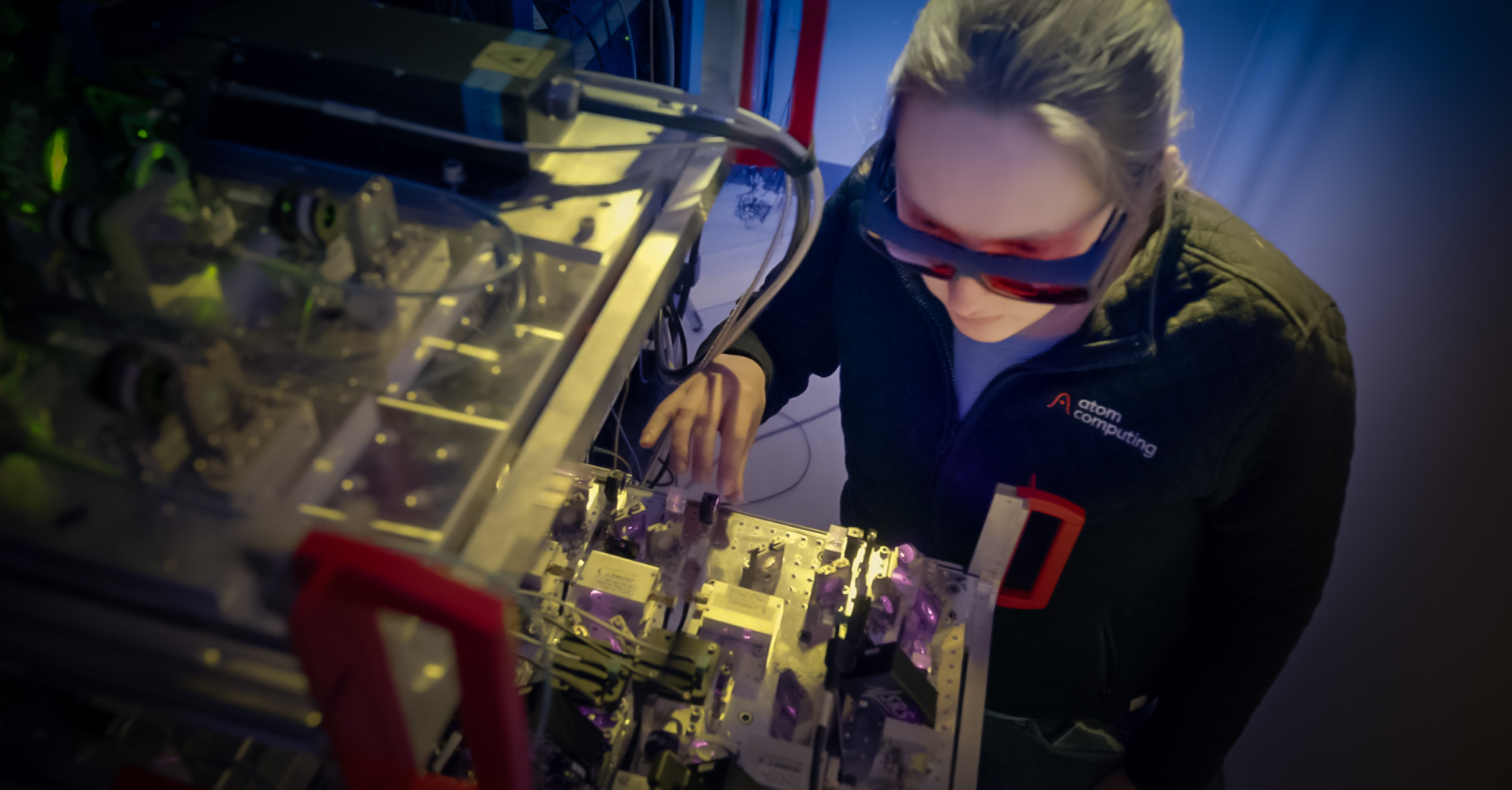
That spending pays for a deeply mixed discipline. Atomic physicists need optical engineers. Optical engineers need control electronics. Control electronics need firmware and software. Application researchers then have to find problems worthy of the apparatus. The company's offices span Berkeley, Boulder, and Austin; its careers material promises flexibility, catered lunches, and “license to push the limits.” The phrase is jaunty. The task underneath it is severe.
Bloom and King found Atom Computing.
Phoenix arrives with 100 neutral-atom qubits.
The second-generation array crosses 1,000 qubits.
Microsoft collaboration reports logical computation.
QuNorth becomes the first named commercial buyer.
Toric-code error correction and a $100 million Series C.
The copyable part is not the atom
A reader cannot reproduce an AC1000 over a weekend, which is fortunate for the weekend. But its product lesson travels. First, select an architecture whose components remove a scaling bottleneck rather than merely improve a benchmark. Identical atoms answer manufacturing variation; free-space optical control reduces per-qubit wiring; rearrangement turns connectivity into software-defined geometry.
Second, make failure a supported operation. Measurement, reset, reuse, and replenishment are not glamorous, but they convert a laboratory object into a maintainable system. Third, borrow a harder customer's metric. Microsoft's logical-qubit standard forced the story beyond raw counts. DARPA's staged benchmarking asks for evidence rather than confidence. QuNorth asks whether the whole thing can be installed, supported, and used by a community.
The condition hidden in the bet
Neutral atoms win only if Atom can improve gate fidelity and error correction faster than the overhead grows. The machine is also unnecessary when a classical computer already solves the problem cheaply. Scale without useful circuits is a magnificent way to own many atoms.
Atom competes directly with neutral-atom builders QuEra, Pasqal, Infleqtion, and planqc, and indirectly with every other hardware approach - superconducting circuits, trapped ions, photons, silicon spins, and Microsoft's own topological work. Each architecture has a favorite boast and a private inconvenience. Neutral atoms have attractive coherence, connectivity, and natural uniformity; they also demand a demanding optical apparatus and better two-qubit performance. The winner, if there is one, will not be the platform with the prettiest qubit. It will be the one that survives the arithmetic of correction.
This is why Atom Computing is interesting now. Not because it has settled the argument, but because it has made the argument more practical. A quantum computer is an exotic proposition. A computer whose faulty parts can be detected, reset, and replaced is merely good engineering - performed, in this case, with the furniture of the universe.