Venture Capital / Deep Tech / Frontier Science
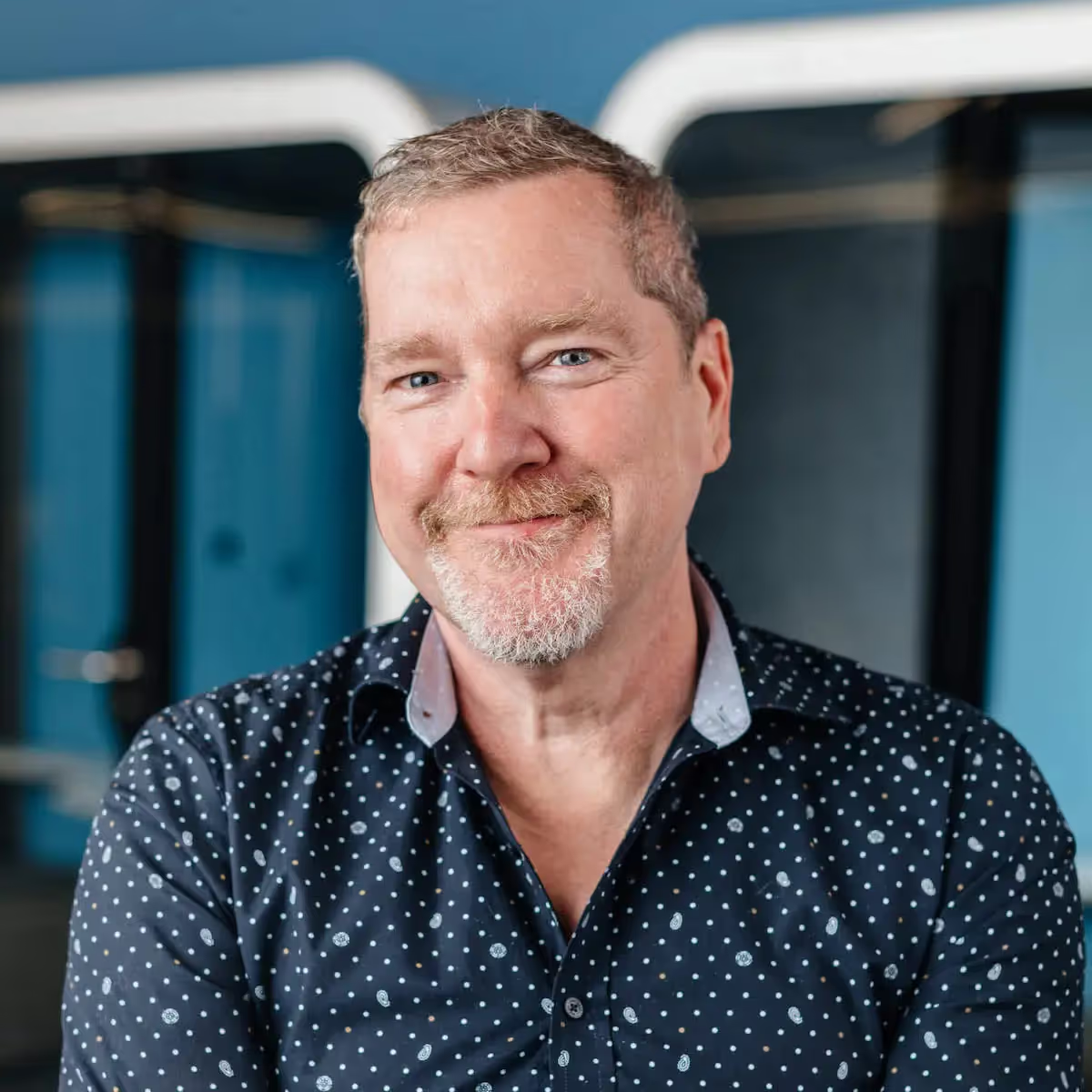
Peter Barrett
Founder & General Partner / Playground Global / Palo Alto
"The computing revolution - and arguably even the industrial revolution - hasn't happened yet."
"The computing revolution - and arguably even the industrial revolution - hasn't happened yet."
Barrett draws a precise distinction between ventures that are genuinely hard and ventures that are simply not possible. The former he funds. The latter he avoids. What lies between them - the region where conventional wisdom says "not yet" and where patient capital can change the timeline - is Playground's territory.
Barrett's emphasis on physical systems is deliberate and somewhat contrarian in a venture world that has spent two decades chasing software. His argument is structural: software is compressible - one good AI model can displace thousands of software workers. Physical systems are not. You cannot software your way to a room-temperature superconductor, a drought-resistant crop, or a photon-based data interconnect. The companies that build these things have durable advantages precisely because they are hard.
He is also characteristically direct about what he will not fund. When the debate around small modular reactors (SMRs) intensified in 2024, Barrett called them "unwarranted innovation" - arguing that the US should deploy large conventional reactors that already have regulatory approval rather than reinventing nuclear from the ground up. The opinion cost him friends in the climate tech community. He published it anyway.
For all of his Silicon Valley tenure, Barrett maintains a strong focus on Australia's scientific potential. In 2024, he championed a vision for a million-qubit quantum machine to be built in Queensland - calling Australia "always a thought leader in quantum computing and quantum sensing." He urged the Australian government to invest in world-class semiconductor fabs with next-generation light sources, connecting national infrastructure investment to commercial competitiveness.
His relationship with Australia is not nostalgia. It is strategic. He travels frequently between Palo Alto and Sydney, where his parents and siblings still live in Wahroonga. His wife's career as a school teacher gives him a grounded perspective on how technology eventually reaches the people who didn't build it - and what that journey actually costs.
Photonic quantum computing. Targeting silicon-based million-qubit machines. Barrett sits on the board.
Autonomous rocket factory using 3D metal printing for orbital launch vehicles.
Next-generation DNA sequencing platform targeting $1 genome sequencing.
In-memory compute chips for AI inference. One of Playground's unicorns.
Optical I/O chiplets for data centers - moving data at the speed of light. Unicorn.
Programmable mRNA therapies for cancer and rare disease.
Industrial robotics intelligence. Barrett sits on the board.
Green metals decarbonization. Barrett serves on the board.
AI model training efficiency - acquired by Databricks for ~$1.3 billion.
Modular green hydrogen supply chain for aviation decarbonization.
Autonomous drywall installation robots for the construction industry.
Mesh WiFi systems for homes and small businesses - acquired by Amazon.