The revealing object in Lawrence Schwartz's career is not a campaign brief. It is a magnetic actuator. Filed for a patent in 1996, the device was designed to travel a long distance in one direction while correcting tiny errors across other dimensions. It had to be compact, efficient and reliable in places where repair might be impossible. Space is a merciless client. It does not accept a clever explanation in lieu of working hardware.
Schwartz was then an engineer at MIT, studying aeronautics and astronautics before taking a master's in mechanical engineering. He would build satellites for Hughes and Boeing and sit on a review panel connected to NASA's Cassini mission. Later came a Harvard MBA and a turn toward the commercial side of technology. The nouns changed: storage, electronic paper, databases, cloud, industrial AI, supply chains, quantum computers. The original problem survived. How do you move something complicated, at useful scale, without losing control of the small corrections?
The engineer crosses the hallway
There is a familiar corporate myth that engineers make things while marketers decorate them. Schwartz's résumé is a useful rebuke. His move was less a departure from engineering than a change in the thing being engineered. Instead of designing motion, he began designing understanding: what a product is, whom it helps, why a cautious buyer should believe it and which proof will survive contact with procurement.
At EMC, where he worked from 2004 to 2009, that meant infrastructure and storage at the moment flash was changing the data center. His team won a company President's Award for the rollout of flash drives. Then came E Ink, the electronic-paper company whose product was visible but whose physics stayed tucked behind the page. At Tokutek and Attunity, the subject became databases and data movement, technical plumbing whose value is often clearest only after it fails.
In a 2015 discussion about Attunity, Schwartz described the business with engineerly directness: customers needed to get data from where it originated to where it needed to go. The sentence contains no fireworks. It does contain a job to be done. Around that plain proposition, Attunity built cloud relationships, including work in the AWS ecosystem, while pushing its software toward faster analytics and less manual preparation.
Attunity is very focused on how customers get the data from where it originates to where it needs to go.Lawrence Schwartz, 2015
A world of invisible products
SoftwareONE gave Schwartz a different scale. The company operated across more than 80 countries, and his job included building a global marketing organization that could sound coherent without pretending every market was identical. A former colleague described him as deliberative and persistent, the sort of leader who could carry a change from C-suite attention down to smaller country operations. Another remembered that Schwartz made work fun while keeping the machinery of planning, demand generation and sales alignment moving.
The fun was not entirely metaphorical. A 2017 global kickoff put 850 SoftwareONE employees inside Spain's PortAventura resort for three days of meetings, rides, games and a closing party with food trucks. Schwartz later said employees returned talking about what they had learned and how much they enjoyed it. In enterprise marketing, this qualifies as a rare alignment of content and roller coasters.
By 2018, he had joined Aspen Technology. AspenTech sells software for industrial operations, the plants and processes where efficiency is measured in actual energy, material, time and risk. Schwartz helped frame its Industrial AI position, integrate acquired businesses and tell a story that connected first-principles engineering with machine learning. The phrase “industrial AI” can sound like a trade-show banner. In practice, its audience wants to know whether a model understands the physical process, whether an operator can trust it and whether it keeps delivering after the pilot ends.
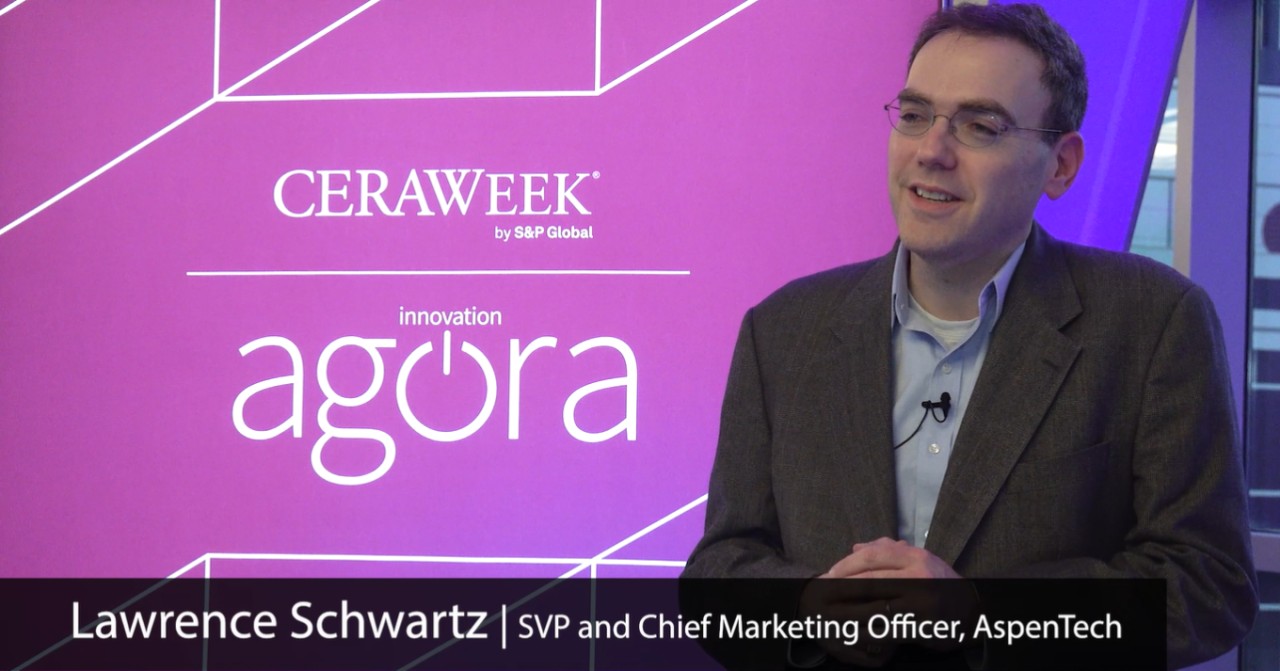
On camera at the 2021 ARC Industry Forum, he discussed artificial intelligence for industrial operations. At CERAWeek two years later, he recapped conversations about the energy transition, security and scale. The setting changed from database interviews to energy stages, but his public manner remained notably untheatrical. He explains the system, names the constraint and returns to the customer. It is the behavior of someone who knows that a factory manager can detect vaporous language at fifty paces.
The brief stop where everything moves
In February 2024, Schwartz became chief marketing officer and executive vice president of software for Körber Supply Chain. Supply chains had become dinner-table conversation through disruption: delayed goods, scarce components, crowded ports, brittle assumptions. Schwartz called the issue urgent for businesses and argued that stronger customer and partner relationships belonged alongside growth.
The appointment added another invisible system to his collection. A supply chain is experienced through its exceptions. When it works, a package simply arrives. When it does not, the world suddenly notices every warehouse, handoff and planning decision. Marketing such software requires a taste for the backstage, where competitive advantage often looks like fewer surprises.
Storage, cloud, industrial operations, supply chains and quantum computing share a commercial inconvenience: customers buy outcomes, while the product's crucial work happens out of sight.
Quantum, before the vocabulary settles
Schwartz joined Quantinuum as chief marketing officer in January 2026. The move completed a neat circle. He had started around machines built for space, moved through layers of enterprise abstraction and arrived at hardware whose behavior is governed by physics many buyers will never study. Quantinuum combines trapped-ion systems with a software stack aimed at chemistry, materials, cybersecurity, finance and other enterprise problems. Its Helios system had launched two months earlier with early work involving Amgen, BMW, JPMorganChase and SoftBank.
The assignment is partly linguistic. Quantum companies speak about physical qubits, logical qubits, gate fidelity, error correction and fault tolerance. Customers speak about chemistry workflows, security, optimization, access and cost. Neither vocabulary can simply swallow the other. A credible commercial story has to preserve the boundary between what the system can do now, what partners are testing and what remains on the roadmap. Schwartz has lived at versions of this boundary before. Quantum merely makes the line brighter, and the penalty for stepping over it more public.
In announcing the job, Schwartz praised the “caliber and humility” of the scientists, engineers and business leaders he had met. The second word matters. Quantum computing has endured decades of genuine research, meaningful advances and extravagant promises. Humility is not a branding garnish in such a market. It is a control system.
Five months after Schwartz arrived, Quantinuum began trading on Nasdaq under the ticker QNT. The public listing expanded the audience overnight. A quantum company must now speak at once to researchers, enterprise customers, partners, employees, reporters and investors. Each group carries a different clock. Scientists think in milestones of fidelity and error correction. Customers think in workflows and budgets. Public markets think in quarters. The CMO's task is to keep those clocks from pretending they tell the same time.
Building a company at the forefront of deep tech requires patience, resilience, and exceptional execution.Lawrence Schwartz, on Quantinuum's Nasdaq debut
Since the listing, Quantinuum has announced collaborations around hybrid quantum and classical computing, cloud access and the industrial infrastructure required to manufacture larger systems. The language of the category is shifting from laboratory performance toward deployment. That shift suits Schwartz. He has spent years at the seam between a technical achievement and the organization expected to use it.
The small corrections
Schwartz's public biography supplies the expected executive metrics: large teams, sizable budgets, growth programs and acquisitions. The smaller details are more revealing. He mentors through MIT's Venture Mentoring Service. He is a limited partner in Stage 2 Capital, whose network centers on go-to-market expertise. In 2022, he played on an inter-city pickleball championship team. None of these items proves a philosophy, though together they suggest someone who likes systems that improve through exchange, repetition and adjustment.
Colleagues describe a leader open to outside advice and resistant to disconnected “random acts of marketing.” That preference resembles the old actuator again. Big motion is useful only if the machine can make small corrections. A campaign without feedback drifts. A category story without customer evidence saturates. A global team without local adjustment shakes itself apart.
Quantum computing will test every instinct for simplification. The field needs language accessible enough to invite new users and exact enough not to mislead them. It needs stories about commercial value that do not sprint past the hardware. Schwartz's advantage is not that he can make quantum mechanics easy. No honest person can. It is that he has spent a career learning where clarity ends and distortion begins.
The magnetic actuator from his MIT days was built around shared flux paths, precise movement and redundancy for an environment where repair might be impossible. A career is not a patent diagram, but the analogy is too good to waste. Schwartz has traveled a long distance from aerospace engineering to the C-suite. The corrections have been continuous. The machinery still shows.