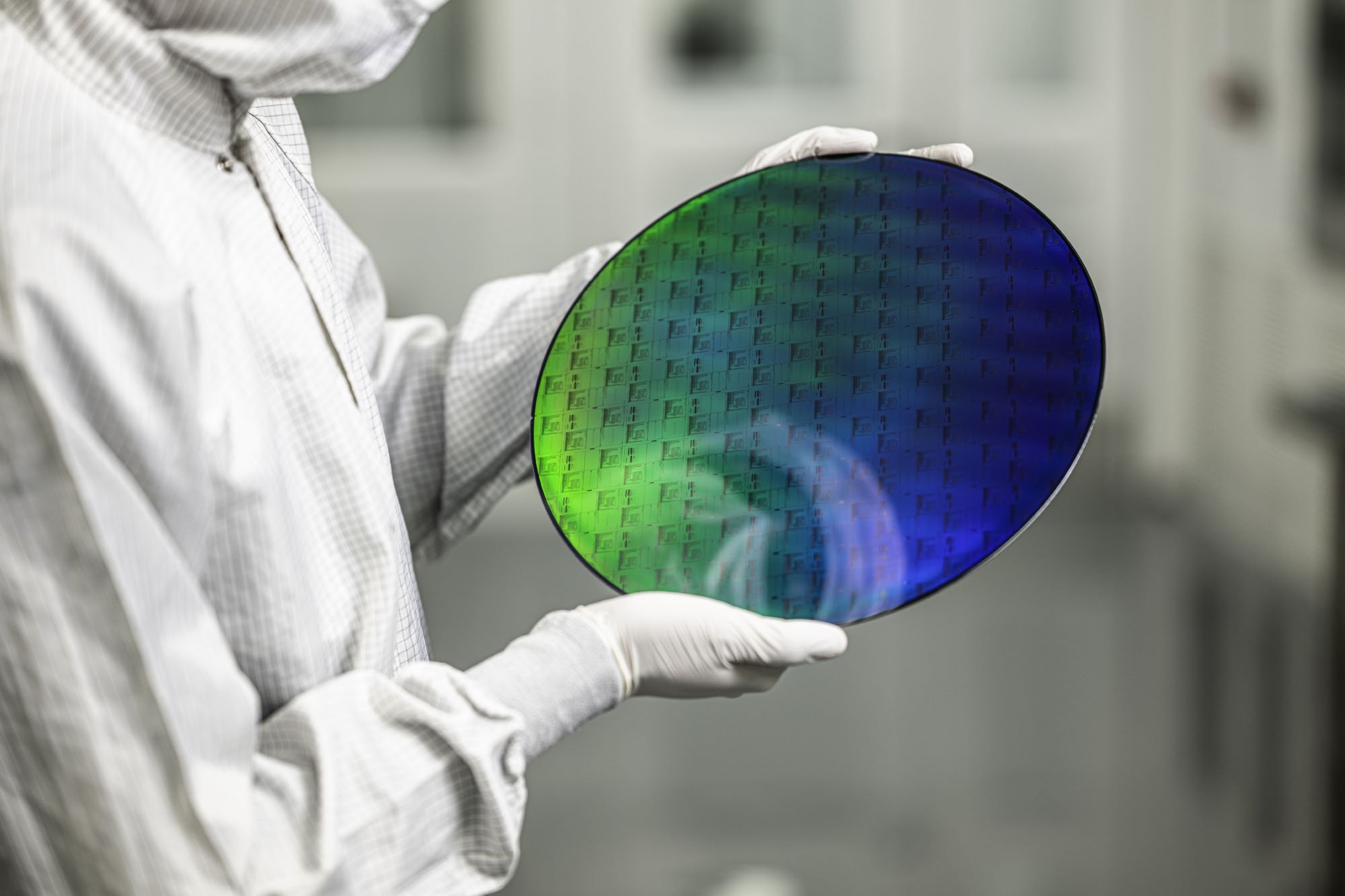
A silicon wafer is a peculiar place to look for the future of quantum computing. It is round, repetitive and built for production. That is precisely what interests PsiQuantum. The company’s wager is that a useful quantum computer must inherit the habits of a factory: make the parts reliably, measure them relentlessly, then connect enough of them to do something worth paying for.
- The bet: photons for qubits, semiconductor fabs for scale.
- The work: connect chips, control errors and build the cooling infrastructure.
- The opening: Construct lets researchers develop algorithms today.
Consider the order of operations. A research breakthrough can earn a paper. A manufacturing process must survive repetition. PsiQuantum has organized itself around the second problem, while continuing to wrestle with the first. The distinction explains both its appeal and its enormous appetite for capital.
01 Start with the factory
Founded in 2016 by Jeremy O’Brien, Terry Rudolph, Peter Shadbolt and Mark Thompson, PsiQuantum grew from research associated with Bristol and Imperial College London. Its founding premise was unusually demanding: aim for error-corrected computing at roughly a million physical qubits. Error correction consumes physical resources to protect logical information. A machine’s raw qubit count, by itself, tells you surprisingly little about useful work.
That premise made manufacturing an architectural choice. PsiQuantum designs photonic chips and works with GlobalFoundries, whose Fab 8 in Malta, New York, produces its silicon photonic wafers. Omega, announced in February 2025, brings together the components for generating, manipulating and measuring single photons. Existing semiconductor infrastructure supplies a route to volume. It does not remove the need to invent difficult components.

02 Light has a logistics problem
Photons offer an attractive delivery service. They can travel between chips over standard telecom fiber, avoiding a conversion step between unlike kinds of qubit. PsiQuantum uses telecom-band light, borrowing another piece of an industry that already knows how to move information around.
But a single photon is an unforgiving parcel. Lose it, and the architecture must cope with the missing information. Sources, detectors, switches and connections all contribute to the outcome. PsiQuantum has introduced materials including barium titanate for optical switching, alongside low-loss waveguides. Its engineering problem lives in the interfaces as much as inside the chip.
Chip-to-chip qubit interconnect fidelity
± 0.04% · reported in the 2025 Omega benchmarks
The competitive distinction needs care. IBM is pursuing modular superconducting processors. Xanadu also uses photonics and has demonstrated a networked prototype. Manufacturing and modularity are concerns across the field. PsiQuantum’s particular commitment is to combine its photonic architecture with foundry production and industrial infrastructure.
03 Four kelvin. Bring a jacket.
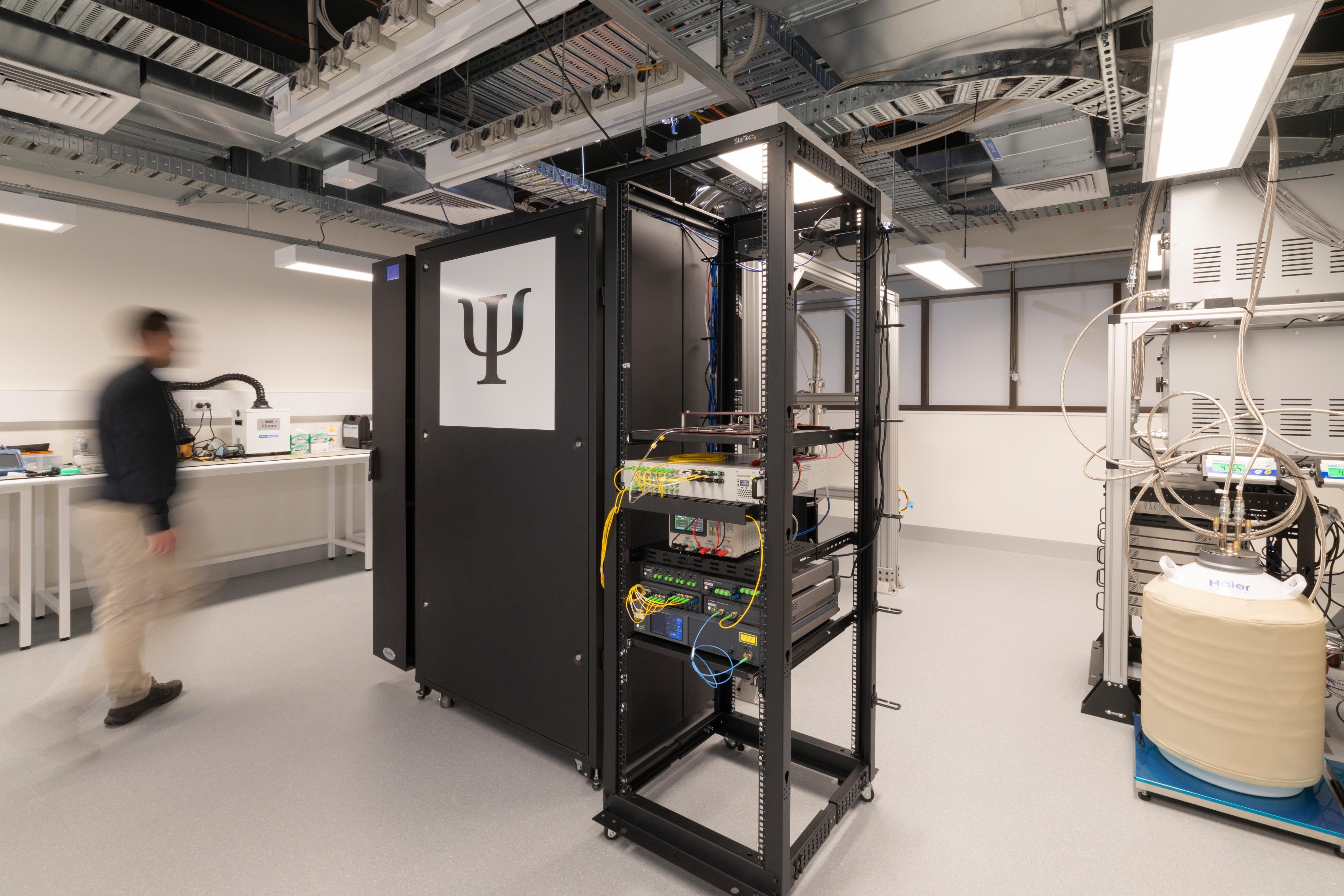
Even a computer built around light needs refrigeration. PsiQuantum’s superconducting detectors require cryogenic conditions. Its prototype modules operate around two to four kelvin, allowing a different cooling design from the millikelvin refrigerators familiar in superconducting quantum computing.
Instead of the dangling chandelier seen in countless quantum photographs, PsiQuantum uses cabinets designed to accommodate many chips. Linde Engineering is its partner for an industrial cryogenic plant in Australia. The practical expertise extends from quantum physics to packaging, control electronics, refrigeration and assembly. A clever circuit needs a very capable building.
Schematic · scale comes from integrating every stage
04 The bill arrives before the computer
In September 2025, PsiQuantum raised a $1 billion Series E at a $7 billion valuation. BlackRock-managed funds, Temasek and Baillie Gifford led the round. Separately, the Australian and Queensland governments announced approximately A$940 million in equity and loans in 2024. These are different financial instruments, currencies and obligations, not one tidy construction bill.
The company broke ground in Chicago in September 2025 and at Moreton Bay Central in Queensland in June 2026. Its September 2026 Commerce announcement reported roughly $200 million spent with American suppliers during 2025. That figure makes the physical demands unusually concrete.
Federal support has distinct conditions, too. A $125 million expanded DARPA agreement supports evaluation and infrastructure. A $100 million Commerce R&D award was finalized in September 2026. October brought a conditional loan commitment of up to $150 million from the Office of Strategic Capital. The loan is not guaranteed.
That creates a business with several clocks running at once. Government-funded development can pay for work now: an April 2025 Air Force Research Laboratory contract worth $10.8 million covers photonic circuits and components. Industrial collaborations prepare future workloads. The larger computing service depends on systems still under construction.
05 You can use the software today
There is a nearer-term entry point: Construct, opened as a free platform in May 2026. Circuit Designer helps sketch circuits; Workbench supports Python algorithm development; Resource Analyzer exposes computational bottlenecks. Researchers can estimate what a proposed calculation would demand before asking a future machine to run it.
The software grew out of an internal frustration. Tools intended for small, noisy experiments did not suit the company’s fault-tolerant algorithm research, so its teams built their own. That is a practical lesson others can copy: specify the workload, count the resources, find the bottleneck.
Airbus is collaborating on fluid-mechanics algorithms. Brookhaven National Laboratory announced a Construct partnership in September 2026. The company also presents pharmaceutical and battery-research case studies. These are preparations for future computation, rather than evidence that a finished PsiQuantum machine is already improving medicines or aircraft.
06 The last connection is the hard one
The work also shapes the company’s culture. Its careers page describes packaging engineers inventing measurement methods for single-photon devices. Here, even checking whether a part works can require an invention.
Victor Peng became CEO in 2026, with O’Brien moving to Executive Chairman. As the buildout advances, the decisive question is whether measured components can become a reliable, economically useful system. Optical loss, accumulated errors and integration costs could defeat a design that looks persuasive piece by piece.
“The QBI program has been admirably skeptical by design.”
Peter Shadbolt · Co-founder · July 2026
DARPA’s continuing evaluation makes that distinction explicit: Stage C tests whether proposed systems can be built and operated as intended. PsiQuantum has chosen an industrial route to that test. The factory is ready for repetition. The computer still has to earn it.