Seven working days is a surprisingly earthly unit of time for a quantum computing story. In May 2026, Quantum Machines reported that its team had taken a nine-qubit Rigetti Novera processor from cold start to operation in that span. The result was 99.5% median two-qubit gate fidelity across 11 functioning qubit pairs. The chip was Rigetti’s. The external control and calibration stack was Quantum Machines’.
- The job: make quantum processors obey precise, adaptive instructions.
- The buyer: quantum builders, research labs and supercomputing centers.
- The wager: competing kinds of qubits can need the same supplier.
- The useful lesson: judge the whole experiment, including the work between experiments.
That distinction matters. A processor can contain excellent qubits while the surrounding apparatus struggles to make them cooperate. The Novera exercise tested whether another company’s equipment could reach Rigetti’s performance target across the device. A single carefully pampered gate would have been a much easier party trick.
Reported bring-up time for the nine-qubit Novera demonstration. A specific integration result, rather than a timetable for every quantum computer.
A business beside the chip
Quantum Machines began in 2018 with three physicists: Itamar Sivan, Yonatan Cohen and Nissim Ofek. Their research backgrounds ran through the Weizmann Institute. Today Sivan is CEO, Cohen is CTO and Ofek is chief engineer. Their choice of business puts them alongside the companies building quantum processors, supplying the apparatus required to operate them.
It is an appealing place to stand in an unsettled market. Superconducting circuits, semiconductor spins and neutral atoms ask different things of their hardware. Quantum Machines offers control technology across those approaches. Its commercial logic is that several competing routes to quantum computing can become customers. It need not manufacture the winning qubit to sell equipment around it.
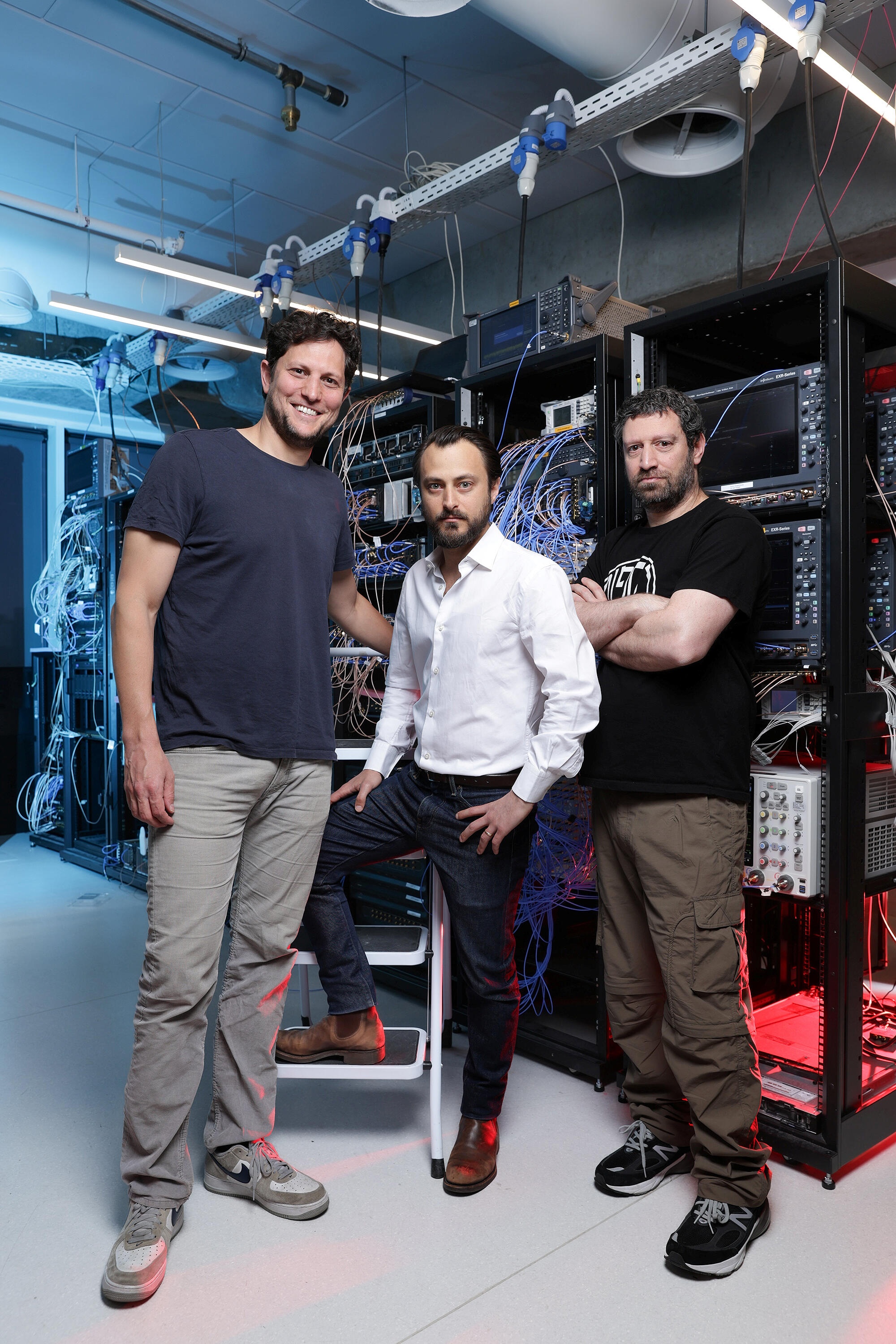
Those customers are specialist buyers: academic and national laboratories, quantum computer manufacturers and high-performance computing centers. In February 2025, Quantum Machines said its customer base exceeded half of companies developing quantum computers. That is the company’s own adoption claim, with a particular denominator. It tells us about reach among builders, rather than how much commercial computation quantum machines currently perform.
“Turning a quantum processor into a functional quantum computer is an immense technical challenge.”Yonatan Cohen, co-founder and CTO, February 2025
The next pulse cannot wait
Consider a simplified experiment. A controller sends a pulse to a qubit, reads a measurement, calculates what should happen next and sends another instruction. The timing belongs to the experiment. A decision arriving after the quantum state has become unusable is an elegant answer to a question that has expired.
Quantum Machines’ Pulse Processing Unit, or PPU, combines pulse generation and classical computation in the control architecture. Its QUA language lets researchers express quantum operations alongside loops, conditions and calculations. The advantage is practical: the researcher can describe an adaptive sequence within the controller’s programming model instead of continually handing decisions back to a separate computer.
- 01 DRIVESend a timed pulse
- 02 READAcquire a measurement
- 03 DECIDEProcess the result
- 04 ADAPTChoose the next operation
OPX1000 is the modular hardware platform. It uses microwave and low-frequency front-end modules, and multiple units can be programmed to operate together. Its microwave module generates signals directly from digital waveforms up to 10.5 GHz. That is a concrete engineering feature; a scientist still has to match the controller’s capabilities to the actual device, wiring and experiment.
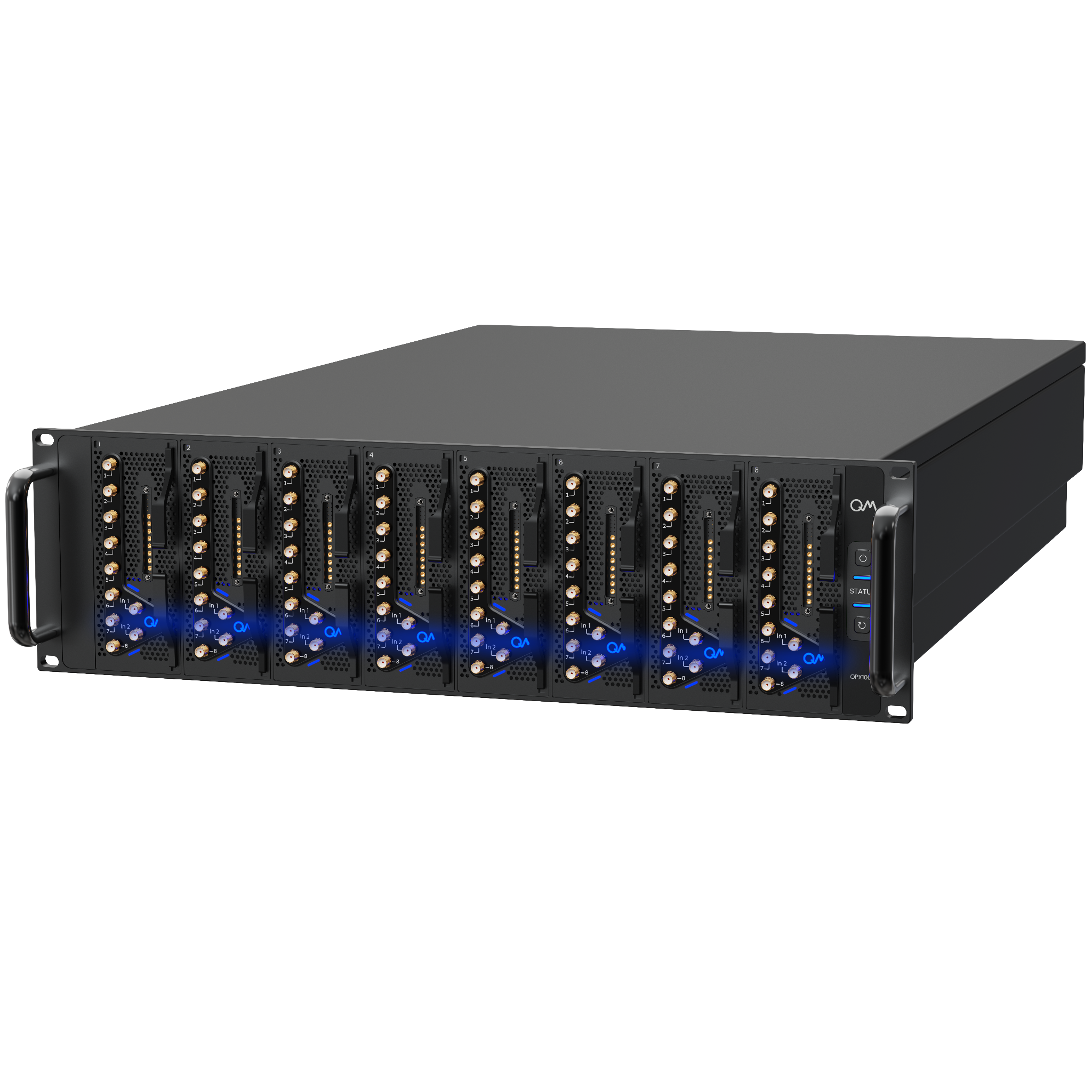
The wider catalog fills other parts of the setup. OPX+ combines control and readout; Octave handles RF conversion. QDevil, acquired in 2022, added low-noise voltage generators, cryogenic filters and sample holders. These products reach from room-temperature electronics toward the cold environment where many quantum devices operate. A company can sell an ambitious vision, but someone must also sell a reliable connection.
The price of getting ready again
Calibration is the recurring bill paid in research time. Before running useful experiments, a team has to establish the settings that make its device behave as intended. Those settings can drift. Adding qubits brings more parameters and interactions to manage. The business opportunity lies partly in helping people get back to doing the experiment they meant to do.
QUAlibrate turns that work into programmable nodes and graphs: individual operations connect into a calibration workflow, with results influencing the route through it. Researchers retain code-level control and can inspect execution through a web interface. On the product page, Qolab co-founder John Martinis reports calibrations taking less than ten minutes where manual work could take up to two hours. That is a customer account of a particular workflow, not a universal speed guarantee.
There is a software-access detail buyers should check. QUAlibrate launched as open source in 2025. Its current GitHub repository says the software is free to use, while its source code has moved to a private repository. Public examples and other QUA tools remain available through the QUA Platform organization. Free use and permission to inspect or modify every component are separate purchasing questions.
Quantum Machines sells hardware and supporting software to organizations, with configurations scoped through its sales process. A sensible budget includes channels, modules, integration and support, alongside the staff time a team would otherwise spend building its own control stack. For scale on the supplier’s side, its February 2025 Series C raised $170 million, led by PSG Equity, bringing the company’s stated funding total at that date to $280 million. Financing pays for a business to expand; it is not the price tag on an OPX1000.
The customers changed the question
Jonathan Reiner, who leads Product Solutions, described a revealing change in a January 2026 interview. Earlier customers wanted to get experiments running and iterate quickly. Increasingly, they cared about analog quality, fidelity and fast connections to external processors. The original question - can we run this experiment? - had acquired a demanding sequel: can we keep it working while the system grows?
That account is more useful than an invented tale of a disastrous first prototype. It identifies the pressure that changed the product requirements. Reiner also described a team of Product Solutions physicists representing customer needs inside the company. Expertise here means translating between the experiment a researcher wants and the system an engineering team must deliver.
In March 2026, Quantum Machines introduced its Open Acceleration Stack alongside NVIDIA, AMD and Riverlane. The framework connects the PPU to external classical accelerators through low-latency interfaces. Tasks such as error decoding and advanced calibration can require computation beyond the controller itself. The objective is to bring those resources into the operating loop with the necessary timing and synchronization.
The pattern appears in its acquisitions. QHarbor joined in May 2026, supporting software-defined experimentation, data management and a new Delft office. PCB Engineering followed in June, adding hardware expertise and a Budapest R&D hub. The work around a chip keeps expanding: cleaner electronics, better workflows, more dependable integration.
The latest step came in September 2026. Quantum Machines announced a CUDA-Q program executed across live qubits and classical processors using NVIDIA NVQLink. The demonstration aims to let developers use familiar programming tools while the system routes work to the appropriate resource. It is evidence of an integration milestone, with commercial usefulness still dependent on the application and underlying quantum hardware.
Ask for the whole experiment
Quantum Machines has alternatives. Qblox offers modular control hardware and software. Zurich Instruments offers its quantum control systems and LabOne Q. A capable laboratory can also develop its own stack. The distinction to examine is the combination of signal quality, real-time processing, programming tools, calibration and support on the buyer’s workload. A specification table starts that conversation; it cannot finish it.
For a research team, the copyable habit is to test the entire workflow. Bring a representative device and protocol. Measure how long calibration takes, how the system responds to drift, whether feedback arrives soon enough and how performance holds across interacting qubits. Ask which parts your team can modify and who helps when the integration stalls.
There are limits. Better control cannot rescue a device whose underlying qubits cannot reach the required performance. A lab needing a few fixed signals may have less reason to buy a broad orchestration platform. Existing software, unusual interfaces and specialist pulse requirements can change the calculation. The right purchase is the system that makes more of your actual experiments possible.
Quantum Machines offers a lesson beyond quantum physics: when a field admires a brilliant component, inspect everything required to use it twice. Somewhere between the first demonstration and the next reliable run, there may be a business.
Follow the pulses
Explore the company website, OPX1000, QUAlibrate and QUA Platform on GitHub.
Read the Novera experiment account, Open Acceleration Stack announcement, September CUDA-Q update and funding announcement.
Watch the Qolab live-calibration demonstration and Yonatan Cohen’s hybrid-control interview, or browse the YouTube channel. Follow LinkedIn, X and Facebook.