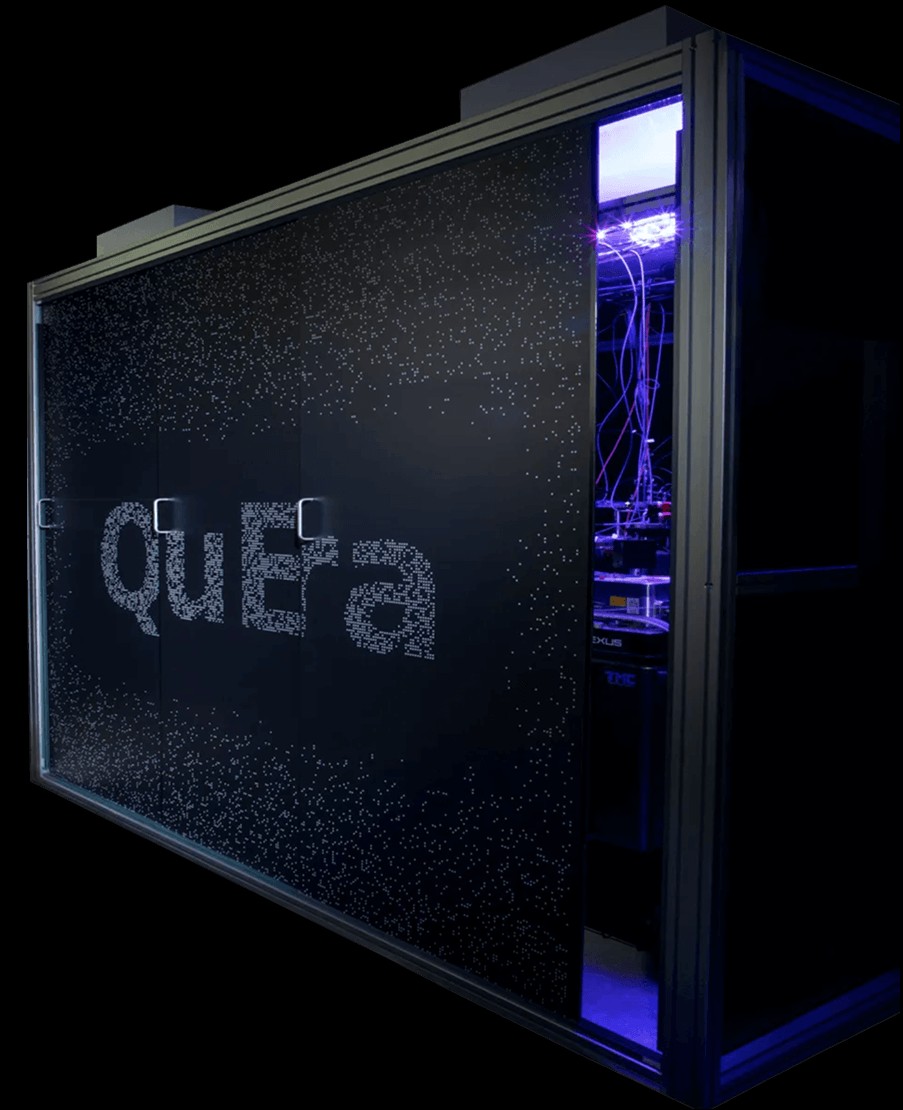
Imagine a computer whose working parts are identical by nature, yet cannot be soldered to a board. QuEra begins with neutral atoms, cools them nearly to a standstill, and holds them in place with carefully aimed light. It can rearrange those atoms before asking them to interact. The image is lovely. The job description is brutal: make the arrangement repeatable enough that a researcher can use it on Tuesday without the physicist who built it standing nearby.
That tension explains QuEra Computing better than the usual qubit tally. The Boston company, founded in 2018 from Harvard and MIT research, has already put one machine on a public cloud and installed another in Japan. It has also promised a fault-tolerant successor for 2028. Those are three different claims, with three different degrees of certainty.

- Aquila is a 256-physical-qubit analog machine available through Amazon Braket.
- Gemini adds gate-based operation and serves as an error-correction testbed; a Gemini-class system was installed at AIST in Japan.
- Libra, with more than 256 logical qubits, is QuEra's target for 2028, not a machine available today.
- The business is access, installations, support and co-development for people doing serious computing research.
First, a computer you can reach
Aquila arrived on Amazon Braket in November 2022. Its 256 physical qubits are neutral atoms arranged in a programmable array. Users submit an analog program, repeat it for a chosen number of shots, and examine the resulting measurements. This is especially suited to quantum simulation and certain optimization experiments. It does not make Aquila a general-purpose replacement for a laptop, or even a gate-based quantum computer. A researcher still has to frame the problem in the language the machine speaks.
The commercial trick was access. A lab that cannot buy a machine can still run an experiment through AWS. Braket bills hardware use by task and shot; reservations and premium access are other arrangements. The exact bill depends on the work submitted and current pricing. This matters because a quantum experiment is usually many runs, not one grand press of a button. A cheap-looking demonstration can become expensive when the number of trial parameters and repetitions grows.
Aquila also supplies the first answer to the awkward customer question: what can I do with it? Researchers can study quantum dynamics, test analog algorithms and compare simulated systems with classical calculations. QuEra's Bloqade tools help define those programs and simulate them before using hardware. The sensible workflow is to begin with a small, falsifiable experiment, establish a classical baseline, and spend hardware time only where the hardware can teach something new.
Then the atoms learned to move
Aquila's attraction is the array; Gemini's attraction is what QuEra hopes to do with it. A gate-based machine needs sequences of operations that can eventually support error-corrected computation. QuEra's reconfigurable architecture can move atoms between zones and change which qubits meet. In principle, that makes some interactions and error-correction layouts less costly than they would be on a fixed grid. In practice, every move and laser pulse has to be controlled and measured. Nature supplies identical atoms, but no free operations.
The shift shows up in the software. Bloqade began as a way to program Aquila's analog processor. QuEra later added digital circuit tools and work on atom shuttling. The company was responding to a real limitation: an analog programming model that served the first machine could not simply be stretched into the language of a fault-tolerant one. The SDK had to follow the physics.
A logical qubit is an error-protected unit made from physical qubits. The numbers in these three columns are different kinds of numbers.
In 2025, a Gemini-class system was installed at Japan's National Institute of Advanced Industrial Science and Technology, alongside the ABCI-Q supercomputer. The underlying 2024 selection was reported as a roughly $41 million contract. The co-location is the important clue. A quantum processor will likely handle selected pieces of a larger job while conventional machines do the rest: preparing data, steering the experiment, decoding errors and checking the result. A quantum computer that cannot fit that workflow has a limited market, however photogenic its qubits.
The expensive part is reliability
QuEra and its academic collaborators reported a logical quantum processor with 48 logical qubits in 2023. Subsequent research addressed magic-state distillation, sustained operation of large atom arrays and lower-overhead error correction. These are advances in the parts list for a useful machine. They are not, by themselves, proof that an industrially useful fault-tolerant computer has arrived.
That money bought time to attack a very unromantic problem: stability. In August 2026, QuEra described an AI-assisted control system that recovered a drifting laser in seconds, a task that had required expert intervention measured in minutes. A laser lock is hardly the sort of thing that sells a quantum dream. It is precisely the sort of thing that decides whether a device is a service or a perpetual maintenance call. The company has not published a simple unit-cost ledger for Aquila, Gemini or Libra, so the public financing and Japan contract are the clearest visible prices of this engineering campaign.
There is also an architectural cost. More physical qubits do not translate neatly into useful logical qubits. Error correction consumes qubits, control capacity and time. QuEra's work with Los Alamos National Laboratory tries to cut that burden for structured simulation. Its stated Libra goal is more than 256 logical qubits on more than 10,000 physical ones, with a logical error rate of one in a million. That remains a target for 2028 cloud access through an expanded AWS partnership.
A seat beside the supercomputer
The market is crowded with different bets. Pasqal, Atom Computing and Infleqtion work with neutral atoms; IBM and Google use superconducting circuits; IonQ favors trapped ions. The meaningful comparison is not a single qubit count. It is how easily each architecture can connect qubits, correct errors, operate continuously and plug into existing computing. QuEra's distinctive wager is that atom movement will help on several of those fronts at once.
Its customers are correspondingly selective. AIST and NERSC are research and HPC organizations. AWS distributes access to cloud users. Pharmaceutical and other enterprise partners explore applications, but a collaboration is not the same as a demonstrated commercial advantage. QuEra's recent agreement with HPE to explore integration with HPE Cray systems points toward a future in which customers shop for quantum capacity as part of a computing center, not as a curious separate appliance.
What can another company copy? The sequence, more than the physics. Put a limited machine in real users' hands. Watch where programming and operations fail. Build the next software layer around those failures. Place the new hardware where serious users already work. QuEra's progression from Aquila to Bloqade to Gemini is a visible version of that method. It is slow, capital hungry and highly dependent on access to unusual scientific talent. It would be a poor recipe for a team without patient funding, a credible experimental platform or customers willing to help define problems.
The atom array remains a marvelous sight. Yet the more revealing scene may be a duller one: a researcher submitting a job, a laser correcting itself, a classical computer doing most of the bookkeeping, and a result that can be checked. When that scene becomes ordinary, QuEra's wager will have paid for something more useful than wonder.