The most expensive part of an AI chip may be the room built to keep it from cooking itself. Buy another accelerator, pack another server into the rack, and the invisible invoice arrives: fans, pipes, cooling equipment, floor space, power. ZutaCore, a company founded in 2016, asks a small, awkward question. What if the liquid touching the chip were allowed to boil?
In its HyperCool system, a dielectric fluid enters a cold plate attached to a processor. Heat turns the fluid into vapor. The vapor travels to a cooling distribution unit, gives up its heat, condenses and returns. The loop is sealed. The idea belongs to familiar physics - a phase change carries heat efficiently - but the setting is newly urgent. AI chips are getting hotter, and a rack can only do as much work as its cooling system permits.
- ZutaCore sells a complete cooling loop for dense AI and high-performance computing, from chip plates to row-level equipment and monitoring software.
- Its dielectric fluid keeps water out of the server loop; some configurations still transfer heat to facility water outside the IT space.
- Research institutions and data center operators have published deployment results. In June 2026 the company announced a $100 million Series C.
A tiny weather system in a rack
Air cooling is admirably simple until the air cannot carry away enough heat. Conventional direct liquid cooling brings fluid much closer to the silicon, but usually relies on a single liquid phase. ZutaCore’s distinction is to use controlled boiling at the hot surface. The fluid is nonconductive, so the company can put a water-free circuit next to electronics. The heat still has to go somewhere, of course. A CDU collects vapor from the rack or row, condenses it and passes the heat onward.
“Waterless” describes the chip-side circuit, not every possible facility connection.
That distinction matters. ZutaCore offers an air-based in-rack unit for a 20kW rack, plus facility-water CDU configurations for higher loads. Its published range reaches 120kW per rack and 1.2MW to 2MW at the end of a row. In the latter design, facility water exchanges heat beyond the server aisle. Keeping water away from the servers may make leak risk easier to manage; it does not make the heat, or the building infrastructure, disappear.
The useful test is a Tuesday afternoon
Data center buyers are not paid to admire elegant thermodynamics. They need to know whether the machine fits an existing server, who will service it, and what happens while the workload is live. That is why the university deployments tell a better story than a glossy efficiency claim. At the University of Münster, a team retrofitted ten servers in one day. ZutaCore reports an 82% drop in cooling-related energy consumption there. The figure belongs to that deployment, with its own baseline and equipment, not to every building with a server room.
Oregon State University had a messier, more representative estate: Dell, HP and Supermicro servers, with NVIDIA and AMD processors. A wholesale replacement was an unattractive answer. Its reported results after a HyperCool integration were processor temperatures 30% lower and compute performance 20% higher. The university also said it could avoid four additional air-cooling units and direct recovered heat toward nearby campus buildings. A research center measures success in more experiments per square foot; a cooling project can become a computing project.
There are other settings. The University of Chicago compared the system with rear-door heat exchangers. Texas Advanced Computing Center reported chips running 18°C cooler with lower energy use. At the University of Pisa, ten cold plates helped existing Dell servers run AI workloads at full load. These accounts do not amount to a universal price list or a universal savings rate. They show the kind of proof a facilities team can actually use: real servers, named operators, measured thermal behavior.
“Translate that into processing power for servers.”Christopher M. Sullivan, Oregon State University, on repurposing cooling power
The difficult part is selling the whole loop
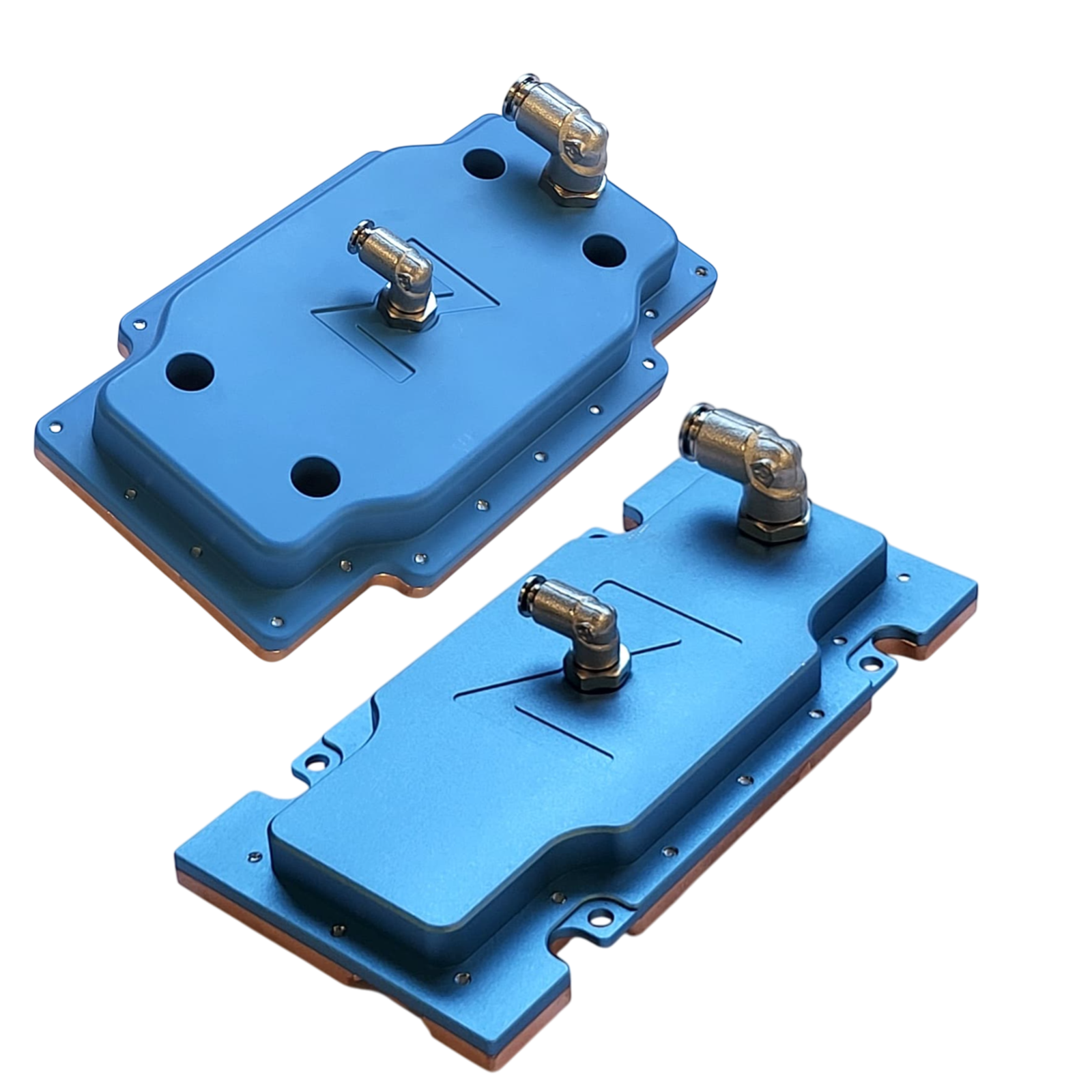
A cold plate alone cannot persuade an operator. It needs manifolds, a CDU, controls, maintenance procedures and somebody willing to stand behind the installed server. ZutaCore sells that architecture as HyperCool. Its OmniTherm plate addresses awkward component orientations and, in a 2026 version, fits servers built around NVIDIA RTX PRO 6000 Blackwell Server Edition PCIe GPUs. HyperCool Cloud adds remote telemetry, alarms and control across racks, rows and sites. The resulting business is industrial B2B: equipment and integration, usually through data center operators, server makers and systems integrators. Standard public pricing is unavailable because the design varies with the facility.
The partnerships reveal the sales problem. UNICOM Engineering agreed to deliver HyperCool-equipped Dell XE9680 servers with lifecycle support and warranties. Parker Hannifin contributed fittings and couplers to the cooling circuit. ASRock Rack worked on an integrated HGX B300 server. Mitsubishi Heavy Industries signed a white-label sales agreement. Each answers a different objection: can the pipes connect, can the box ship, can the warranty survive, can the system be delivered in more than one market?
The company has tried to widen the unit of sale. In 2025 it introduced end-of-row CDUs rated at 1.2MW and 2MW. Those figures are equipment capacities, not proof that every customer has deployed a two-megawatt system. The larger format matters because AI infrastructure buyers plan in rows and megawatts, while the first compelling demonstration of this physics might happen on one chip. ZutaCore says it built a 2MW emulation platform in Israel to test how the cooling system behaves with realistic facility interactions before customers place it beside production IT.
Start with a measured heat bottleneck and a representative rack. Compare sustained processor performance, fan and cooling power, installation time, service access and heat-rejection needs against the existing setup. The useful calculation is site-specific: more work from the same power and footprint, minus the cost of new cooling equipment and integration.
A bigger market, and a stubborn boundary
ZutaCore’s ambition is plainly bigger than the university lab. SoftBank and Foxconn developed a rack-integrated AI cooling project with a measured partial power usage effectiveness as low as 1.03. Equinix deployed HyperCool in the New York metro area with a path to heat reuse. In September 2026, Options Technology agreed to make the system available for financial-services infrastructure, where electronic trading and risk models are asking more of dense hardware. The heat problem does not care whether the processor trains a model or prices a derivative.
In June 2026, ZutaCore announced a $100 million Series C backed by Mitsubishi Electric, Carrier Ventures, Samsung Ventures and others. Money at that scale can buy manufacturing reach and field support, but it cannot change the rules of thermodynamics. The system still needs somewhere to reject heat. A modest, air-cooled room may have no reason to accept the complexity of a two-phase loop; an operator without suitable heat-rejection infrastructure may face a costly upgrade. Waterless near the electronics is a strong advantage only when it solves the buyer’s actual constraint.
That is the interesting turn in ZutaCore’s story. The company began with a tiny event inside a cold plate and has had to build outward: a rack, a row, a monitoring system, a partner network, a commercial argument. The vapor comes back as liquid. The question for the business is whether the calculation comes back as useful compute.