Artificial intelligence is fond of pretending it has no body. Its language arrives weightless, one token at a time, while the physical machinery stays in a room most people never see. Erez Freibach has built his latest career inside that missing room. There, intelligence comes with cables, pumps, racks and a stubborn invoice from thermodynamics: nearly every watt consumed by a processor eventually becomes heat.
Freibach is the co-founder, chairman and chief executive of ZutaCore, a company that places a non-conductive liquid close to the processor. The liquid absorbs heat, boils, moves away as vapor, condenses and returns. Boiling, ordinarily the moment a cooling system has lost the argument, becomes the point of the exercise. There is no water circulating over the electronics, and the phase change carries away more heat than air can reasonably manage.
This sounds like a specialist's concern until one meets the appetite of an AI rack. Conventional racks used roughly 10 kilowatts. Advanced AI deployments can pass 100. The expensive chips do the glamorous work, but the surrounding infrastructure decides whether they can keep doing it.
A career with several climates
The route to the server room was anything but direct. Freibach grew up in Kibbutz Nahal Oz in southern Israel. He served as a naval officer on a missile boat and left the military in 1987 with the rank of major. Then he and his wife, Hagar, went to Guatemala to work in agriculture. The melon farm they found was partly wrecked. Within months, he said, they had turned it around, eventually managing an operation with 250 employees.
It is tempting to treat the melon years as a colorful detour. They look more like an early draft of his operating style: enter an unfamiliar system, learn what moves through it, then organize people around the constraint. After earning a bachelor's degree in agricultural economics, he moved into finance management at hardware companies including Indigo and 3Com. CFO roles followed at OzVision and Clarizen, the collaborative work-management software company.
In 2007, Freibach moved with his family to Palo Alto and started a flight-training business. He had once entered an Israeli Air Force pilot course, left it, and later earned a license to fly a Cessna. The startup recorded an entire training flight so a student could review it afterward. Several hundred units sold, he said. It was a modest venture, and a revealing one: turn an experience into data, then make the invisible mistake visible.
Leaves naval service, then helps revive a melon farm in Guatemala.
Moves to Palo Alto and founds a flight-training technology venture.
Returns to Israel, mentors ventures and meets inventor Nahshon Eadelson.
Co-founds ZutaCore around two-phase processor cooling.
ZutaCore closes a $100 million Series C.
Thirty ideas, one rising temperature
After returning to Israel in 2014, Freibach became a mentor. A Colombian government-backed program put him in regular contact with roughly 40 companies. He would travel there about every six weeks, meet founders, assign homework and push ventures from an idea toward a prototype. At the Mirage entrepreneurship incubator he met Nahshon Eadelson, an inventor with experience in irrigation, algae cultivation and Netafim projects.
Eadelson brought him about 30 ideas. Cooling won. Freibach knew computing and understood that electronic components were becoming more difficult to cool. He supplied the blunt division of labor himself: Eadelson gave the technological answer; Freibach translated it into a business.
“I like challenges and flourish when there's uncertainty; that's where I'm happy. Order drives me crazy because it's not challenging.”Erez Freibach
The translation was slow. Freibach said ZutaCore needed seven years to win permission to enter servers. Qualification with each chip and server manufacturer could take a year or more, and each customer's requirements sent the system through another turn. Deep technology is often described as an invention problem. Just as often, it is a trust problem with an engineering syllabus.
Then the market caught up with the temperature. Freibach said that chips once drawing 100 to 200 watts were giving way to AI processors around 2,000 watts. In 2024, he reported more than ten times as many customers as the year before. By June 2026, ZutaCore said its systems were deployed at more than 75 sites across North America, Europe and Asia.
To make that shift credible, the company built a two-megawatt thermal simulation and testing facility at its Sderot-area development center. The number matters because a cooling claim made on a bench is not the same claim inside a working data center. Systems must cope with changing loads, fit existing infrastructure and keep running when a component fails. Customers buy a result measured over time, not a handsome diagram of a boiling liquid.
Freibach's finance years are useful here. Hardware asks for cash long before scale returns the favor. Parts must be designed, tested and manufactured; partners must be persuaded to place an unfamiliar system beside costly equipment. ZutaCore's investor list eventually came to resemble its route to market, including industrial groups with businesses in cooling, electronics and infrastructure. Mitsubishi Heavy Industries announced a strategic alliance and investment in 2023. Carrier, Mitsubishi Electric and Samsung Ventures led the 2026 round. These are not merely names on a cap table. They are companies that understand the long, unromantic distance between a thermal idea and repeatable installation.
The old CFO is still visible in the founder's vocabulary. He talks about density, existing real estate and the cost of modifying a facility, not only about thermal elegance. His case for waterless cooling joins three ledgers: the risk of liquid near electronics, the energy required to remove heat, and the amount of computing that can fit into a rack. Physics establishes the limit. Finance decides whether crossing it is useful.
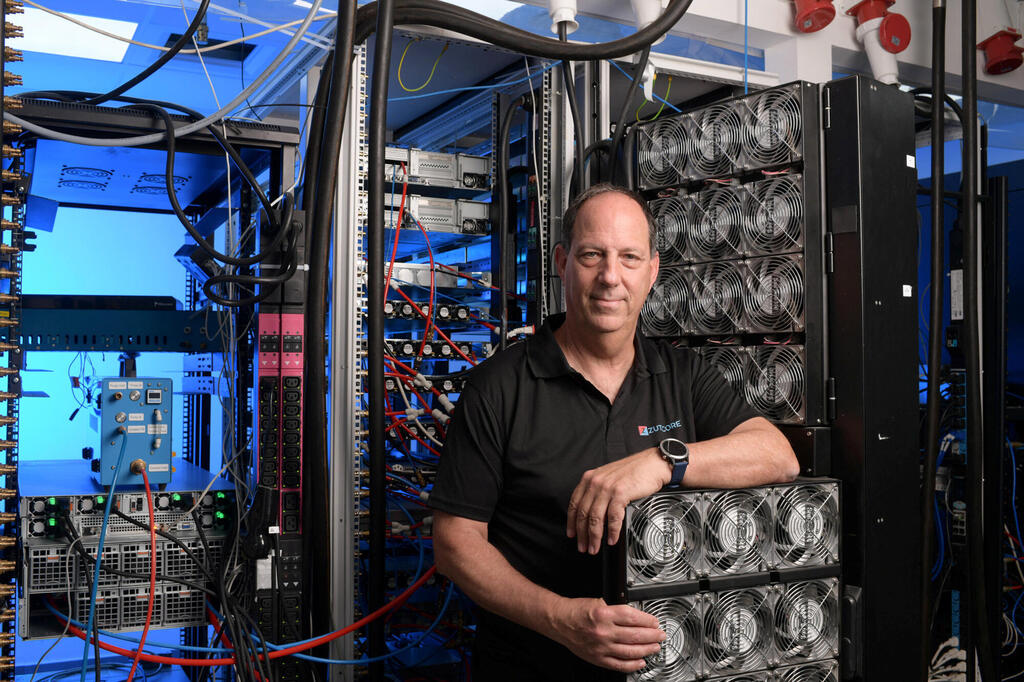
The address was part of the mission
ZutaCore has commercial headquarters in San Jose, with operations in Europe, India and Taiwan. Its research, development and manufacturing center, however, is in the Sapirim Industrial Park near Sderot. Freibach says that choice began with Nahal Oz. Years ago, as communities near Gaza worried about their economic future, the kibbutz asked current and former members for plans that might create resilience. His answer was to build a company in the region.
The three aims he later set out for ZutaCore were braided together: develop sustainability technology, bring advanced industry to southern Israel and create skilled jobs near the border. Geography was not a corporate charity project attached to the business. It was one of the reasons for building it.
That promise became brutally practical after October 7, 2023. Freibach was in Mountain View, where he had moved to accelerate fundraising and sales. The date was also his 60th birthday. His mother, brother, nieces and nephews were in Nahal Oz; employees and friends were scattered or trapped across the border communities. Within days, he returned to Israel.
The ZutaCore site sat inside a closed military zone. Employees had been evacuated across the country. Freibach described going person by person, asking what would make work possible: a computer, a bicycle, a car. Work, he noticed, offered a small horizon of certainty. The language is characteristic. Faced with a crisis far larger than a company, he looked for the next operable unit.
“We went through three very challenging months, and we came out of them as a family.”Erez Freibach
In 2026, ZutaCore reported about 140 employees worldwide, roughly 100 of them in Israel, and plans to add around 50 more. Freibach also co-founded and chairs Carrar, founded in 2019 to apply two-phase thermal management to batteries used in automotive, marine and grid systems. Different machine, familiar enemy.
Give the electrons another job
The most interesting part of Freibach's pitch begins after the chip is cool. At a 2025 interview, he described AI as an energy story. A large AI facility consumes enormous power, and the work converts that energy into heat. Merely disposing of it is an incomplete answer. His phrase is better: give the electrons “a second useful life.”
A two-phase system can preserve heat at a useful grade, making recovery more practical. That heat might support a district system, an industrial process or, in one example discussed by ZutaCore's executives, water treatment. The data center stops behaving only like an appliance that consumes electricity and starts looking like a participant in the local energy network.
There are still qualifications to earn, installations to execute and economics to prove. A $100 million Series C, announced in June 2026 with backing from Mitsubishi Electric, Carrier and Samsung Ventures, buys time and scale, not exemption from either physics or customers. Calcalist estimated the company at close to $600 million. Freibach said the goal was a lasting business rather than a quick sale.
His career can look restless from a distance: navy, melons, finance, airplanes, mentorship, processors, batteries. Up close, it is remarkably consistent. Each chapter begins where a familiar system encounters an awkward physical limit. Freibach seems happiest there, before the procedure is tidy, while the machinery and the organization are both still being figured out.
Artificial intelligence may speak in abstractions. Its future will be decided partly by people willing to stand beside a hot rack and ask where all that energy should go next.