Storage is what everybody assumes will be there. It waits below the application, below the dashboard, below the clever demo in which a machine recognizes a face or answers a question. When it works, nobody applauds. When it fails, the meeting becomes unusually well attended. Jon Toor has built a career in this unfashionable but essential layer of computing, beginning with the physical business of hard drives and arriving, four decades later, at the data problem underneath artificial intelligence.
His résumé reads like a compact history of enterprise storage. Seagate. Quantum. Micropolis. Maxtor. ONStor. Xsigo Systems. Brocade. Cloudian. The nouns change along the way: disk drives give way to network-attached storage, virtualized I/O, hybrid cloud and S3-compatible object storage. The constant is an appetite for explaining why unseen machinery deserves a decision-maker's attention.
Toor is now chief marketing officer at Cloudian, the San Mateo company known for software-defined object storage. He leads its inbound and outbound marketing teams. It is a role that suits an uncommon academic combination: a bachelor's degree in mechanical engineering, a bachelor's in economics and an MBA, all from Stanford. Engineering asks whether it works. Economics asks what it costs and what must be traded away. Marketing asks why anyone should care before lunch. Toor has spent his working life keeping those questions in the same room.
First, learn the machine
The story starts in 1983 at Seagate Technology, where Toor worked in engineering management. That beginning matters. Enterprise infrastructure marketing is a difficult form of translation because the audience can detect hand-waving at twenty paces. A marketer must understand not only the feature but the bottleneck, the dependency and the unpleasant thing that happens at scale. Toor learned the category near its metal.
He moved into marketing at Quantum in the early 1990s, then held senior roles at Micropolis and Maxtor. By the time he became vice president of marketing at ONStor in 2002, the industry was shifting from individual devices toward systems that could make growing seas of files manageable. The storage box was becoming an architecture. The pitch had to move with it.
At Xsigo Systems, Toor led outbound marketing from company launch until Oracle acquired the business in 2012. That is the whole dramatic arc of a startup compressed into one line: give an unfamiliar technology a vocabulary, find customers willing to believe it, survive the awkward middle, then pass through the bright door marked acquisition. Xsigo sold a way to virtualize connections between servers and storage, reducing the cable-heavy rigidity of data centers. It was infrastructure about infrastructure, a stern test for anyone who prefers obvious products.
After Xsigo came Brocade, where Toor served as vice president of digital marketing and demand generation. Then, in 2016, he joined Cloudian. The company had been founded in 2011 around an idea that was becoming steadily more important: enterprises wanted the scale and familiar S3 interface of public-cloud storage, but they did not necessarily want every byte to live in someone else's building.
“A hybrid cloud approach gives organizations the best of both worlds.”Jon Toor, on workload placement
The archive wakes up
Toor's public work at Cloudian shows how a category story evolves without losing its spine. In 2017, he spoke at Storage Visions about active archives for media and entertainment. The problem sounded mundane until the numbers arrived. Higher-resolution video created more data; producers wanted immediate access to old footage; tape was cheap but slow; disk was fast but expensive. An archive could no longer be a dignified cemetery for files.
At the 2018 NAB Show, visitors asked about ballooning capacity, faster media search and cloud integration. Toor explained metadata as the hinge. Add descriptions to unstructured files and an enormous archive becomes searchable. Apply machine learning and those descriptions can include a player's name, a venue, weather conditions or a transcription. His phrase for the result was lovely and slightly strange: “a sort of instant replay forever.”
That sentence reveals his preferred technique. Begin with the technical mechanism, then give it a human consequence. Object storage is not merely buckets, nodes and erasure coding. It is the clip a producer can find before the deadline. Hybrid cloud is not a diagram with two fluffy shapes. It is keeping latency-sensitive data near compute while using remote capacity for disaster recovery. Immutability is not a checkbox. It is a backup that ransomware cannot quietly rewrite.
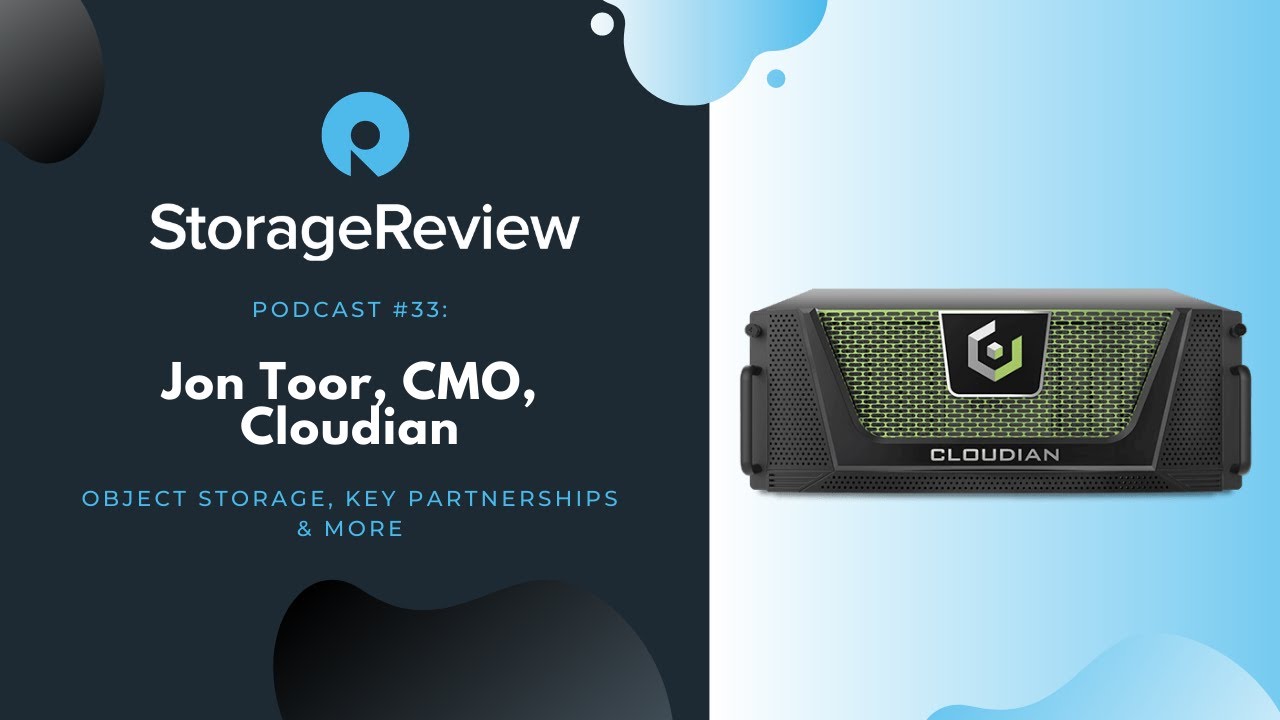
In a 2018 interview, Toor argued that private and public clouds carry different advantages. Local data can improve speed, throughput and control. Public cloud can provide elastic, off-site resources for variable work or disaster recovery. The useful decision is not allegiance to one camp. It is placement: which environment fits the workload? Years later, as companies reconsider cloud bills and data jurisdiction, that restrained answer has aged better than the grand migrations promised by either side.
The villain changes. The constraint remains.
Then ransomware turned storage from an efficiency conversation into a survival conversation. Attackers learned to target backups along with production systems. Cloudian's case leaned on S3 Object Lock, which can make stored objects immutable for a defined period. Toor's message became blunt: if the backup can be altered by an intruder, it may only be a second copy of the same disaster.
The pattern repeated. A low-level capability became legible through a high-stakes outcome. Storage people may enjoy discussing replication policies. Executives prefer to know whether the company can recover on Monday morning. Toor's work connects the two without treating either audience as foolish.
Editorial map of themes in Toor's talks, interviews and writing - not a quantitative performance measure.
Now the demanding customer is AI. Models need vast datasets for training, low-latency access for inference and orderly pipelines for retrieval-augmented generation. GPUs are expensive enough that idle time becomes a visible line item. Sensitive training data can also carry residency and compliance requirements. The supposedly dull storage layer suddenly decides whether the dazzling layer can run.
Toor's 2025 and 2026 commentary has followed that shift. At Cloudian, he has written about on-premises video analysis, AI in financial services and manufacturing, sovereign data lakes, neocloud infrastructure and the placement of workloads returning from public cloud. In company survey releases, he has described AI as “the forcing function” behind a more exacting infrastructure debate. Cost, latency and jurisdiction were always present; AI simply turns up the volume.
“Enterprises aren't abandoning the cloud - they're getting smarter about where AI workloads belong.”Jon Toor, 2026
A career built on translation
People who worked with Toor have publicly praised a balance that his education suggests: analytical and technical ability on one side, creativity and people skills on the other. The distinction is tidier than real life, but the combination explains the path. He did not leave engineering behind so much as change the deliverable. Instead of building only systems, he built frames through which buyers could understand systems.
There is a lesson here for anyone selling an invisible product. Do not start with its invisibility. Start with the moment it becomes impossible to ignore. The lost archive. The slow restore. The GPU waiting for data. The cloud invoice whose little variable charges have reproduced like rabbits. Then work backward to the architecture.
Another lesson is patience. Toor stayed with storage while fashion moved from dot-com networking to cloud to cybersecurity to AI. Each wave threatened to make the old category sound obsolete. Each wave instead created more data, more movement and more reasons to care where the bits went. The storage industry is blessed with this quiet joke: every revolution eventually needs somewhere to sit.
That does not make the future automatic. Cloudian still competes in a market crowded with hyperscalers and established infrastructure vendors. Workload repatriation is not a universal retreat from public cloud, and Toor himself frames hybrid architecture as selection, not surrender. The sharper aspiration is to make placement deliberate: elastic workloads where elasticity helps, sensitive or latency-bound data where control helps, and interfaces consistent enough that the choice does not become a prison.
For Toor, the current chapter looks less like a reinvention than a convergence. The engineer understands throughput. The economist notices egress fees and stranded capacity. The marketer sees that “AI data platform” opens a door that “object-storage appliance” may leave shut. Four decades of category knowledge meet a moment when the category has wandered onto center stage.
Storage still will not receive the loudest applause. Infrastructure rarely does. But the next time a model answers instantly, an archive survives an attack, or a company keeps regulated data within the right border, some stubborn machinery underneath will have done its job. Jon Toor has spent a career giving that machinery a voice.